Greyhound Betting Odds Explained
Best Greyhound Betting Sites – Bet on Greyhounds in 2026
Loading...
What the Numbers Actually Mean
Odds are the language of betting. Every price you see next to a greyhound’s name on a racecard or a bookmaker’s board is a statement about probability — or more precisely, about the bookmaker’s estimation of probability, adjusted to guarantee their margin. Understanding what odds mean, how they work in different formats, and what they tell you beyond the surface number is fundamental to making informed bets.
In UK greyhound racing, you will encounter three main odds formats: fractional, decimal, and starting price. Each expresses the same information in a different way, and most online bookmakers let you toggle between them. The format you use is a matter of preference, but understanding all three prevents confusion and lets you compare prices across different platforms without fumbling with conversions.
Beyond the format, odds carry information about the market’s collective view of each dog’s chances. A short price means the market believes the dog is likely to win. A long price means it is considered unlikely. Neither of these assessments is infallible, which is the entire basis for profitable betting — finding situations where the market’s estimate of probability differs from your own.
Fractional Odds
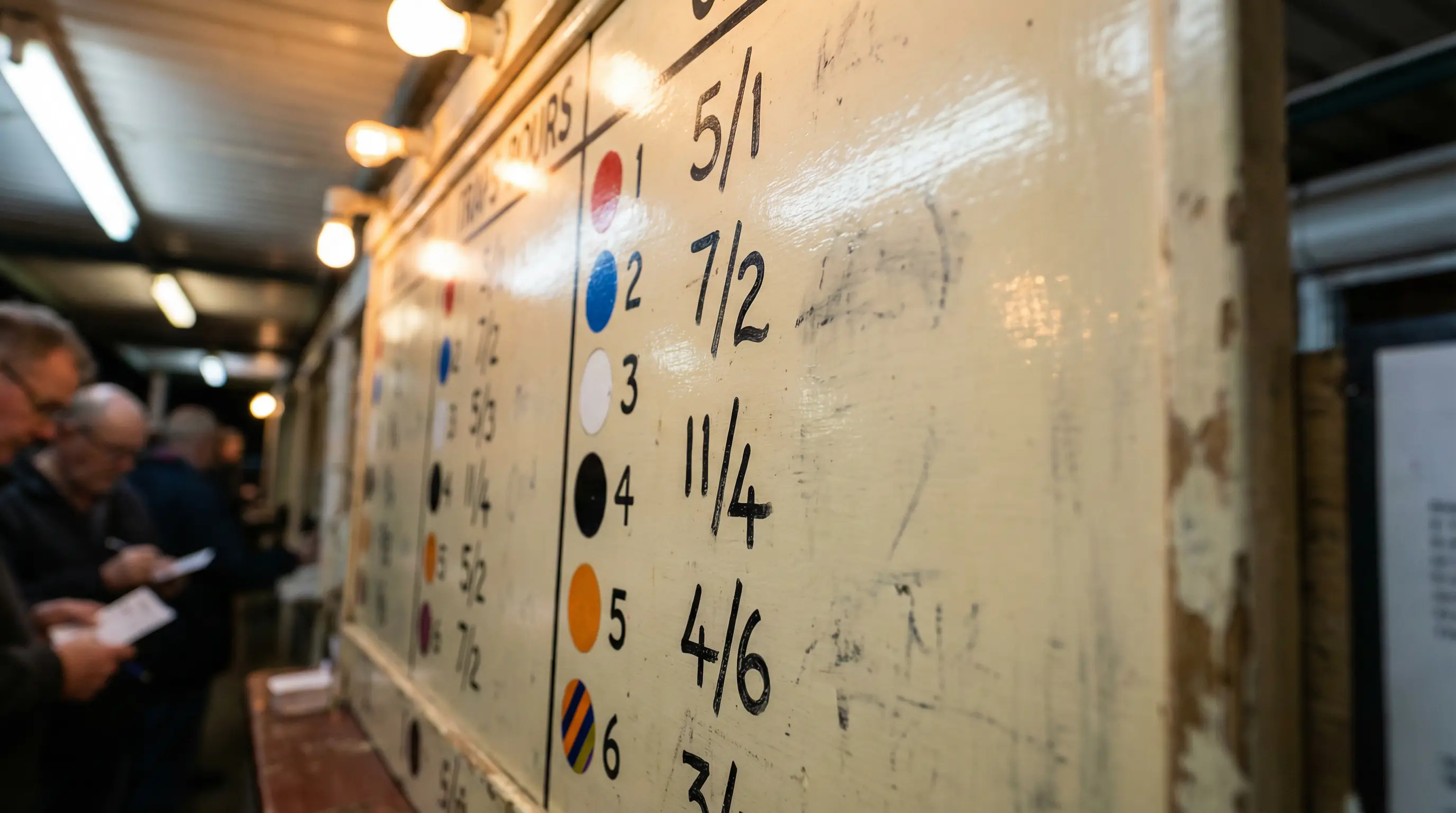
Fractional odds are the traditional format in British betting and the one you will see on racetrack boards, in betting shops, and on many UK-facing online bookmakers by default. They are expressed as one number over another — 5/1, 7/2, 11/4, 6/4, 4/6 — and they describe the profit you will receive relative to your stake if the bet wins.
The first number is the profit. The second number is the stake required to earn that profit. At 5/1, you receive five pounds of profit for every one pound staked. At 7/2, you receive seven pounds for every two pounds staked (or three pounds fifty for a one-pound bet). At 6/4, you receive six pounds for every four staked (one pound fifty per pound bet). Your original stake is always returned on top of the profit.
Fractional odds above evens — anything where the first number is larger than the second, like 5/1, 3/1, or 7/4 — indicate a dog that the market considers less likely to win. The bigger the first number relative to the second, the longer the odds and the lower the implied probability. Odds below evens — where the first number is smaller, like 4/6, 1/2, or 2/5 — indicate a dog the market rates as more likely to win. These “odds-on” prices return less profit than the amount staked.
The evens price (1/1) is the midpoint. A one-pound bet at evens returns one pound profit plus the stake, for a total of two pounds. It implies a roughly fifty per cent chance of winning, before the bookmaker’s margin is factored in.
Fractional odds can feel cumbersome with unusual fractions — 11/8, 100/30, 15/8 — but they become intuitive with practice. The key is always to reduce the fraction to a per-pound basis: 11/8 means one pound thirty-seven and a half pence profit per pound staked. With experience, you stop calculating and start recognising prices by feel, which is why fractional odds remain the preferred format for many seasoned UK punters.
Decimal Odds
Decimal odds express the total return per unit staked, including the stake itself. A decimal price of 6.00 means that a one-pound bet returns six pounds in total if it wins — five pounds profit plus the original pound back. A decimal price of 2.50 means a total return of two pounds fifty per pound staked, which is one pound fifty profit.
The conversion between fractional and decimal is straightforward: divide the first number of the fraction by the second and add one. Fractional 5/1 becomes (5 divided by 1) plus 1 equals 6.00 decimal. Fractional 7/2 becomes (7 divided by 2) plus 1 equals 4.50. Fractional 4/6 becomes (4 divided by 6) plus 1 equals 1.67.
Decimal odds are increasingly popular in online betting, particularly on betting exchanges and with European-facing operators. Their advantage over fractional odds is simplicity of calculation: to work out your return, multiply your stake by the decimal price. A twenty-pound bet at 4.50 returns ninety pounds. A fifteen-pound bet at 2.80 returns forty-two pounds. No fractions, no reduction to per-pound figures — just multiplication.
The threshold between odds-on and odds-against in decimal format is 2.00. Anything above 2.00 means you will receive more than double your stake if the bet wins (the equivalent of odds above evens in fractional terms). Anything below 2.00 means the profit is less than the amount staked. A price of exactly 2.00 is the decimal equivalent of evens.
Implied Probability and the Bookmaker’s Margin
Every set of odds implies a probability. At 5/1 (6.00 decimal), the implied probability is one divided by six, which is 16.7 per cent. At 2/1 (3.00 decimal), the implied probability is one divided by three, or 33.3 per cent. At evens (2.00 decimal), it is 50 per cent. The formula is simply one divided by the decimal price, expressed as a percentage.
If you add up the implied probabilities of all six dogs in a greyhound race, the total should theoretically be 100 per cent — representing the certainty that one of the six will win. In practice, the total will always exceed 100 per cent, typically falling somewhere between 115 and 130 per cent depending on the bookmaker and the market. That excess is the bookmaker’s overround, commonly referred to as the margin or the vig. It is how the bookmaker ensures a profit regardless of the outcome.
Understanding the overround matters because it tells you how much of a hurdle you face as a punter. A market with a total implied probability of 120 per cent means the bookmaker has built in a 20 per cent margin. To be profitable in such a market, your selections need to overcome that 20 per cent drag. The lower the overround, the closer the available odds are to the “true” probabilities, and the less ground you need to make up through superior selection.
Betting exchanges typically operate with much lower overrounds than traditional bookmakers because the prices are set by other punters rather than by a bookmaker protecting a margin. The exchange takes a commission on winning bets instead. For greyhound racing, exchange liquidity is sometimes thin — especially for smaller meetings at tracks like Kinsley — but when it is available, the prices often represent better value than the bookmaker’s offerings.
The practical takeaway is this: when you look at a dog’s odds, do not see them only as a potential payout. See them as the market’s estimate of the dog’s probability of winning. Then ask yourself: does my form analysis suggest this dog’s true probability is higher or lower than the market implies? If you believe the dog has a 25 per cent chance of winning but the odds imply only 15 per cent, you have found a value bet. If the odds imply 30 per cent and you think the true chance is closer to 20, you should pass. This comparison between your assessed probability and the market’s implied probability is the foundation of all profitable betting.
Starting Price vs Early Price
When you place a bet on a greyhound race, you have a choice: take the current price offered by the bookmaker (the early price, sometimes called the board price), or accept the starting price (SP). The starting price is the odds available on the dog at the moment the race begins. It is determined by a combination of on-course and off-course betting activity and represents the final market assessment of the dog’s chances.
The difference matters because odds move. When a racecard is first published, bookmakers offer opening prices based on their initial assessment of each dog’s form. As money comes in on specific dogs, the odds shorten on the backed runners and drift on the others. By the time the race starts, the starting price may be significantly different from the early price.
Taking an early price locks in your odds. If you back a dog at 5/1 in the morning and it is backed down to 3/1 by race time, you are still paid at 5/1 if it wins. The early price was the better deal. Conversely, if the dog drifts from 5/1 to 8/1 — often because information has emerged that the dog is not in peak form or the trap draw is unfavourable — the starting price would have been more generous, and the early price was a mistake.
For greyhound racing at Kinsley, markets are generally formed closer to race time than for horse racing. Early prices are available through online bookmakers, but the volume of money bet on a typical Kinsley card is not enormous, and prices can shift significantly in the final minutes before a race. SP is a reasonable default for punters who bet close to post time and are comfortable accepting whatever the market settles on. Early-price betting is more useful when you have identified a dog that you believe will be backed — if you expect the price to shorten, locking in the early number secures better value.
There is no universally right answer to the SP-versus-early-price question. It depends on the specific race, the specific market, and your confidence in the direction the odds will move. What matters is being conscious of the choice rather than accepting SP by default. Every time you leave the price decision to chance, you are forfeiting control over one of the few variables in betting that is entirely within your power to manage.