Greyhound Calculated Times and Going Allowance
Best Greyhound Betting Sites – Bet on Greyhounds in 2026
Loading...
Why Raw Times Lie
A greyhound’s raw finishing time — the number of seconds from trap release to crossing the line — is a fact. It is also, taken on its own, frequently misleading. Two dogs can run the same race at the same track on different nights, post identical raw times, and yet one performance might be significantly better than the other. The difference is the going.
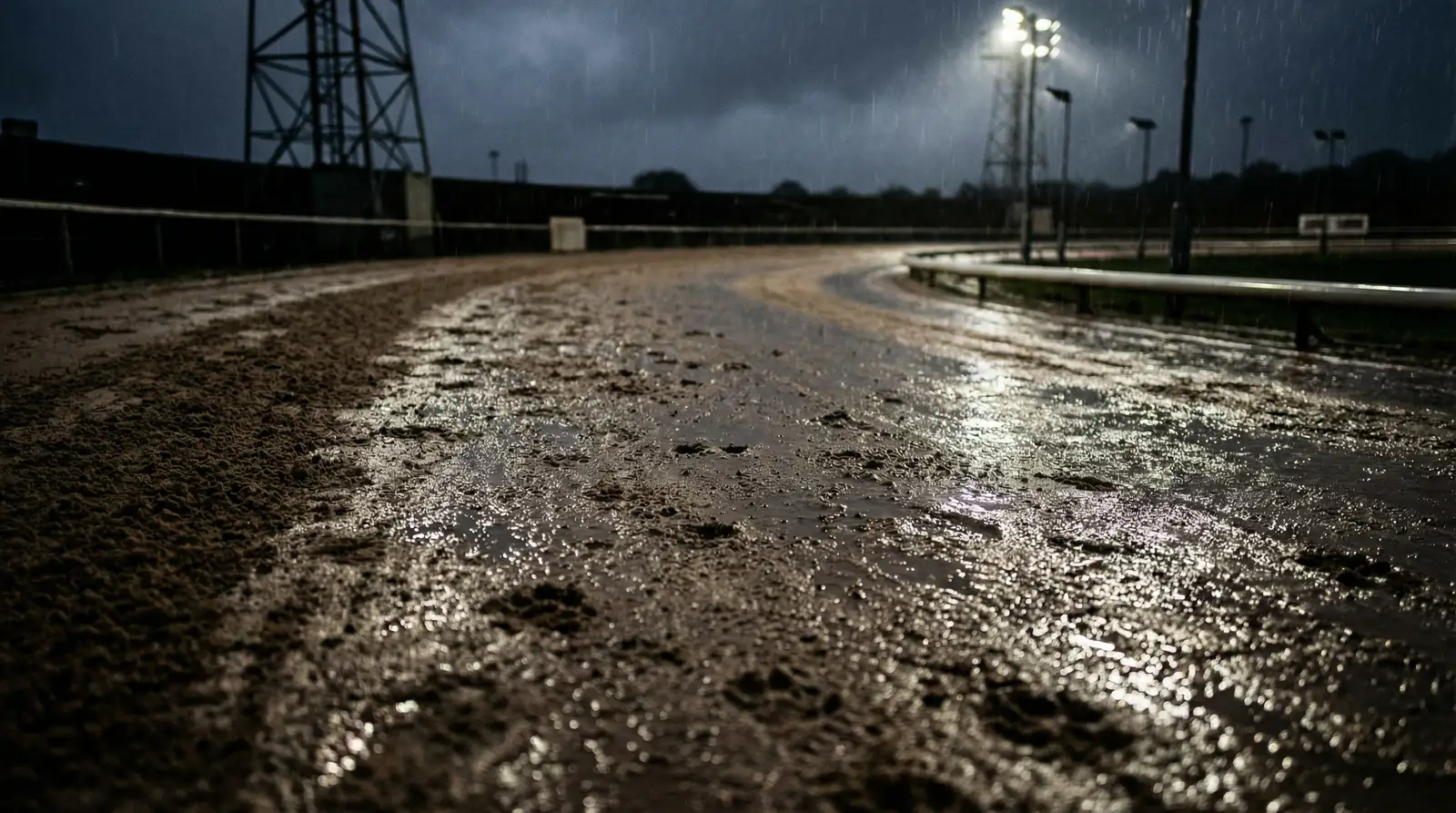
Track conditions change from meeting to meeting and sometimes within a single evening. Rain softens the surface. Temperature affects the sand. Humidity alters grip. All of these variables influence how fast a greyhound can run, and they affect every dog in the race equally. A raw time of 29.4 seconds over 462 metres at Kinsley on a fast night is not the same achievement as 29.4 seconds on a heavy, rain-soaked surface. The calculated time exists to bridge that gap.
Calculated times and going allowance are the tools that level the playing field between form recorded on different nights. Without them, you are comparing numbers that look equivalent but are not. With them, you have a standardised measure that strips out the effect of conditions and lets you assess a dog’s intrinsic speed. For any punter who takes form analysis seriously, understanding how these adjustments work is not optional — it is the difference between reading the data and being misled by it.
Raw Time vs Calculated Time
The raw time is what the clock records. It is the actual elapsed time from the moment the traps open to the moment the dog crosses the finishing line. This figure appears on every racecard and in every results service. It is objective, precise, and incomplete.
The calculated time is the raw time adjusted for the conditions that prevailed during the race. The adjustment is made using the going allowance — a figure published by the track’s racing manager that quantifies how much the track surface on a given night was faster or slower than the theoretical standard. A positive going allowance means the track was slow (times were longer than they would be on a standard surface). A negative going allowance means the track was fast (times were shorter).
The formula is straightforward: calculated time equals raw time minus going allowance. If a dog records a raw time of 29.6 seconds and the going allowance for that meeting is +0.30, the calculated time is 29.30 seconds. The adjustment tells you that on a standard surface, this dog would have been expected to run about 0.3 seconds faster than the clock showed. Conversely, if the going allowance is -0.10 (a fast track), a raw time of 29.2 becomes a calculated time of 29.30 — the dog benefited from a quick surface, and its performance was slightly less impressive than the raw number implied.
This distinction matters every time you compare form from different meetings. A dog that ran 29.1 on a fast night (going allowance -0.20, calculated time 29.30) has delivered the same standardised performance as a dog that ran 29.6 on a slow night (going allowance +0.30, calculated time 29.30). Without the adjustment, you would assume the first dog was half a second faster. With it, you see they are equivalent. That kind of false comparison costs punters money repeatedly, and it is entirely avoidable.
On racecards and form databases, the calculated time is sometimes marked with an asterisk or displayed separately from the raw time. Some services flag a dog’s best recent calculated time over the relevant distance, which is a useful shortcut for identifying the fastest dogs in a race on an adjusted basis. Get into the habit of reading the calculated column rather than the raw column, and your form assessments will be built on more solid ground.
How Going Allowance Is Determined
The going allowance at a GBGB-regulated track like Kinsley is set by the racing manager before the start of each meeting. It is not an arbitrary figure. It is calculated by running a trial — typically the hare alone or a combination of hare and time trials — and comparing the result against a known baseline for that track. The difference between the trial result and the baseline is the going allowance for the meeting.
The baseline represents “standard” going — a notional set of conditions against which all adjustments are measured. At Kinsley, the standard is specific to the track’s surface composition, its 385-metre circumference, and the Swaffham McGee hare system. It does not correspond to any other track’s standard. This is important to remember: a going allowance of +0.20 at Kinsley means something different from +0.20 at Nottingham, because the baselines are track-specific.
Several factors influence the going allowance from meeting to meeting. The most obvious is weather. Rain increases the moisture content of the sand surface, making it heavier and slower. Persistent dry conditions can bake the surface, making it firmer and faster. Temperature matters too — cold conditions tend to produce slightly slower going, while mild, dry evenings often correspond with fast surfaces. Wind can also play a role, particularly on exposed tracks, by affecting the running pace of the hare and the comfort of the dogs.
Beyond weather, the track’s maintenance schedule influences going. If the surface has been freshly graded or raked between meetings, the characteristics of the sand will differ from a surface that has been raced on without resurfacing. Tracks that are heavily used — with four meetings a week, as Kinsley runs under its ARC contract — can develop wear patterns that affect going differently from tracks that race less frequently.
The going allowance is published before the first race of each meeting and applies to all races on that card. In theory, conditions could change during an evening — a rain shower midway through a meeting, for example — but the published figure is not adjusted race by race. This means that late races on a card affected by changing weather may produce times that are slightly less accurately corrected by the going allowance than earlier races. It is a minor imprecision, but one that experienced form students keep in mind.
Comparing Form Across Different Nights
The primary use of calculated times is cross-meeting comparison. Most greyhounds at Kinsley race once or twice a week, and their recent form will span several meetings with different going conditions. Without calculated times, you are looking at a string of raw numbers that may have been produced on surfaces ranging from fast to heavy, and drawing conclusions that the data does not support.
A practical example: a dog’s last four runs show raw times of 29.4, 29.8, 29.3, and 29.7. At first glance, this looks inconsistent — the dog appears to be running well one week and poorly the next. But when you apply the going allowances from each meeting, a clearer picture might emerge. If the going allowances were -0.10, +0.30, -0.20, and +0.20 respectively, the calculated times become 29.50, 29.50, 29.50, and 29.50. The dog has been running with remarkable consistency. The variation was in the surface, not in the dog.
This is a common pattern, and it illustrates why calculated times are essential rather than merely useful. Dogs that look inconsistent on raw times often look highly consistent on calculated times, which changes the entire assessment. A dog that appears unreliable becomes one you can set your watch by. Conversely, a dog whose raw times look steady might actually be declining when the going allowance reveals that favourable conditions were masking a slowdown.
When comparing two dogs from different recent meetings, always use calculated times. If Dog A ran a calculated 29.2 last Friday and Dog B ran a calculated 29.5 on Wednesday, you have a meaningful comparison: Dog A is roughly three tenths of a second faster on a standardised basis. That difference translates to approximately a length and a half at the finishing line — a significant margin in a six-dog greyhound race.
One caveat: calculated times are an approximation, not a perfect science. The going allowance captures the broad condition of the track but does not account for micro-variations — a slightly wetter patch on the first bend, for instance, or a lane that has been more heavily used. Treat calculated times as the best available standardised measure, not as an exact reading of each dog’s ability down to the hundredth of a second. They are accurate enough to inform good betting decisions. They are not precise enough to be the sole basis for them.
The Adjusted Picture
Calculated times and going allowance do not make form analysis easy. They make it accurate, which is a different thing. A punter who uses adjusted figures still has to assess trap draw, running style, grade context, race comments, and a dozen other factors. What the adjustments do is remove one major source of distortion — the false comparison created by varying track conditions — so that every other element of the analysis rests on a level foundation.
The punters who ignore going allowance are building their form assessments on shifting sand, which is ironic given that sand is the surface they are trying to account for. A dog that looks slow may have been running on a heavy track. A dog that looks fast may have been flattered by quick going. Without the adjustment, you cannot tell the difference, and the decisions that follow will be contaminated by that uncertainty.
Make it a habit. When you open a racecard for a Kinsley meeting, check the going allowance first. When you review a dog’s form, read the calculated time column, not the raw time column. When you compare two dogs from different meetings, use adjusted figures. It adds a few seconds to each assessment and eliminates a class of error that costs careless punters real money, meeting after meeting, all season long.