Inside vs Wide Runners: Track Position Strategy
Best Greyhound Betting Sites – Bet on Greyhounds in 2026
Loading...
Where They Run Matters
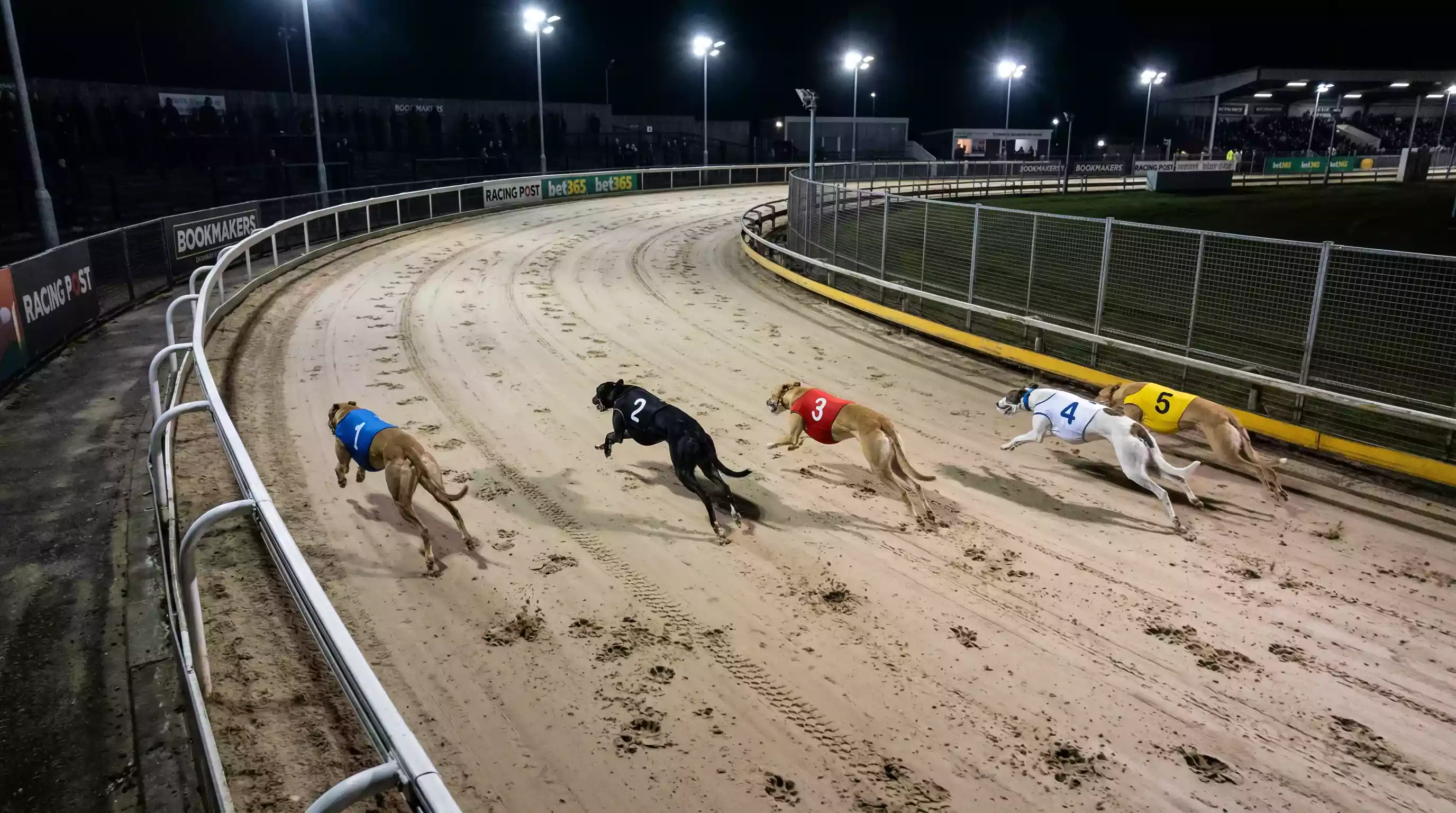
In a greyhound race, six dogs break from the traps and converge on the first bend within seconds. Where each dog positions itself during that opening phase — and where it tends to run through the remainder of the race — is a defining characteristic of its racing style. Some dogs hug the inside rail, covering the shortest possible distance around the bends. Others swing wide, taking a longer route but avoiding the congestion that forms on the rail. A third group switches between the two depending on circumstance.
Running style is not a matter of preference in the way a human athlete might choose to run on the inside or outside of a track. It is a deep-seated behavioural pattern, shaped by the dog’s temperament, its early racing experiences, and its physical build. Under GBGB Rule 78, dogs are classified as railers, middle runners, or wide runners, and these designations determine how they are drawn in graded races. A dog that runs the rail does so instinctively. A dog that runs wide does so because its natural action takes it to that part of the track. Attempting to force a dog into the wrong position — by drawing a wide runner in trap one or a rail runner in trap six — rarely works. The dog will tend to revert to its natural line regardless of where it starts.
For the bettor, understanding running style and its interaction with trap draw is one of the most practical tools available. It does not require complicated analysis or specialist data. It requires reading the racecard codes, watching a few replays, and matching what you know about a dog’s running preference to the trap it has been drawn in. The alignment — or misalignment — between style and draw is a form factor that influences the result of more races than most punters realise.
Running Styles Explained
Greyhound racecards and form databases use shorthand codes to describe a dog’s typical running position. The most common are “Rls” (rails), meaning the dog runs close to the inside rail; “Mid” (middle), meaning it runs in the centre of the track; and “W” or “Wide” (wide), meaning it habitually takes a wider path around the bends. Some form services add further detail: “MdRls” (middle to rails), “MdW” (middle to wide), or combinations that indicate a dog drifts from one position to another during the course of a race.
A rails runner is a dog that seeks the shortest route. After the break, it aims to get to the inside rail as quickly as possible and stays there through the bends. The advantage is distance efficiency — the rail is the tightest line around the track, and a dog that holds it covers less ground than any rival running wider. The disadvantage is vulnerability to crowding. The rail is where the traffic accumulates. A rails runner that gets boxed in behind slower dogs, or that is bumped as the field converges on the first bend, loses its distance advantage and may not have the agility to extract itself.
A wide runner takes the opposite approach. It swings to the outside through the bends, covering more ground but running in cleaner air. Wide runners are less affected by first-bend crowding because they avoid the congestion zone on the rail. The trade-off is the extra distance. A dog running two or three metres wide on every bend is covering significantly more ground over a four-bend race — potentially several lengths’ worth of additional running by the time the field returns to the finishing straight. To compensate, the wide runner needs to be faster or stronger than the dogs on the rail.
Middle runners are the most adaptable. They tend to race in the central portion of the track, taking a moderate line through the bends that avoids both the rail congestion and the distance penalty of running wide. A middle runner can adjust its position depending on the pace of the dogs around it, drifting slightly inside if the rail is clear or moving slightly wider if there is trouble ahead. This flexibility makes middle runners harder to predict but also harder to inconvenience — they have options that dedicated rail or wide runners do not.
Running style is mostly consistent across a dog’s career. A rails runner at two years old will almost certainly be a rails runner at four. Occasional exceptions exist — a dog that suffers repeated trouble on the rail may learn to run slightly wider, or a young dog may settle into a consistent pattern after a few exploratory early runs — but wholesale changes in running style are rare. When you read a dog’s form and see “Rls” or “Wide” noted repeatedly, you can trust that the pattern will continue.
The Rail Advantage
The geometry of a greyhound track creates a natural advantage for the inside position. Kinsley’s 385-metre circumference means that every bend has a measurable radius, and a dog running on the rail takes a tighter arc than a dog running one or two metres wide. Over four bends at the 462-metre trip, the cumulative distance saving is meaningful — roughly equivalent to a length or more, depending on how wide the outside runner goes.
This distance advantage is reflected in trap statistics. Across most UK tracks, trap one has the highest win percentage over standard distances. The dog in trap one has the shortest run to the rail and is most likely to establish the inside position before the first bend. Trap two benefits similarly, though to a slightly lesser degree. The advantage diminishes as you move to the higher-numbered traps, which are progressively further from the rail at the point of the first bend.
However, the rail advantage is conditional, not absolute. It operates most strongly when the rails runner gets a clean break and reaches the inside line without interference. If the dog is slow out of the traps, or if a dog from a middle or outside trap cuts across to the rail first, the supposed advantage evaporates. A rails runner that is second to the inside line often ends up trapped behind the leader with nowhere to go, losing more ground to congestion than it gained from the inside draw.
The rail advantage also varies by distance. Over sprints (268 metres), the advantage is pronounced because there are only two bends and the race is so short that every metre of distance saving matters. Over staying trips (650 and 844 metres), the advantage is diluted by the longer race duration — the extra bends and extended running allow wider dogs more time to use their pace and stamina to compensate for the longer route. At the 462-metre standard trip, the rail advantage sits in between: significant but not decisive.
For betting purposes, the rail advantage is most useful as a tiebreaker. When two dogs of similar form and ability are competing, the one drawn closer to the rail has a structural edge. It is not enough to overcome a clear ability gap — a better dog drawn wide will still beat a slower dog drawn on the rail — but in the closely matched races that make up most of a Kinsley card, that structural edge can be the difference between first and third.
When Wide Running Wins
Wide runners are often dismissed by casual punters as dogs that waste ground. This is an oversimplification. There are specific race scenarios where a wide running style is not just acceptable but actively advantageous, and recognising these scenarios is part of informed form analysis.
The most obvious scenario is a race with multiple rails runners drawn in the low traps. When two or three dogs are all trying to secure the same inside line, the first bend becomes a bottleneck. Crowding, bumping, and checking are almost inevitable. The wide runner, drawn in trap five or six, avoids this entirely. While the inside dogs fight for position, the wide runner sweeps around the outside of the first bend in clear air, loses nothing to interference, and arrives in the back straight with a clean run ahead. The distance penalty is real, but the unimpeded passage can more than compensate.
Another scenario is when the early pace is concentrated on the inside. If the fastest dogs out of the traps are all drawn low, they will converge on the rail at speed. The wide runner, breaking from an outside trap, does not need to compete with that speed. It can settle into its natural rhythm, take its wider line, and rely on sustained pace through the middle and late phases of the race. In effect, the wide runner trades the first bend for the finishing straight — conceding position early but maintaining momentum when the dogs that fought for the lead begin to tire.
At Kinsley, the track’s relatively tight circumference means that wide running carries a slightly greater distance penalty than at larger venues. A dog running three metres wide on every bend at a 385-metre track is covering proportionally more extra ground than the same dog would at a 450-metre track. This makes it particularly important that wide runners at Kinsley have the raw speed to offset the longer route. A moderate wide runner will struggle. A fast wide runner with a clean outside draw can be a genuine contender.
Track Position at Kinsley
Kinsley’s compact track amplifies the importance of running style more than many larger venues. The tighter bends mean that dogs change direction more sharply, and the margin for error in positioning is smaller. A dog that drifts half a metre wide on a gentle bend at Towcester might drift a full metre wide on the tighter turns at Kinsley. That extra width accumulates across four bends and shows up in the finishing time.
The practical application is to pay close attention to the match between a dog’s running style and its allocated trap. A confirmed rails runner in trap one or two at Kinsley is in its ideal position. A confirmed wide runner in trap five or six has clear space to express its natural style. The problems arise with mismatches: a rails runner drawn in trap five or six must cross the field to reach the inside line, risking interference. A wide runner drawn in trap one has no room to move outward without cutting across the paths of other dogs.
When you see a mismatch on the racecard, do not assume the dog will adapt. It almost certainly will not. A rails runner drawn wide will still try to get to the rail, and the attempt will cost it ground and energy. A wide runner drawn inside will still swing out, and the move will disrupt dogs running behind it. The mismatch is a negative form factor that should lower your assessment of the dog’s chances in that specific race, regardless of how good its recent form looks.
The strongest betting positions arise when a dog’s running style, trap draw, and recent form all align. A rails runner, drawn in trap one, with improving times and a good weight — that is a dog where every factor points in the same direction. Finding these alignments consistently, and having the discipline to pass on dogs where one factor jars against the others, is the difference between systematic betting and hopeful punting.