How Track Conditions Affect Greyhound Racing
Best Greyhound Betting Sites – Bet on Greyhounds in 2026
Loading...
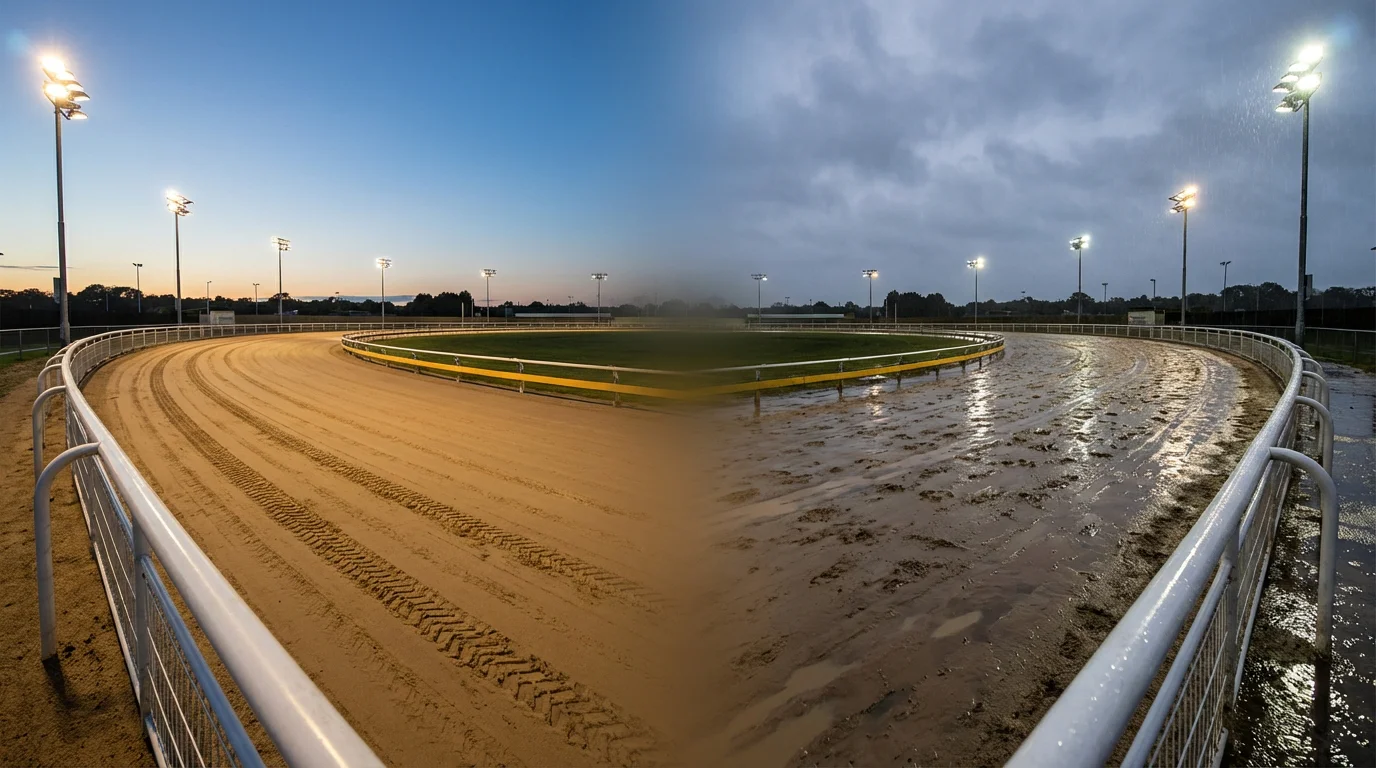
The Surface Beneath the Speed
A greyhound race takes place on sand. This is such an obvious fact that it rarely receives the attention it deserves. The sand surface is not a constant. It changes from meeting to meeting and sometimes within a single evening, influenced by weather, maintenance, temperature, and cumulative wear. Those changes affect every dog in every race, altering finishing times, shifting the competitive balance between runners, and creating conditions that favour certain types of dog over others.
In horse racing, the going description — firm, good, soft, heavy — is a central piece of pre-race information that punters analyse obsessively. In greyhound racing, the equivalent information exists in the form of the going allowance and the track condition reports, but it attracts far less attention from the betting public. This is partly because the format is less prominent and partly because many punters do not understand how to use it. The surface is a factor in every race. Ignoring it means ignoring a variable that affects the result as surely as form, trap draw, or grade.
Going Categories in Greyhound Racing
Greyhound tracks do not use a formal going description system in the way that horse racing employs terms like “Good to Firm” or “Heavy.” Instead, conditions are communicated through the going allowance — a numerical value, expressed in seconds, that quantifies how much faster or slower the track is running compared to its standard baseline. A positive going allowance indicates slow going. A negative going allowance indicates fast going. Zero, or very close to it, means the track is running at its standard pace.
Although there is no official naming convention, experienced punters and form students informally categorise conditions into three broad bands. Fast going corresponds to a negative going allowance — the surface is firm, dry, and offering good grip. Dogs run quicker than normal, and finishing times are shorter. Standard going corresponds to a going allowance close to zero — the surface is in its typical state, and times are in their expected range. Slow going corresponds to a positive going allowance — the surface is soft, heavy, or waterlogged, and dogs take longer to complete the race.
Within these broad categories, there is a spectrum. A going allowance of +0.10 is marginally slow — barely distinguishable from standard. A going allowance of +0.50 or more is genuinely heavy going, where the surface has absorbed significant moisture and dogs are visibly labouring. At the other end, a going allowance of -0.10 is a touch quick, while -0.30 or beyond indicates a surface that is exceptionally fast. The magnitude of the going allowance tells you how far conditions have moved from the norm.
The going allowance at Kinsley is published before each meeting and applies to the entire card. It is determined by trials run before racing begins, as described in the calculated times article. For the form student, the first action on any race night should be to note the going allowance and consider how it might affect the runners. A going allowance that differs significantly from recent meetings means that form comparisons need adjusting, and certain dogs may be better or worse suited to the conditions than their recent results suggest.
Weather is the primary driver of changes in going. Rain softens the surface, increasing the going allowance. Prolonged dry spells harden it, reducing the allowance. Temperature plays a secondary role — cold conditions tend to firm the surface slightly, while warm, humid conditions can keep it softer even without rain. Wind accelerates the drying process on exposed tracks. At Kinsley, which races four times a week under its ARC contract, the surface is subject to frequent use and frequent maintenance, and the going can shift noticeably between Monday and Saturday meetings depending on the weather across the week.
How Conditions Change Finishing Times
The relationship between going and finishing times is direct and measurable. On fast going, a dog completing the 462-metre trip at Kinsley might run 28.8 seconds. On standard going, the same dog in the same form might run 29.2. On heavy going, the time could stretch to 29.8 or beyond. The dog has not changed. Its ability has not fluctuated. The surface has done the work, adding or subtracting tenths of a second that the raw time does not explain by itself.
This is why calculated times, which strip out the going allowance, are essential for form comparison. A raw time of 29.0 on fast going and a raw time of 29.6 on slow going might represent identical performances once the surface effect is removed. The punter who relies on raw times alone will misjudge the relative ability of dogs whose recent runs have been on different surfaces. The punter who adjusts for going will see through the noise.
Conditions also affect the spread of finishing times within a race. On fast going, the field tends to be more closely bunched because all dogs benefit from the improved surface and the advantage of superior fitness is partially masked. On slow going, the field often spreads out more. Dogs that lack stamina or carry extra weight feel the drag of the heavy surface more acutely, and the gap between the front of the field and the back widens. This has implications for forecast and tricast betting — on heavy going, the better dogs tend to separate more clearly from the weaker ones, which can make predicting the first two or three finishers slightly more straightforward.
Sectional times are also affected by going, though not always to the same degree as finishing times. The opening phase of the race — the sprint from the traps to the first bend — is less influenced by surface conditions than the later stages, because the initial burst relies more on explosive power and less on sustained running over a changing surface. On heavy going, you may find that sectional times are only marginally affected while finishing times are significantly slower, because the dogs can still break sharply but fatigue sooner through the later bends.
Which Dogs Prefer Which Conditions
Not all greyhounds handle all conditions equally. Like horses, individual greyhounds have surface preferences that become apparent over a series of runs on different going. Some dogs run their best times on fast going and decline measurably when the surface is heavy. Others seem to relish slow going, producing their most competitive performances when the sand is soft and taxing. Identifying these preferences is an underused form tool that can give you an edge in races where conditions differ from the norm.
Broadly, lightweight dogs with a smooth, efficient running action tend to perform better on fast going. They can maintain their speed on a firm surface without the muscular effort that heavier dogs require. Heavier, more powerful dogs sometimes handle slow going better because their extra strength allows them to drive through the soft surface where lighter dogs struggle for traction. This is a generalisation — exceptions are common — but it provides a starting framework for assessing condition suitability.
Dogs with strong stamina also tend to cope better on slow going. A heavy surface saps energy faster, which means stamina becomes a more important factor as the going deteriorates. A dog that is purely a speed specialist — fast out of the boxes but unable to sustain its pace — will find slow going particularly punishing, because the surface is working against it throughout the race. The stayer, by contrast, is built for sustained effort and can maintain its pace even when the going is demanding.
The practical approach is to review a dog’s form record and note its performances on different going. If a dog’s best calculated times have consistently been recorded on fast going and its worst on slow going, you can reasonably expect that pattern to continue. When the going allowance for tonight’s meeting is in the fast range, that dog becomes a stronger prospect. When the going is heavy, downgrade its chances even if its recent form looks good — the form may have been recorded on a better surface.
Reading the Conditions
Incorporating track conditions into your form assessment is not complicated. It requires checking one number — the going allowance — and asking three questions. First, how does tonight’s going compare to the going on the nights when each dog last ran? If conditions are significantly different, the recent form may not transfer directly. Second, does any dog in the field have a demonstrated preference for tonight’s conditions? A dog that loves heavy going, running on a night with a high positive allowance, has a built-in advantage that the form figures alone do not capture. Third, is the going likely to change during the meeting? If rain is forecast and the early races run on standard going, the later races may encounter slower conditions. The going allowance is set before racing and does not adjust mid-meeting, so the later races may not be accurately corrected.
At Kinsley, where four meetings a week produce a constant flow of data, tracking the going allowance across successive meetings reveals patterns. A week of dry weather will produce a run of negative or near-zero allowances. A wet spell will push the figure progressively higher. If you know the weather forecast for the days leading up to a meeting, you can anticipate whether the going is likely to be fast, standard, or slow before the official figure is published. This foresight lets you make provisional assessments earlier and act on early prices before the market adjusts for conditions.
The punters who treat going as an afterthought are working with incomplete information on every race they assess. The punters who build it into their process — checking the allowance, cross-referencing each dog’s going record, adjusting expectations accordingly — are using a variable that is freely available, easy to apply, and consistently underweighted by the betting market. Track conditions are not glamorous. They are not as exciting as a fast sectional time or a dramatic grade drop. But they affect the result of every race, and the punter who respects that fact has an advantage over the one who does not.