How Greyhound Trainers Affect Race Results
Best Greyhound Betting Sites – Bet on Greyhounds in 2026
Loading...
The Name Above the Dog
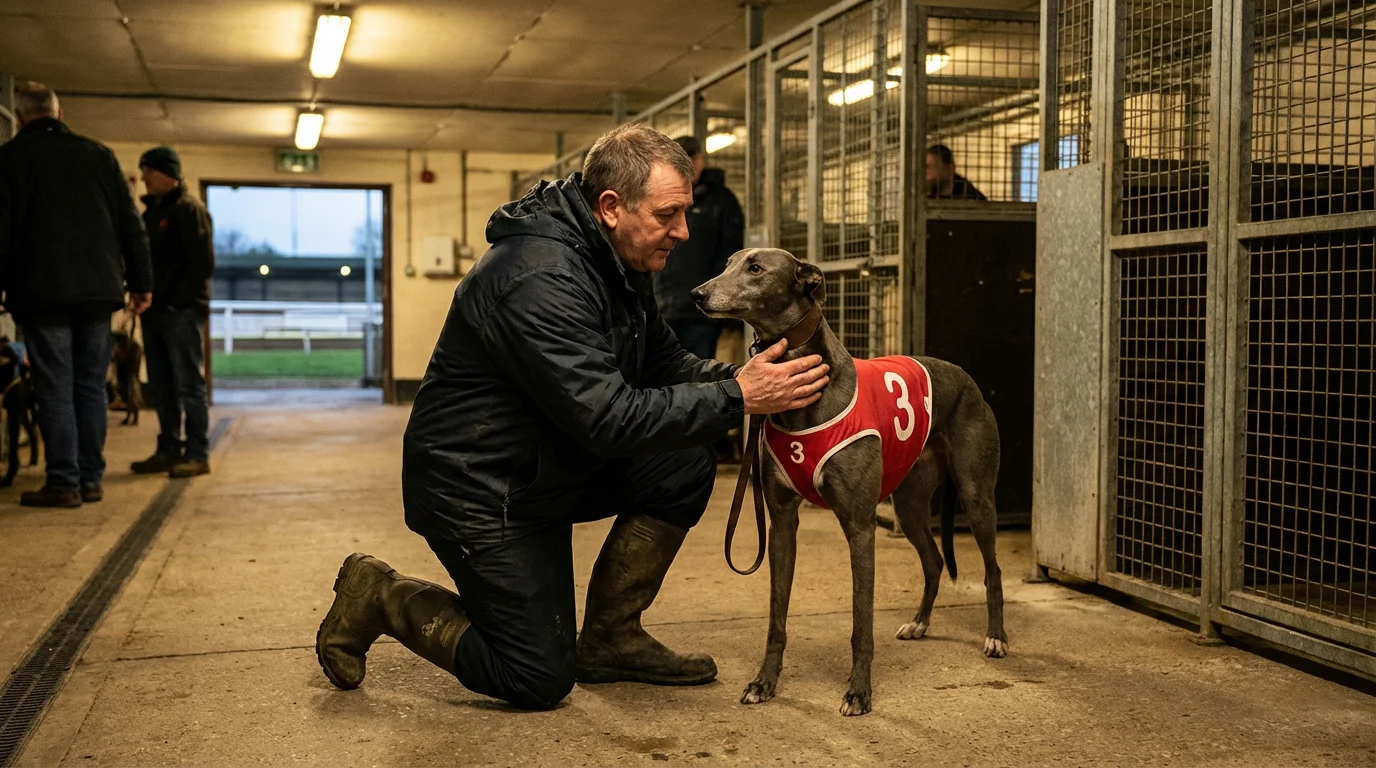
Every greyhound racecard lists two names for each runner: the dog and the trainer. Most punters read the first and ignore the second. That is a mistake. The trainer is the single most important human influence on a greyhound’s racing performance, responsible for the dog’s fitness, diet, trial preparation, race selection, and mental sharpness on the night. Two dogs of identical ability, placed in different kennels, will produce different results over a season. The trainer is the variable that explains the gap.
In horse racing, the trainer’s influence is widely acknowledged and factored into betting markets as a matter of course. In greyhound racing, trainer analysis is underdeveloped among the general betting public, partly because the information is less prominently displayed and partly because greyhound racing attracts less media analysis than its equine counterpart. This creates an edge for the punter willing to do the work. Trainer form, kennel patterns, and track-specific records are all available in the data. Most of the market does not use them, which means the punter who does is working with information that is not yet priced in.
What a Trainer Actually Controls
A greyhound trainer’s influence begins long before race night. The daily routine of a racing greyhound — feeding, exercise, galloping, trialling — is entirely in the trainer’s hands. The decisions made in the kennel across the week leading up to a race have a direct bearing on whether the dog arrives at the track in peak condition or slightly below par.
Feeding and weight management are the most obvious elements. A greyhound’s racing weight is closely monitored, and the trainer decides what the dog eats, when it eats, and how much. A dog that arrives at the track a pound or two above its optimal racing weight may lack sharpness. A dog that is slightly underweight may lack the strength to finish strongly over four bends. The trainer calibrates this balance for each individual dog, and the best trainers get it right consistently.
Trial work is another area of direct influence. Between races, most greyhounds will be given at least one trial — a solo or paired run on the track to maintain fitness and assess condition. The timing and intensity of these trials matter. A dog that is trialled too hard too close to race day may arrive at the meeting with tired legs. A dog that has not been trialled at all since its last race may be ring-rusty. Experienced trainers develop a feel for what each dog needs, and that intuition is difficult to quantify but easy to see in the results.
Race selection is the subtler part of the trainer’s craft. At GBGB tracks, the racing manager assigns dogs to races based on grade and availability, but trainers have some influence through which meetings they enter their dogs for and how they manage the dog’s schedule. A trainer who runs a dog every four days is making a different decision from one who spaces runs at seven-day intervals, and both approaches suit different types of greyhound. The trainer who understands their dog’s recovery pattern and races it accordingly will, over time, produce better results than one who simply enters every available opening.
There is also the psychological dimension. Greyhounds are creatures of routine and temperament. Some dogs are nervous in the kennels before a race and need calm handling. Others are excitable and need to be kept settled. The relationship between a dog and its trainer — the small things, like how the dog is loaded into the traps, whether it is walked or kept still in the pre-parade — can influence the dog’s state of mind at the moment the lids fly open. This is almost impossible to measure from the racecard, but it is a real factor.
Kennel Form and Streaks
Trainers do not send out individual dogs in isolation. They manage kennels of anywhere from a handful to several dozen greyhounds, and the performance of those dogs tends to cluster. When a kennel is running well — when the trainer has the feeding right, the trial regime dialled in, and the dogs arriving at the track in peak condition — the whole string tends to produce results. When something is off, the underperformance often spreads across the kennel rather than affecting just one runner.
This pattern is observable in the data. A trainer whose dogs have produced three or four winners in the past week is operating a kennel in form. The probability that the next runner from that kennel will outperform the market’s expectation is higher than average. Conversely, a trainer whose last ten runners have all finished out of the places may be dealing with a kennel-wide issue — a change in feed supplier, a minor virus running through the dogs, or simply a period where the trial programme is not producing the desired fitness levels.
Kennel form streaks are not random. They have causes, even if those causes are not always visible to the outside observer. The punter who tracks trainer statistics — winners from runners, place strike rate, profit and loss to starting price — can identify these hot and cold streaks and adjust their betting accordingly. Backing runners from in-form kennels and avoiding runners from out-of-form kennels is a simple filter that, applied consistently, improves long-term results.
The streak effect is strongest at smaller tracks where a limited number of trainers supply the majority of runners. At Kinsley, the regular trainer pool is relatively compact, and the same kennel names appear on most racecards. Tracking five or six key trainers and their recent records is a manageable task that yields disproportionate insight. At larger tracks with a wider trainer base, the same principle applies but requires more effort to monitor.
Trainer Statistics at Kinsley
Trainer statistics at any track can be broken down into several useful metrics: win strike rate (winners as a percentage of total runners), place strike rate (first or second finishes as a percentage of runners), and level-stakes profit or loss (what you would have won or lost backing every runner from that trainer at starting price). Each tells a different part of the story.
Win strike rate identifies the trainers who send out the most winners per runner. A trainer with a 20 per cent strike rate is producing a winner roughly every five runners — a strong record in six-dog races where the base probability is 16.7 per cent. A trainer at 25 per cent or above is operating at a high level and is worth noting whenever their dogs appear on the card. Below 12 per cent, and the kennel is underperforming relative to what random chance would produce.
Place strike rate is useful for each way betting and forecast selections. A trainer whose dogs consistently finish in the first two, even when they do not win, is producing runners that are competitive and well-prepared. A high place rate combined with a lower win rate often indicates a kennel that specialises in solid, reliable dogs rather than spectacular but inconsistent performers.
Level-stakes profit is the metric that matters most for bettors. A trainer can have a high strike rate and still produce a loss to level stakes if the winners are all short-priced favourites. Conversely, a trainer with a modest strike rate can be profitable if the winners come at bigger prices. The ideal is a trainer with a solid strike rate whose runners are consistently underestimated by the market — producing enough winners at good enough odds to generate a long-term profit. These trainers exist at every track, including Kinsley, and identifying them is one of the quieter edges available to the studious punter.
One practical note: trainer statistics are most useful when the sample size is large enough to be meaningful. A trainer who has had three winners from five runners looks phenomenal on the numbers but the sample is too small to draw conclusions. Look for records built over at least fifty runners, ideally across multiple months, before treating the figures as reliable indicators of kennel quality.
Behind the Kennel Door
The limitation of trainer analysis is that you are always working from the outside. You can see the results, track the statistics, and identify form streaks, but you cannot see what happens inside the kennel. You do not know whether a dog has had a minor knock in exercise, whether the trainer has changed the feeding routine, or whether a promising young dog has been given extra trial work in preparation for a step up in grade.
This information gap is a feature of greyhound racing, not a flaw in the analysis. Horse racing has the advantage of a large press corps that reports on stable visits, gallops, and insider intelligence. Greyhound racing, particularly at independent tracks like Kinsley, has far less of this coverage. The punter must rely on the data rather than the narrative, which is arguably a healthier analytical habit. The numbers do not lie, even if they do not tell the complete story.
There is a final point about trainers that is easy to overlook. A change of trainer is one of the most significant form indicators in greyhound racing. When a dog moves from one kennel to another, its entire routine changes — feeding, exercise, trial programme, handling. Some dogs improve dramatically after a kennel switch, particularly if they were not suited to the previous trainer’s methods. Others decline. The first two or three runs after a trainer change are worth watching closely, because the dog’s established form may no longer apply. The racecard will note the change. The question is whether the punter notices it, and whether the market has adjusted for it. Often, it has not.