Kinsley Greyhound Racing: History, Events and Key Races
Best Greyhound Betting Sites – Bet on Greyhounds in 2026
Loading...
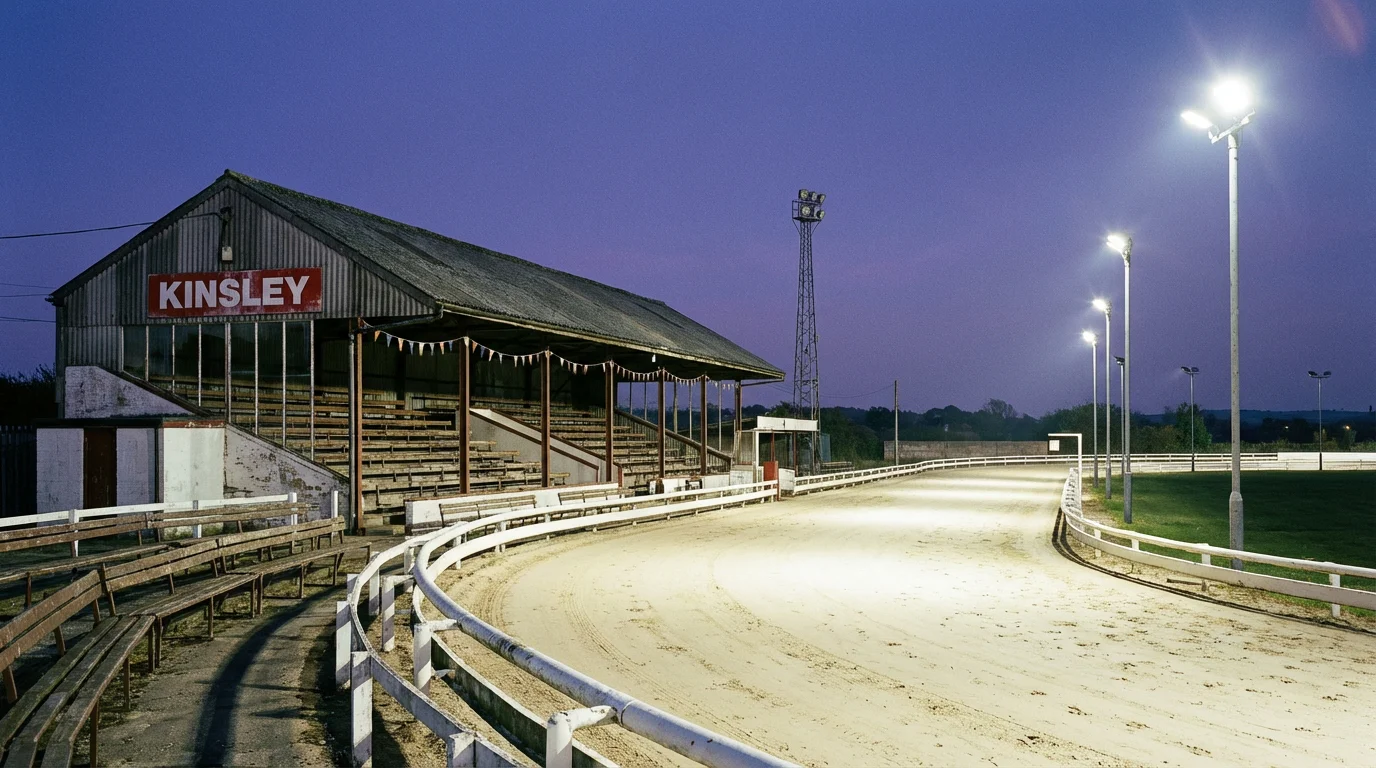
Running Dogs Since 1939
Kinsley has been running dogs since 1939 — long before most of its competitors even had floodlights. That is eighty-seven years of continuous greyhound racing in a village that most people outside West Yorkshire would struggle to find on a map, and it makes Kinsley one of the most enduring venues in British dog racing. Not the biggest, not the most glamorous, not the one that attracts the national headlines — but one that has survived when dozens of other tracks have closed, and one whose history tells a story about the sport itself.
Understanding Kinsley’s history matters for more than nostalgic reasons. The track’s evolution — from a flapping circuit built for miners to a GBGB-regulated stadium hosting nationally recognised events — has shaped the racing programme, the grading system, the facilities, and the competitive environment that punters engage with today. The dogs that race here run on a track that has been refined over nearly nine decades, chasing a hare system that was upgraded from an Inside Sumner to an outside Swaffham McGee, under a regulatory framework that the venue only adopted at the turn of the millennium.
This article traces that evolution: the origins in a Yorkshire mining community, the transformative ownership change in 1985, the shift to licensed racing in 2000, the arrival of prestige events, and the Arena Racing Company partnership that now structures the weekly programme. For the punter, the history provides context. For the racing enthusiast, it provides something richer — the story of a track that has earned its place through stubbornness, investment, and a refusal to go quietly when the sport around it was contracting.
A Flapping Track in a Mining Village
A flapping track in a mining village — that’s where this story begins. Kinsley in 1939 was a coal-mining community in the West Riding of Yorkshire, a place defined by the pit and the social life that grew around it. When the greyhound track opened on Wakefield Road that year, it was built for that community — a place where miners could spend a Tuesday or Saturday evening watching dogs run, have a bet, and decompress from a week underground. The timing was not ideal. The Second World War broke out in the same year, but the track survived its first years and continued operating through the conflict and beyond.
The term “flapping track” describes an independent venue operating outside the jurisdiction of the National Greyhound Racing Club, which governed licensed racing in Britain. Flapping tracks were common across the UK in the mid-twentieth century — they were cheaper to run, less regulated, and often deeply embedded in their local communities. Kinsley was a textbook example. It had no NGRC licence, no official grading system, and none of the administrative infrastructure that regulated tracks required. What it had was a loyal local crowd. After the war, the track could accommodate up to 3,500 spectators, which was a substantial number for a village venue and a testament to the demand for live entertainment in a pre-television era.
Racing in the early years was conducted over imperial distances: 342, 457 and 700 yards, with both handicap and level-break races on the card. Five dogs per race was the standard field size, smaller than the six-dog fields that became the norm under licensed rules. There was a licensed bar on site, trials were held on Sundays, and the atmosphere was closer to a working men’s club with a racetrack attached than to anything resembling the corporate-branded venues of modern greyhound racing. Twelve bookmakers stood at Kinsley during its independent years, which gives an indication of the betting activity the track generated — enough to support a significant number of on-course layers.
For the first four and a half decades of its existence, Kinsley changed very little. The mining industry sustained the community, the community sustained the track, and the track sustained a local tradition of dog racing that passed through generations. The facilities were basic, the racing was informal by today’s standards, and the ambition was local rather than national. Kinsley was a flapper, and it was content to be one. That contentment would not last, but it defined the track’s identity for longer than many people realise — the roots of everything Kinsley became were laid down in those decades of quiet, independent operation, when the track existed simply because the people around it wanted it to exist.
The Curran and Murrell Era
In 1985, John Curran and Keith Murrell took over — and Kinsley started becoming the track it is today. The new ownership represented the most significant change in the venue’s history, and virtually every feature of the modern track can be traced back to decisions made in the years following their arrival.
The investment was immediate and substantial. The facilities were upgraded, the track was resurfaced, and the racing distances were reconfigured to metric measurements: 100, 260, 330, 460 and 630 metres. An Inside Sumner mechanical hare was installed, replacing whatever manual or lower-specification system had been used previously. A computer tote was introduced for pool betting. Forty-eight kennels were built on site, allowing resident trainers to house their dogs at the venue. The Jubilee Restaurant was established, offering sit-down dining for up to 160 covers — a facility that gave Kinsley a social dimension well beyond the trackside betting experience.
The most audacious move was the creation of the Kinsley Greyhound Derby, a new flagship competition that carried a prize fund of twenty thousand pounds. That figure was remarkable for an independent track — it eclipsed the prize money offered by many of the NGRC’s top events at licensed venues. The Kinsley Derby attracted attention from the broader greyhound racing world and signalled that Curran and Murrell’s ambitions extended far beyond maintaining a quiet local flapper. They wanted Kinsley to compete, and the prize money was the clearest statement of intent.
Through the late 1980s and the 1990s, the track built on these foundations. The crowd capacity was set at approximately 3,000, with parking for 300 cars. A social club operated on site throughout the week, extending the venue’s role in the community beyond race nights. The track was beginning to show, as the historical record puts it, all the hallmarks of a regulated circuit — everything except the actual NGRC licence. That step would not come until the new millennium, but the groundwork laid by Curran and Murrell during these fifteen years made it possible. When Kinsley finally applied for official recognition, the application was accepted at the first attempt — a reflection of just how close to licensed standards the track had already been operating.
The first officially regulated meeting at Kinsley took place on the 15th of January 2000, with Keith Murrell serving as racing manager and Craig Hunt subsequently brought in to support the operation. The distances were adjusted again to align with NGRC requirements — 275, 450, 485 and 656 metres in the initial configuration — and a Swaffham hare replaced the Inside Sumner. The transition from flapping track to licensed venue was a bureaucratic and practical milestone, but in many ways the real transformation had already happened. Curran and Murrell had built a track that deserved the licence long before it received one.
The Flagship Races
The flagship races define a track’s ambition — Kinsley’s signature events say it wants to be taken seriously. Two competitions in particular have elevated Kinsley from a well-run northern track to a venue with national significance: the Television Trophy and the Gymcrack.
The Television Trophy
The Television Trophy is one of the oldest and most prestigious competitions in British greyhound racing, first held in 1958 and originally broadcast on the BBC’s Sportsview programme. The format is distinctive: rather than being tied to a single venue, the TV Trophy travels to a different track each year, staging heats and a final at the selected location. It is a marathon-distance event, run over the longest trip available at the host track, and it attracts the best staying greyhounds in the country.
In 2010, Kinsley was selected to host the Television Trophy — a decision that represented a significant vote of confidence in the track from the Greyhound Board of Great Britain, which administers the competition. For a venue that had only been operating under an NGRC licence for ten years, hosting one of the sport’s marquee events was a statement of how far and how fast Kinsley had developed. The 2010 edition was won by Midway Skipper, a greyhound whose story captured the imagination of the racing public. Trained by his eighty-year-old owner-breeder-trainer Henry Chalkley, Midway Skipper had risen from A9 races at Henlow to become a formidable stayer, and his victory at Kinsley added to a narrative that already had something of the fairytale about it. It was Midway Skipper’s second consecutive TV Trophy win, having taken the 2009 edition at Newcastle.
The Television Trophy’s visit to Kinsley brought national broadcast coverage, bigger crowds, and a spotlight on the track’s facilities and racing surface that the venue had never previously received. For the broader Kinsley audience — the regular Saturday-night punters and the online bettors who followed the track through SIS coverage — the TV Trophy was a tangible marker that their track had arrived at the top table.
The Gymcrack
The Gymcrack is a puppy competition for greyhounds over fifteen months but under two years of age, and it is now one of the most important developmental races in the British greyhound calendar. The event did not originate at Kinsley — it was first held at Hackney Wick Stadium in 1994, ran for three years before being discontinued in 1996, and was then revived at Hall Green Stadium in Birmingham in 2000. In 2011, the Gymcrack switched to Kinsley, and it has been the track’s signature annual event ever since.
The first Gymcrack at Kinsley was won by Taranis Rex, trained by Nick Colton — a black and white dog that did not merely win the race but broke the track record in the process. That debut set a standard for the event at Kinsley that subsequent renewals have maintained. The Gymcrack attracts high-quality young greyhounds from across Britain and Ireland, and the roll of winners reads as a who’s who of emerging talent. Notable victors at Kinsley include Droopys Hope in 2012, Young Golden in 2013, Stay Loose in 2015, and Cometwopass in 2017 — the first Irish-trained winner at the venue, handled by Peter Cronin.
The Gymcrack runs over 462 metres — Kinsley’s standard distance — and the race has attracted significant sponsorship, with Betfred taking over from SkyBet in 2011. The combination of young, fast, relatively unexposed greyhounds, national-level competition, and commercial backing makes the Gymcrack the highlight of Kinsley’s racing year. For punters, it is also one of the most challenging races to assess, because the competitors typically have limited form records and their ability relative to one another is less established than in a standard graded event featuring mature dogs with dozens of runs on their cards.
Beyond the headlines, the Gymcrack serves a developmental function for the sport. It identifies the best young greyhounds in the country at an early stage of their careers, and performers in the Kinsley Gymcrack frequently go on to contest the sport’s biggest open races at other venues. For Kinsley, hosting this pipeline of talent ensures that the track’s name appears alongside the country’s top events — a positioning that would have been unthinkable during the flapping years, and one that the venue has earned through consistent investment in its racing product.
The ARC Partnership
The ARC deal changed Kinsley’s national visibility — four weekly meetings under a corporate banner. In 2018, Kinsley signed a partnership agreement with Arena Racing Company, the organisation that manages the commercial and broadcast infrastructure for a significant portion of UK greyhound racing. The deal formalised Kinsley’s position within the national racing network and brought the track’s fixtures into the ARC broadcast schedule, ensuring that every meeting was available to betting shop customers and online viewers across the country through SIS and Sky Sports Racing.
Under the ARC arrangement, Kinsley stages meetings four times a week. The current schedule typically includes Tuesday and Friday afternoon fixtures and Sunday afternoon meetings, with Saturday evening meetings open to the public, though the specific days have varied at different points since the partnership began. Each meeting features a full card of approximately twelve races across Kinsley’s four distances, providing a consistent supply of betting content for the track’s followers and the wider greyhound betting audience.
The commercial significance of the ARC deal extends beyond broadcast access. ARC meetings attract a standardised level of prize money, which supports the quality of the racing product by incentivising trainers to enter competitive dogs. The partnership also brought infrastructure investment, with Greyhound Media Group announcing additional funding for prize money and trainer support at Kinsley alongside other ARC venues including Swindon, Sheffield and Yarmouth. These increments may seem modest individually, but they contribute to a competitive environment where graded racing at Kinsley attracts a field quality that would be difficult to sustain without the ARC framework.
For the punter, the ARC partnership has practical implications. The regular four-meeting weekly schedule provides a consistent flow of Kinsley form data, which makes the track easier to follow than venues with more sporadic fixtures. Dogs racing at Kinsley under the ARC programme run frequently enough to build meaningful form lines over short periods, and the grading system adjusts quickly to recent performance. This data density is an advantage for the form analyst: the more frequently a dog races at the same track, the more reliable the form picture becomes.
The partnership also means that Kinsley’s results and racecards are available through every major UK bookmaker and racing data provider. Before the ARC deal, accessing Kinsley information required seeking out the track directly. Now, the data is integrated into the same platforms that serve Romford, Nottingham, Monmore Green and every other ARC venue. That visibility has broadened Kinsley’s betting audience from a primarily local and regional following to a national one — which in turn has deepened the betting market and created slightly more efficient odds than the track produced in its pre-ARC days.
Track Records
Track records matter because they set the benchmark — the ceiling against which all other performances are measured. At Kinsley, the records across all four distances have been established by greyhounds that combined natural speed with favourable conditions and clean runs, and they serve as reference points for any serious form analyst assessing the quality of a recent performance.
Over the 268-metre sprint, the track record stands at 15.97 seconds, set by Minglers Jaguar in June 2012. That time represents an extraordinarily fast sprint performance on a sand surface, and it has stood for well over a decade — a measure of just how exceptional the run was. For context, a competitive sprinter at Kinsley in graded racing typically clocks between 16.40 and 16.80 seconds, meaning the record is several tenths of a second clear of the standard performance range. A dog clocking anything under 16.20 over 268 metres at Kinsley is running at an elite level for this track.
The 462-metre record is 26.95 seconds, set by Brinkleys Poet in the 2018 Gymcrack final. Over Kinsley’s most commonly run distance, this time remains the gold standard. Competitive graded runners typically produce times between 27.80 and 29.00 at this trip, so a calculated time anywhere near 27.50 from a dog in the mid-grades indicates a significant talent running below its potential class. The 462-metre record is particularly useful as a calibration point because the standard distance generates the largest dataset of form data at Kinsley, making it easy to see where any given performance sits relative to the all-time best.
Over 650 metres, Nyla Fantasy holds the record at 39.72 seconds, and the 844-metre mark belongs to Bubbly Capel at 52.54 seconds, both set in 2012. The staying records are less frequently approached than the sprint and standard benchmarks, partly because staying races are run less often and partly because the longer trips require a combination of speed and stamina that fewer dogs possess. A competitive stayer at Kinsley typically runs the 650-metre trip in the low to mid 40-second range, putting the record roughly a full second clear of the standard competitive band.
The fact that three of the four track records date from 2012 — with the 462-metre mark updated in 2018 — is worth noting. It does not necessarily indicate that the quality of greyhound racing at Kinsley has declined — track conditions, field compositions, and the specific pool of dogs racing at the venue fluctuate over time. What it does suggest is that the 2012 season produced an unusual concentration of high-class greyhounds at the track, and that the sprint and staying records they set remain benchmarks that have not been surpassed in over a decade of racing. For the punter, the records provide an anchor point: when a dog clocks a time that approaches any of these marks, it is performing at an exceptional level for this venue, regardless of the grade in which the time was recorded.
Still Running Strong
In an era where UK greyhound tracks are closing, Kinsley keeps signing contracts and running dogs — that says something. The broader landscape of British greyhound racing has contracted significantly since the sport’s mid-twentieth-century peak. Dozens of tracks have shut permanently — Wimbledon, Hall Green, Coventry, Wimbledon Park, Belle Vue — and the number of GBGB-regulated venues has shrunk to a fraction of what it once was. In this environment, the continued operation and investment at Kinsley is not just commercially significant but symbolically important for the sport in the north of England.
The ARC partnership, signed in 2018, provided a commercial framework that secures the track’s fixture list and broadcast coverage. The investment from Greyhound Media Group into prize money and trainer support has supplemented that framework with financial resources that directly benefit the quality of racing. The owners who took over in 1985 have maintained their involvement for four decades, providing a continuity of management that most tracks in any sport would envy. Kinsley’s survival is not the product of a single factor — it is the result of compounding investments over time, each building on the last.
The community dimension matters too. Kinsley has always been a local track first, and its connection to the surrounding area — forged in the mining years and maintained through decades of social change — gives it a loyal attendance base that cannot be replicated by a newly built venue. The Saturday evening race night remains a social event for regulars. The Jubilee Restaurant still serves meals to diners who combine a night out with a flutter on the dogs. The track’s rehoming programme for retired greyhounds, run in partnership with the Retired Greyhound Trust, reflects a welfare commitment that strengthens its position in a sport increasingly scrutinised on animal welfare grounds.
For the punter, the stability of Kinsley’s operation means a reliable and consistent racing programme to follow. The track is not at risk of sudden closure that would disrupt ongoing form analysis. The grading system is well-established and predictable. The fixture schedule is dependable. These may sound like mundane considerations, but for a serious greyhound bettor investing time and method into a single track, the assurance that the venue will still be there next month and next year is worth more than it might seem.
Kinsley opened in 1939 in a mining village that no longer mines. It raced through a world war, survived the decline of the coal industry, navigated the transition from flapping to licensed racing, attracted the sport’s prestige events, and secured a corporate partnership that positions it for the next decade. The story is not finished. But the chapters so far suggest a track that knows how to endure.