Kinsley Track Guide: Distances, Trap Bias and Track Layout
Best Greyhound Betting Sites – Bet on Greyhounds in 2026
Loading...
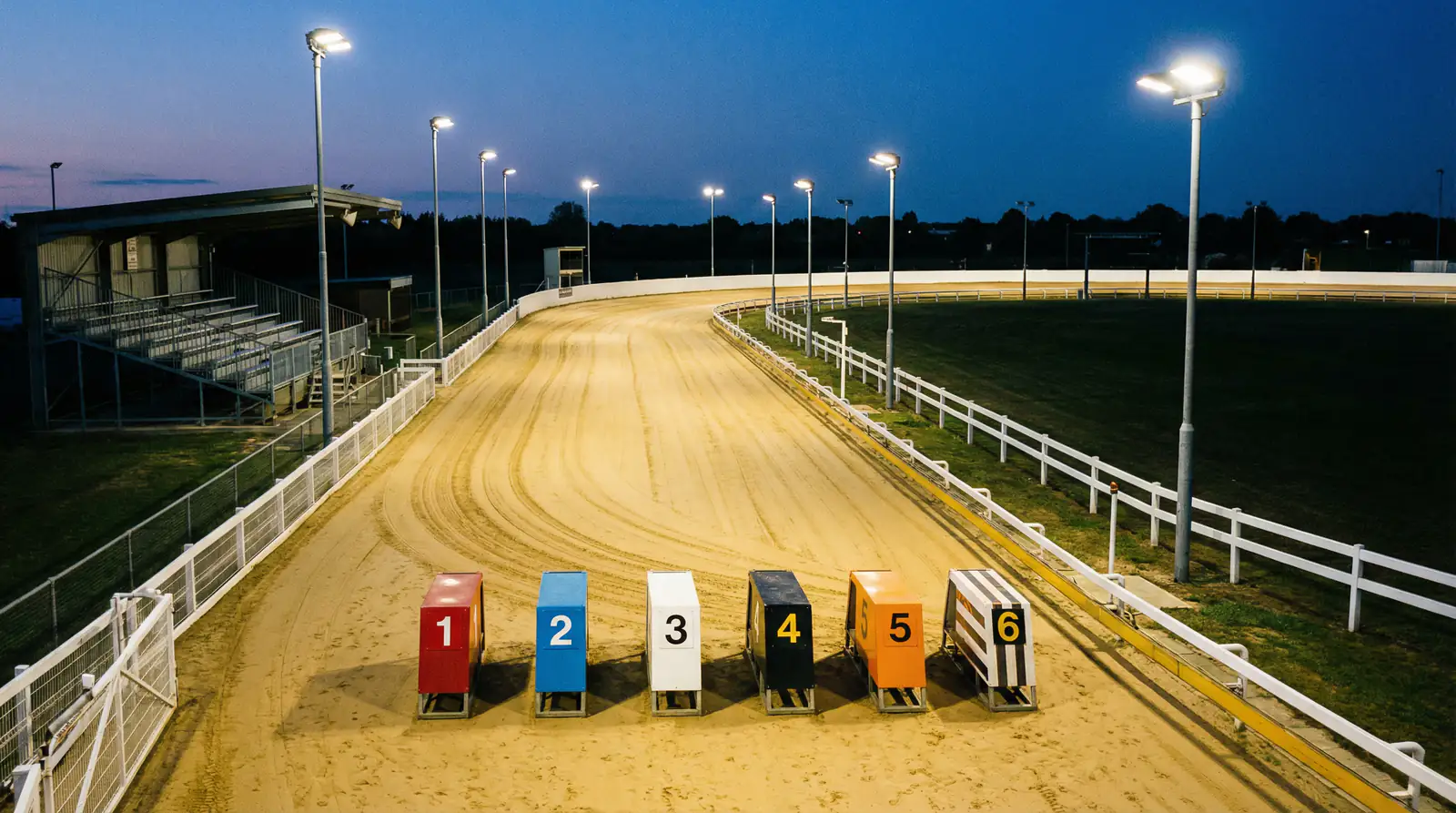
A Track Written in Geometry
Every greyhound track has a personality — Kinsley’s is written into its geometry. The 385-metre circumference, the four racing distances, the sand surface, the Swaffham McGee outside hare: these are not background details for a programme note. They are the fixed variables that determine how every race at this venue unfolds, how every dog performs relative to its ability, and where the smart money either finds or forfeits its edge.
Most punters who bet on Kinsley never visit the track. They see results on a screen, study racecards on a phone, and place bets without any physical sense of the venue where six dogs are about to run. That disconnect is manageable if you understand the track’s characteristics from a data perspective — but it becomes a genuine handicap if you don’t. A dog transferring from Romford to Kinsley faces a different circumference, different bends, a different hare system, and different distances. Its form at the previous track may translate cleanly or not at all, and the difference often comes down to features of Kinsley’s layout that the casual bettor never considers.
This guide covers everything about the physical track that affects race outcomes and, by extension, betting decisions. The circuit dimensions, the four distances and what each demands from a greyhound, the trap biases that appear in large data samples, the surface and hare, and how Kinsley compares structurally to other tracks in the UK. None of this is decorative knowledge. All of it feeds directly into the question that matters most: which dog is most likely to win this race at this track on this distance from this trap.
If you are serious about betting on Kinsley greyhounds with any kind of method, the track itself is the first thing you need to understand. Not the dogs, not the trainers, not the odds — the track. Because the track is the one constant in every race.
The Circuit: 385 Metres of Sand and Bends
At 385 metres around, Kinsley is a mid-sized oval with bends that demand technique as much as speed. That circumference sits comfortably in the middle of the UK greyhound track range — neither so compact that inside runners dominate every race nor so expansive that running style becomes irrelevant. It is a track that rewards balanced dogs — those with enough early pace to hold position into the first bend and enough bend technique to maintain it through the turns.
The oval itself is a standard four-bend layout. Races over 462 metres — the most common distance on any Kinsley card — involve all four bends. Sprints over 268 metres take in only the first two. Staying races over 650 metres and the marathon trip of 844 metres involve multiple laps of the circuit, adding additional bends and testing stamina in a way that the shorter distances do not. The shape of the bends matters because it determines how much ground a wide-running dog loses compared to one that hugs the rail. At Kinsley, the relatively moderate bend radius means the penalty for running wide is present but not as severe as at a tighter track like Romford, where an extra half-length per bend adds up brutally over four turns.
The traps are positioned on the back straight, which provides a run of approximately 90 metres to the first bend on the standard 462-metre trip. That 90-metre run is where trap position and early pace interact to establish the running order that, more often than not, defines the rest of the race. Dogs that break sharply and reach the first bend in front have a clear advantage — they choose their line, avoid crowding, and set the tempo. Dogs that break slowly face the traffic, and traffic at Kinsley’s first bend can be dense because six dogs funnelling from a wide start into a moderate bend creates natural congestion.
The back straight and the home straight are roughly equal in length, which gives dogs two genuine opportunities to make ground — once down the back after the second bend and once up the home straight towards the finishing line. At tracks with an asymmetric layout, one straight may be significantly longer than the other, which alters the race dynamics. Kinsley’s balance means that a dog making a move down the back and a dog making a move up the home straight have comparable opportunities, which in turn makes positional form at the second and fourth bends worth studying carefully.
The finishing line sits partway up the home straight, not at the apex of the final bend. This matters because a dog that rounds the last bend in third but has strong finishing pace may pick up one or two places before the line. Conversely, a dog that leads into the final bend but tires on the run-in may be caught. At Kinsley, these small positional shifts between the last bend and the line frequently decide the outcome — and they are often invisible to anyone who only reads the finishing position without studying where dogs were at each checkpoint.
Four Distances, Four Different Races
Four distances, four different races — understanding what each trip demands is fundamental. Kinsley stages races over 268, 462, 650 and 844 metres. Each distance tests different physical and tactical qualities, and a dog that excels over 268 metres may be entirely unsuited to 650. Betting without knowing what each trip demands is like backing a sprinter in a marathon — the numbers on the racecard will tell you everything, but only if you know which numbers to prioritise for each distance.
The 268-Metre Sprint
The 268-metre trip is Kinsley’s shortest distance and involves just two bends. It is pure speed racing. The traps open, the dogs sprint down the back straight, negotiate the first and second bends, and the race is effectively over before any dog has completed half a lap of the full circuit. Track record holders at this distance have clocked times in the region of 16 seconds flat — which gives some idea of how compressed the action is.
At this distance, early pace is everything. A dog that breaks quickly from the traps and reaches the first bend in front will win more often than not, because there is simply not enough track remaining for a slower starter to make up lost ground. This makes trap draw disproportionately important over 268 metres. Inside traps — particularly trap one — enjoy a structural advantage because the dog has the shortest path to the first bend and can establish the rail position with less effort. A slow-breaking dog in trap six over this trip faces a near-impossible task: it has the longest run to the bend, the widest angle, and no distance left to recover.
When assessing form for 268-metre races at Kinsley, the sectional time to the first bend is the primary metric. A dog with a consistently fast first split will outperform a dog with a better finishing time over 462 metres, because the sprint trip never allows the longer-distance specialist to deploy its stamina. Weight also matters marginally more in sprints — a lighter, more explosive dog tends to break faster than a heavier one, all other things being equal.
The 462-Metre Standard
The 462-metre distance is Kinsley’s bread and butter. It accounts for the majority of races on any given card and involves all four bends plus both straights. This is where form analysis is at its richest because the longer trip allows a wider range of running styles to compete. Front-runners can still dominate, but strong finishers have time to make ground, and bend technique becomes a more significant factor than over the sprint.
Typical competitive times over 462 metres at Kinsley range from around 27.50 seconds for high-grade runners to approximately 29.50 for the lower echelons. The track record stands at 26.95 seconds, set by Brinkleys Poet in the 2018 Gymcrack final — a time that remains the benchmark against which all other 462-metre performances are measured. For the punter, the most useful comparison is calculated time rather than raw time, because calculated times normalise for track conditions and allow meaningful comparisons across different race nights.
Over this distance, the interplay between trap draw, early pace and bend positioning is at its most complex. A dog drawn in trap one with moderate early pace but excellent bend technique may outperform a faster dog drawn in trap six that drifts wide at every turn. The four bends compound any advantage or disadvantage in running style — a half-length lost per bend through wide running becomes two full lengths lost over the race, which is often the difference between winning and finishing fourth.
The 650-Metre and 844-Metre Staying Trips
The 650-metre and 844-metre distances are Kinsley’s staying events. They are run less frequently than the sprint and standard trips, but they feature on most cards and represent a fundamentally different form puzzle. At 650 metres, the race involves multiple passes of the bends, and stamina begins to matter more than pure speed. At 844 metres — effectively two full laps of the circuit — stamina is the primary attribute, and dogs that rely on early pace often fade dramatically in the closing stages.
The track record over 650 metres is 39.72 seconds, set by Nyla Fantasy in 2012, while the 844-metre record stands at 52.54 seconds, held by Bubbly Capel from the same year. These times illustrate the physical demands of the staying trips: a dog maintaining competitive pace for nearly a minute of continuous running needs a very different physical profile from one that sprints for sixteen seconds.
For the bettor, staying races at Kinsley require a shift in assessment priorities. Trap draw is less important because the initial positioning advantage washes out over the longer trip — there are enough bends and enough straight to allow dogs to settle into their preferred positions regardless of where they start. What matters more is stamina evidence in the form figures. Has the dog competed over this distance before? Has it maintained pace through the final bend on previous occasions? Does the race comment history show it finishing strongly or fading? A dog with a form line of 1-1-2 over 462 metres may look impressive until you realise it has never raced beyond that distance and its finishing speed has been achieved in races that ended before its stamina was tested.
Trap Bias at Kinsley: What the Numbers Show
Numbers don’t lie, but they do require context. Trap bias at Kinsley exists, and ignoring it is a quiet way to erode your returns over a season. But the bias is not uniform across all distances, and treating it as a blanket rule rather than a distance-specific pattern is almost as costly as ignoring it entirely.
Over large sample sizes of graded races at Kinsley, trap one shows a win rate that consistently exceeds the expected 16.7 per cent that a perfectly fair six-trap system would produce. This advantage is most pronounced over 268 metres, where the inside draw provides the shortest run to the first bend and allows a fast-breaking dog to establish the rail without interference. Over the sprint distance, trap one’s win rate has historically been several percentage points above the theoretical average. Trap two also outperforms over this trip, though by a smaller margin. Traps five and six tend to underperform, particularly when the dogs drawn there lack the early pace needed to compensate for the wider starting position.
Over 462 metres, the trap bias softens. Trap one retains a slight edge, partly because the geometry of the first bend still favours the inside runner, and partly because dogs drawn inside face less crowding risk at the initial turn. But the four-bend structure of the standard trip allows mid-race repositioning, which dilutes the starting advantage. A dog drawn in trap five with strong bend technique and a patient running style can recover its wide start by the second or third bend. Over the 462-metre distance, trap-to-trap win percentages tend to cluster closer to the theoretical average, with the exception of trap six, which still underperforms modestly in most sample periods.
Over 650 and 844 metres, trap bias at Kinsley is statistically negligible. The extended distance provides enough time and enough bends for the running order to reorganise itself independent of the starting configuration. This does not mean trap draw is irrelevant over staying trips — a dog prone to slow starts will still lose ground early — but it means the trap number itself is a weaker predictor of the outcome than it is over shorter distances.
The practical betting implication is straightforward but requires discipline to apply. Over 268-metre sprints, weight trap draw heavily in your assessment. An inside-drawn dog with fast early pace is the archetypal sprint favourite at Kinsley, and the data supports that weighting. Over 462 metres, consider trap draw as one factor among several — important but not dominant. Over staying trips, deprioritise it in favour of stamina evidence and late-pace form. The punters who get burned by trap statistics are usually the ones who apply a single rule across all distances, rather than adjusting their model to match the distance they are assessing.
One additional note: trap statistics at Kinsley fluctuate between sample periods. A trap that outperformed over the first half of a year may regress in the second half, because the greyhound population at any track is constantly changing as dogs enter and leave the grading system. Treat trap data as a base-rate indicator, not a deterministic predictor. It tells you where to look for value, not where the value definitively is.
Hare and Surface
The Swaffham McGee outside hare sets the pace — and the running rail sets the battleground. Every UK greyhound track uses a mechanical hare to lead the dogs around the circuit, but hare types vary, and the differences matter more than most casual punters realise.
Kinsley uses an outside Swaffham McGee, which means the hare runs on a rail positioned on the outer edge of the track. Dogs instinctively chase the hare, so an outside hare naturally pulls the field toward the outer running line. This has a subtle but measurable effect on how races unfold. Dogs with a natural tendency to rail — to run tight to the inside — are effectively running against their instinct relative to the hare’s position, while dogs that naturally drift wide are running with it. The result is that wide runners at Kinsley do not lose as much relative to railers as they would at a track with an inside hare, because the outside hare encourages a slightly wider racing line across the field.
This contrasts with tracks that use an inside hare system, where the lure runs on the inner rail and pulls the field inward, strongly favouring railers and penalising wide runners. When evaluating dogs transferring to Kinsley from inside-hare tracks, be alert to the potential for running-style adjustments. A dog that railed beautifully at an inside-hare venue may not reproduce that tendency at Kinsley, and vice versa.
The track surface at Kinsley is sand-based, which is standard for UK greyhound racing. Sand surfaces respond to weather conditions — rain makes them heavier and slower, while dry spells produce faster going. At Kinsley, the surface is maintained between meetings, but conditions can vary noticeably between a dry Friday afternoon and a wet Sunday evening. The going affects times directly: a track running slow might add half a second or more to every dog’s finish, and that adjustment is not always fully reflected in the calculated times published on the racecard.
For betting purposes, the surface condition is most relevant when comparing form across different meetings. A dog that clocked 28.50 on a dry Monday is not necessarily slower than one that ran 28.30 on a fast Friday — the going may account for the entire difference. The calculated time on the racecard is designed to normalise for this, but it is an estimate, not a precise measurement. Experienced Kinsley punters develop a feel for how much the going affects times at this specific venue, and they apply that knowledge when the racecard data leaves room for interpretation.
Kinsley Compared to Other UK Tracks
Context matters — how does Kinsley compare to tracks your dogs have raced at before? This is a question that comes up constantly in form assessment, because dogs regularly transfer between tracks, and their previous form needs to be interpreted through the lens of the venue where it was produced.
Kinsley’s 385-metre circumference places it in the middle of the UK range. Romford runs at 350 metres and Crayford at 334 — both tighter circuits where inside-drawn dogs and railers carry a more pronounced advantage. Nottingham operates at 437 metres, and Sheffield at 425. When a dog transfers to Kinsley from a tighter track, its bend form may improve because the wider bends give it more room. When it arrives from a wider track, the opposite may apply — dogs accustomed to generous bends may find Kinsley’s turns slightly more demanding.
Distance comparisons also require care. Kinsley’s standard trip is 462 metres, which is longer than the standard at Romford (400 metres) but shorter than the standard at Nottingham (500 metres). A dog that excels over 400 metres at Romford may struggle with the extra 62 metres at Kinsley, particularly if its form shows signs of fading in the closing stages of its races. Conversely, a dog that races over 500 metres at Nottingham and transitions to Kinsley’s 462-metre trip may have more finishing speed in reserve because the shorter distance asks less of its stamina.
The hare type is another differentiator. Kinsley’s outside Swaffham McGee produces a different running dynamic from the inside hare systems used at some other GBGB tracks. Dogs transferring from an inside-hare track to Kinsley may take a race or two to adjust their natural running line, and their initial outing at the new venue should be treated with caution in the form assessment. A poor first run at a new track does not necessarily indicate declining ability — it may simply reflect the adjustment period.
Perhaps the most significant comparison is the competitive environment. Kinsley’s grading system, with grades from A1 to A10, produces a wider spread of ability levels than tracks with fewer grades. This means a grade drop at Kinsley represents a more specific downward adjustment than at a track with only five or six grades. For the bettor, this has practical implications: a dog dropping from A4 to A5 at Kinsley is meeting opposition that is measurably slower by a narrower margin than a dog dropping a grade at a track with coarser grading bands.
The favourite strike rate at Kinsley — one of the lowest among GBGB-regulated tracks — also sets it apart. At venues where favourites win 35 per cent or more of graded races, the market is more efficient and finding value against the favourite is harder. At Kinsley, the more open fields create more opportunities for second and third favourites to win at better prices, which in turn shapes the kinds of bets that offer value. A punter who primarily bets at tracks with higher favourite strike rates needs to adjust their expectations — and their staking approach — when shifting focus to Kinsley.
Reading the Track
A track isn’t just infrastructure — it’s the constant that shapes every result you’ll ever read here. Every dog that races at Kinsley runs on the same surface, chases the same hare, negotiates the same bends, and is measured against the same distances. The variables are the dogs, the trainers, the weather, and the form. The track is the fixed element, and understanding it as deeply as you understand the runners gives you a structural advantage that most punters never develop.
If you have the opportunity to visit Kinsley in person, take it — not for the atmosphere alone, though the atmosphere on a busy evening is worth experiencing, but for the visual intelligence that no results page or racecard can convey. Stand near the first bend and watch how the dogs negotiate it. Notice which running lines cost the most ground. Observe how the hare position pulls the field wide or allows railers to tuck in. Watch a dog that the racecard says was crowded at the second bend and see what that crowding actually looked like — was it a brush or a collision? The difference matters for your next assessment of that dog, and only the visual record can tell you.
Watch how the surface changes through an evening. Early races on a freshly raked track produce different running conditions from late races on a track that has been churned by ten previous fields. If you notice that times slow progressively through a meeting, that pattern applies to every card — and it means that a dog running the last race of the night at 28.90 may have produced a performance equivalent to 28.60 on the earlier going. Calculated times attempt to capture this, but in-person observation gives you the raw material to judge whether the adjustments are accurate.
For those who cannot attend in person, race replays via SIS or Sky Sports Racing streams provide the next best thing. Even a small-screen replay gives you information about bend technique, crowding severity, and finishing effort that the racecard can only approximate with abbreviations. The punters who develop a visual library of how Kinsley races unfold — how the first bend typically sorts the field, where the gaps open on the back straight, how the home straight favours closers when the going is heavy — are the ones who extract the most value from the form data that everyone else can also see.
The track is the stage. Learn it well, and the performance of every dog that runs on it becomes clearer.