
Kinsley Dog Results: The Complete Track Guide, Form Breakdown & Betting Playbook
 Available in US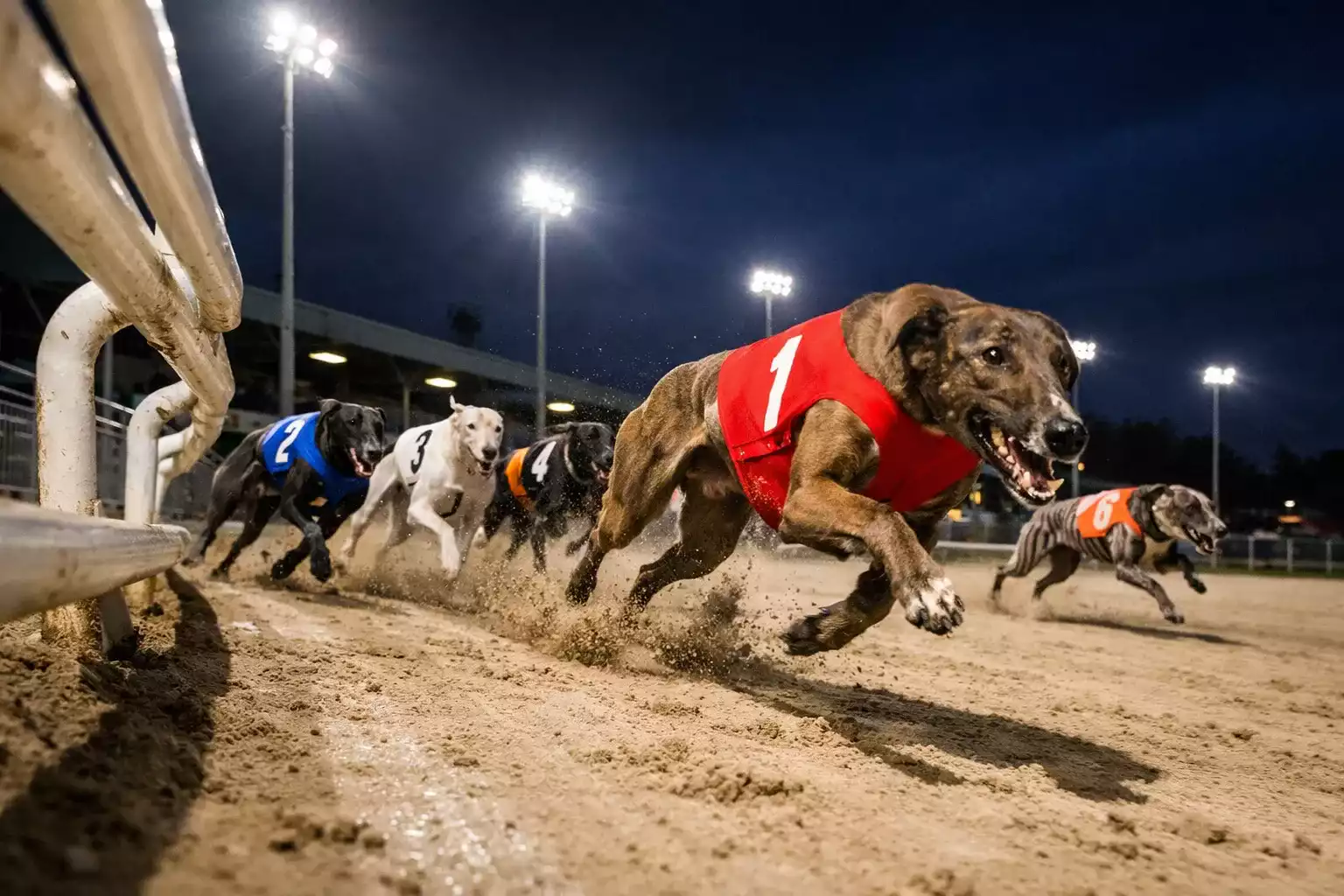
Everything you need to understand results, read form, and bet with method at West Yorkshire's longest-running greyhound track.
Why Kinsley Results Matter More Than You Think
Kinsley is one of those tracks where the numbers tell you everything — if you know how to read them. Tucked into West Yorkshire between Pontefract and Hemsworth, Kinsley Greyhound Stadium has been staging races since 1939 and has operated under GBGB regulation since 2000. It is not the flashiest circuit on the British calendar, but it is among the most consistent: four meetings a week under the ARC (Arena Racing Company) banner, a loyal northern following, and a racing programme that rewards punters willing to do the work rather than chase hunches.
Most websites that publish Kinsley greyhound results give you finishing positions, times and odds. That is useful in the way a menu is useful — it tells you what happened but not why, and certainly not what it means for tomorrow's card. This guide exists to fill the gap between raw results data and actual punting intelligence. You will find a detailed breakdown of the track itself, a method for reading form that goes beyond surface-level finishes, trap statistics that reveal where the edges sit, and a practical approach to the betting markets available at Kinsley.
If you have ever stared at a Kinsley racecard and wondered what the difference is between a dog's calculated time and its finishing time, or why a third-place finish in an A4 might be better form than a first in an A7, this is where those questions get answered. If you already know the basics and want to sharpen your angle, the form analysis section lays out a working method built on sectional times, grade context and the track-specific patterns that shape results at this particular venue.
Kinsley is not a track that flatters casual punters. The favourite strike rate in graded races here sits around 31.6 per cent — one of the lowest of any GBGB-licensed track in the country. That number alone should tell you something: this is a venue where preparation outperforms popularity. The dogs that start at the shortest prices do not win often enough to make blind favourite-backing viable. But that same volatility creates value for anyone who understands the form, reads the trap draw correctly, and knows when a result line is hiding genuine ability behind a poor finishing position.
Everything in this guide is built around Kinsley specifically. The distances, the surface, the hare system, the grading structure, the bias patterns — all of it relates to the 385-metre circuit in West Yorkshire, not to greyhound racing in the abstract. Generic advice gets you generic results. Track-specific knowledge gets you something better.
Kinsley Greyhound Stadium — a GBGB-regulated track located near Pontefract, West Yorkshire, operating since 1939 (GBGB-licensed since 2000). The circuit measures 385 metres in circumference and stages races over four distances: 268m, 462m, 650m and 844m. Meetings are held four times a week under the ARC racing banner, with all results officially recorded and published through GBGB channels.
The Track: Kinsley Greyhound Stadium in Detail
Three hundred eighty-five metres of sand, four bends, and a Swaffham McGee hare — that is the arena. Before you can interpret any Kinsley result with confidence, you need to understand the physical environment that produces it. Track geometry shapes racing outcomes in ways that are easy to underestimate: bend tightness affects inside runners differently than wide runners, surface composition changes pace dynamics from season to season, and the hare system determines how the field flows through the first bend. All of that is baked into every finishing time and form figure you will ever read from this venue.
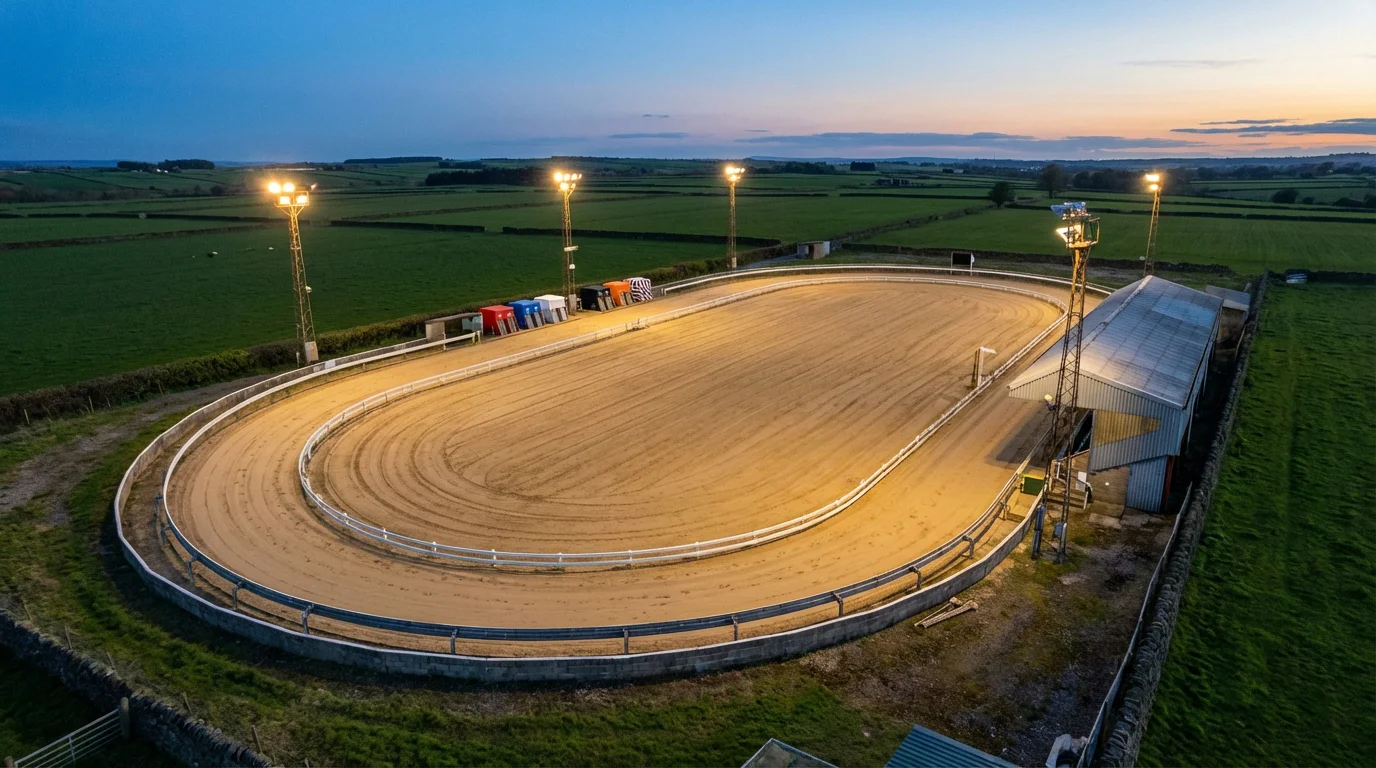
268m Sprint
2 bends. Typical winning time: 16.0–16.5 seconds. Pure early pace.
462m Standard
4 bends. Typical winning time: 28.5–29.5 seconds. The bread-and-butter trip.
650m Middle
6 bends. Typical winning time: 41.0–42.5 seconds. Stamina becomes a factor.
844m Marathon
8 bends. Typical winning time: 55.0–57.0 seconds. Endurance and bend technique.
Race Distances at Kinsley
Kinsley stages races over four distances, and each one produces a fundamentally different type of contest. The 268-metre sprint is a two-bend dash where trap speed dominates. Dogs break from the boxes and have roughly two hundred and seventy metres to establish position before there is nowhere left to recover. Early pace is not just an advantage at this trip — it is virtually the only advantage. The inside traps (one and two) carry a measurable edge because the first bend comes up quickly and the dog closest to the rail has the shortest route through it.
The 462-metre trip is the standard distance and the backbone of Kinsley's graded programme. Four bends, with the opening turn being the critical moment. A dog that gets to the first corner in front, or at least in a clear run, is significantly more likely to be in the finish. Most graded races — from A1 down to A10 — are run over 462m, which means the vast majority of form data you encounter at Kinsley relates to this distance. Typical winning times range from around 28.5 seconds in the higher grades to 29.5 seconds and above in the lower grades, though conditions and going can shift those windows noticeably.
The 650-metre distance adds two more bends and introduces stamina as a genuine variable. At six bends, a dog's ability to sustain pace through the second half of the race matters as much as its initial break. Dogs that lead off the first bend but fade by the fourth are common sights in 650m races, and punters who have only assessed a dog's sprint speed will get caught out. The 844-metre marathon is the longest trip and the rarest, typically reserved for staying events and special open races. Eight bends over nearly a kilometre demand endurance, bend technique and the kind of race temperament that shorter distances never test. These races can look chaotic, but they produce some of the most form-reliable results because the cream genuinely rises over that sort of trip.
Surface, Hare System and Running Rail
Kinsley runs on a sand-based surface that is standard for GBGB tracks. The surface condition — referred to as the going — varies with weather, maintenance and the number of races run on a given night. After heavy rain the track can ride slower, adding anywhere from a few tenths to a full second to finishing times. Going allowance adjustments exist to normalise times across different conditions, but they are imperfect. The practical implication for punters is that raw finishing times from different nights are not directly comparable without accounting for the going.
The hare at Kinsley is a Swaffham McGee outside running rail, which means the lure travels on the outside of the track. This is the most common hare type at British GBGB tracks, but the specifics of the running line at each venue differ. At Kinsley, the hare speed and running line shape how the field enters the first bend. A hare running slightly wide encourages the pack to drift outward, which can benefit inside runners who hold the rail. A hare running tight to the rail compresses the field and increases the likelihood of crowding at the first turn. These are not theoretical distinctions — they show up in trap statistics and in the running comments attached to individual results.
How to Read Kinsley Greyhound Results
A result is never just a finishing position — it is a compressed data file. Every line of a Kinsley result contains layers of information that separate the punter who merely checks who won from the punter who understands why and whether it is likely to happen again. Learning to decode a result line properly is the single most valuable skill you can develop for greyhound betting, and it costs nothing except attention.
Racecard Breakdown: Every Element Explained
A standard Kinsley racecard — whether you pull it up on the official Kinsley website, through Sporting Life or through a results aggregator — contains a fixed set of data elements for each runner. Understanding what each one means, and more importantly what it does not mean, is the foundation of any sensible approach to form.
The trap number (1 through 6) indicates the starting box. Trap 1 is the innermost position, closest to the running rail. Trap 6 is the widest. The trap draw is not random decoration — it directly affects a dog's path through the first bend and therefore its chances of a clear run. We will get to trap bias data later, but for now the key point is that the same dog in trap 1 and trap 6 is effectively running two different races.
The dog name and trainer are listed alongside basic identification data including colour, sex (d for dog, b for bitch) and date of birth. The trainer matters more than most casual punters realise. Kennel form streaks are real: certain trainers run hot for weeks and then cool off, and tracking which kennels are in form at Kinsley on any given month is a legitimate analytical edge.
The weight is recorded in kilograms and appears on the card alongside the dog's most recent weigh-in. Weight fluctuations of more than a kilogram from a dog's running average can indicate changes in condition — sometimes positive (a dog trained down to peak fitness), sometimes negative (loss of condition, illness, inconsistent feeding). The weight column is one of the most overlooked pieces of information on the card.
The race grade (A1 through A10, plus open and special categories) tells you the standard of competition. Higher grades (A1, A2) contain faster dogs; lower grades (A8, A9, A10) contain slower ones. The grade assigned to each race determines the quality of the field, and understanding grade context is essential for comparing results across different meetings.
The starting price (SP) reflects the final odds at the off, as returned by the on-course market or betting exchanges. It is a measure of public and bookmaker opinion — not of ability. An SP of 2/1 does not mean a dog has a 33 per cent chance of winning; it means the market priced it that way. The gap between what the market believes and what the form actually shows is where betting value lives.
Calculated time — the finishing time adjusted for going conditions on the night. Raw finishing times are influenced by track surface conditions (the going), which vary between meetings. Calculated times apply a standardised going allowance to enable fairer comparison of performances across different nights and conditions. When analysing Kinsley form, calculated times are more reliable than raw times for assessing a dog's true speed.
Form Figures Decoded
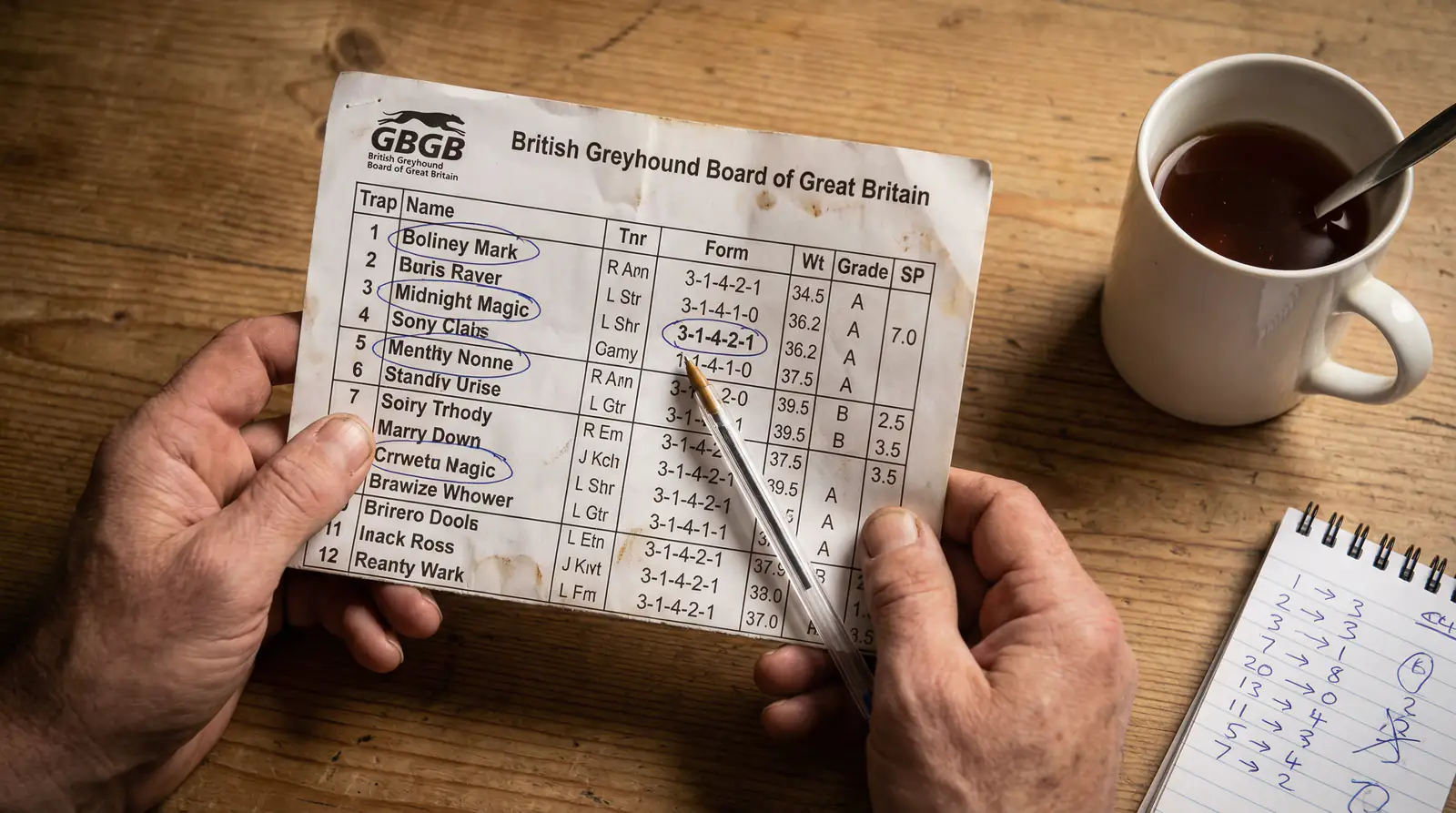
The form figures on a racecard are a sequence of numbers representing a dog's most recent finishing positions, read from left to right with the most recent run on the right. A form line of 3-1-2-4-1-2 tells you that the dog finished third six runs ago, won its next, finished second, then fourth, then won again, and most recently finished second. Simple enough on the surface — but the numbers hide as much as they reveal.
A finishing position only tells you where a dog crossed the line relative to the other five dogs in that specific race. It says nothing about the quality of those five opponents, the grade of the race, the margin of victory or defeat, or what happened during the running. A dog that finishes second by a short head in an A3, beaten by a very fast leader after encountering trouble at the third bend, has produced better form than a dog that wins an A8 by six lengths in a slow time against mediocre opposition. The form figures alone cannot distinguish between these two scenarios. That is why form analysis requires looking beyond the numbers.
Letter codes appear alongside or within form figures to add context. W indicates a wide runner (a dog that tends to race on the outside), M indicates a middle runner, and the absence of a letter generally implies a rails runner. Running style matters because it interacts with the trap draw: a rails runner from trap 1 has a structural advantage that the same dog from trap 6 does not. Other codes include SAw (slow away — a dog that was slow out of the traps), Crd (crowded), Bmp (bumped), and EPace (early pace, indicating the dog led or was prominent early). These abbreviations compress an entire race narrative into a few characters, and reading them properly is how you reconstruct what actually happened from a one-line result.
Now that you can read a Kinsley result, the question becomes what to do with it — starting with where the traps themselves tilt the odds.
Trap Statistics at Kinsley: What the Numbers Actually Say
Trap bias at Kinsley is subtle, but it is there — and ignoring it costs money over time. Every greyhound track has geometric quirks that favour certain starting positions at certain distances, and Kinsley is no exception. The difference is that the bias here is not dramatic enough to be obvious, which means most punters either miss it entirely or overestimate it based on anecdotal evidence. The reality, as it usually does, sits in the data.
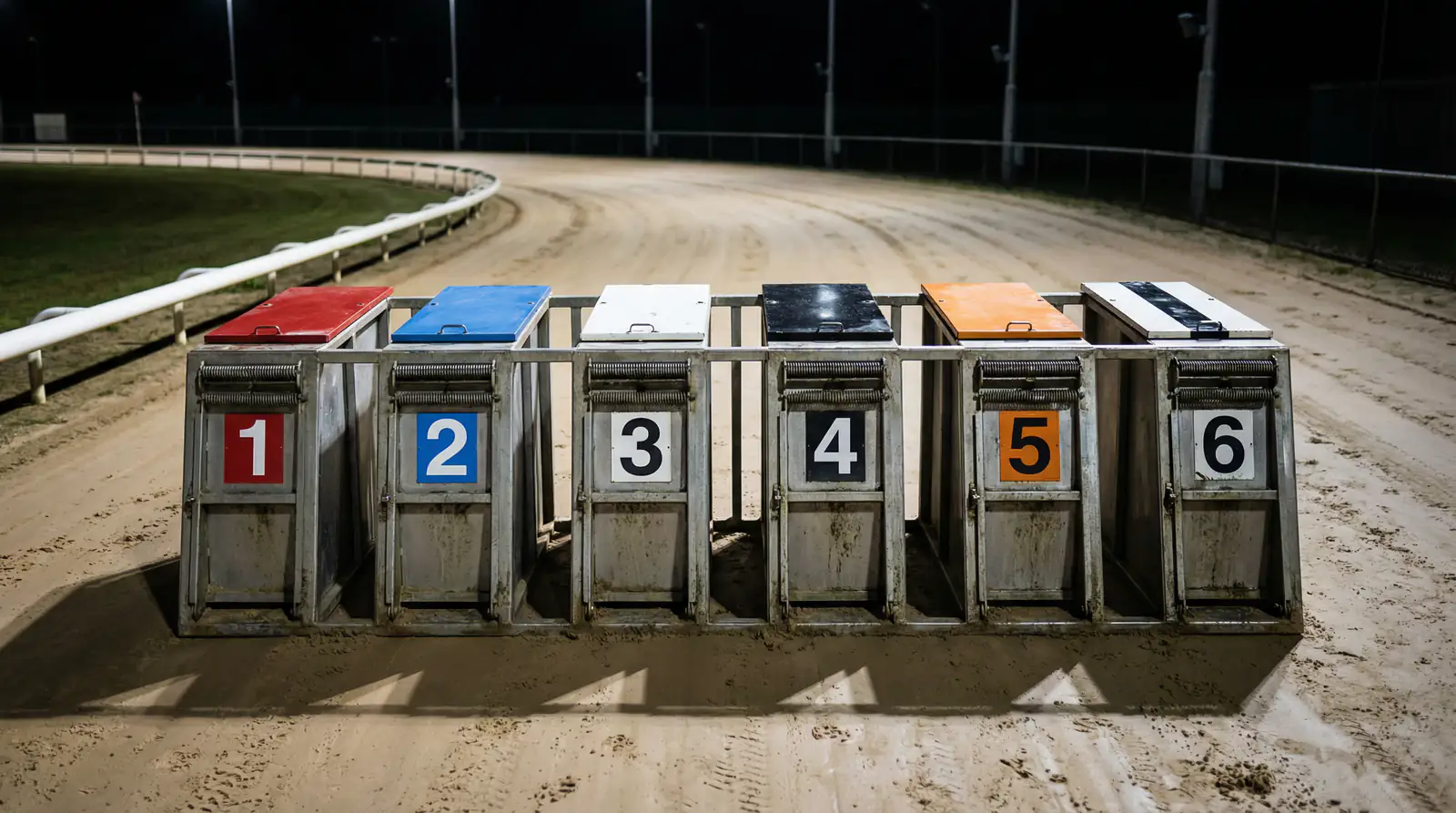
Across the standard 462-metre distance, trap 1 historically produces the highest win percentage at Kinsley, typically hovering between 19 and 22 per cent over rolling twelve-month samples. This is consistent with a track where the opening turn comes up relatively early after the boxes open. The dog closest to the rail has the shortest distance to travel through that first corner and is less likely to encounter crowding from dogs cutting in. Trap 2 tends to perform slightly above average as well, though not as strongly as trap 1. Traps 5 and 6, the widest positions, generally show lower win rates over the standard trip, typically in the 13 to 16 per cent range. They need more early pace to compensate for the wider route and are more vulnerable to being squeezed out on the initial turn.
At the 268-metre sprint, the trap bias becomes more pronounced. Over just two bends with a short run to the first turn, inside traps enjoy a measurable advantage. Trap 1 and trap 2 at 268m produce win rates that can exceed 25 per cent in some samples, because there is simply not enough race distance for a wide-drawn dog to recover from a poor initial turn. If you are backing a dog drawn in trap 5 or 6 over the sprint course, you need strong evidence that it has the early pace to lead or at minimum hold a clear position through the opening corner. Without that evidence, the draw alone makes it a poor proposition.
The longer distances — 650m and 844m — show a more balanced trap distribution. More bends mean more opportunities for position changes, and stamina becomes a levelling factor that dilutes the first-bend advantage. At 844m, trap statistics across GBGB tracks tend to flatten out considerably, and Kinsley follows that pattern.
Across the 2024-25 and 2025-26 GBGB seasons, Kinsley's market leaders converted at roughly 31.6 per cent in graded races — several percentage points below some of the larger southern circuits. Over a punter's typical twelve-month betting cycle, that gap compounds into a meaningful difference in expected returns from any favourite-backing approach.
What does that conversion rate mean practically? It means the market mislabels the likeliest winner more often at Kinsley than at most UK tracks. Part of that is the tight bends compressing the field and increasing the randomness of early crowding. Part of it is the grading structure, where grade drops and rises create races with deceptively uneven quality among the runners. And part of it is simply that Kinsley's regular punters know the track, which means the on-course market is shaped by local knowledge that does not always align with what the form figures suggest to outsiders.
The practical takeaway: do not dismiss trap draws as irrelevant at Kinsley, especially over shorter distances. Factor them into your analysis the same way you factor in form and going. A dog with solid recent form drawn in trap 6 over 268m is a worse bet than a slightly less proven dog drawn in trap 1 — not because trap position is destiny, but because over hundreds of races the percentages favour the inside.
Form Analysis for Kinsley Races: A Working Method
The difference between losing punters and profitable ones usually comes down to method. Not to secret information, not to insider tips, and certainly not to gut feeling — but to a systematic approach that extracts more signal from the same data everyone else can see. At Kinsley, where the favourite fails roughly a third of the time and race outcomes can hinge on a crowded opening turn, having a reliable form analysis framework is not optional. The 2026 graded programme continues the pattern of recent seasons: competitive fields, tight finishes, and a track that punishes guesswork. A structured method is the difference between gambling and investing with a calculated edge.
Sectional Form Rating
Kinsley · 385m circuit · split > finish
The split time is the honest number. Enter a run and see whether the finishing position earned it — or hid it.
The method outlined here is not complicated, but it requires discipline. It is built on three pillars: time analysis (with an emphasis on sectional times over finishing times), positional reading (where a dog was at each bend, not just where it finished), and grade context (understanding the quality of opposition against which a time was recorded). None of these pillars is sufficient on its own. Together, they give you a picture that form figures alone never will.

Why Sectional Times Matter More Than Finishing Times
If you take one thing from this entire guide, make it this: at Kinsley, a dog's split time tells you more about its true ability than its finishing position ever will. The sectional time — sometimes called the split time or trap-to-line time on the first pass — measures how quickly a dog reaches the first timing point after leaving the traps. It captures raw early pace, which at a track where the first bend is decisive is the single most predictive metric available.
A dog that runs a fast sectional but finishes fourth has almost certainly encountered trouble in running — crowding at a bend, interference from another runner, or a check that cost two or three lengths. That dog's underlying ability is better than its finishing position suggests, and if the trouble was circumstantial rather than habitual, there is value in backing it next time out. Conversely, a dog that finishes first but with a slow sectional probably inherited the lead because the early pace dogs knocked each other out. It won the race but did not demonstrate the kind of raw speed that will hold up against stronger opposition or a less chaotic first bend.
Comparing sectional times across different meetings requires some care. Going conditions affect all times, including sectionals, so you need to use calculated or adjusted sectional times where available. If you are working from raw data, compare sectional times from the same meeting night rather than across different dates. The dogs racing on the same card experienced the same track conditions, making those comparisons more reliable.
For Kinsley's standard 462m trip, a sectional time under 5.00 seconds (to the first timing point) is quick. Under 4.90 is notably fast. Above 5.20 is slow and indicates either a dog that was slow away or one that lacks natural early pace. These benchmarks shift with conditions, but they give you a workable frame of reference.
Grade Drops, Grade Rises and What They Signal
The grading system at Kinsley, as at all GBGB tracks, assigns dogs to race classes based primarily on their recent times over the standard distance. A dog running faster times gets promoted to a higher grade; a dog running slower gets relegated to a lower one. The grades run from A1 (the fastest graded class) down to A10 and occasionally beyond. Open races sit outside the graded structure and attract the best dogs regardless of grade allocation.
A grade drop — when a dog moves from, say, A4 down to A5 — is one of the most significant signals in greyhound form. It does not necessarily mean the dog has deteriorated. It often means the dog has been running against opposition too strong for its grade time, or has had a series of unlucky runs where trouble in running produced slow finishing times that triggered the demotion. A dog dropping a grade while maintaining fast sectional times is a prime value candidate. It is running against weaker opponents than last time but has shown it possesses speed that belongs in the higher grade.
Grade rises work in reverse but are less immediately valuable for punters. A dog promoted from A6 to A5 after winning convincingly will face faster opponents, and the market usually adjusts its odds upward to reflect the tougher challenge. The value here is more nuanced: sometimes a dog rises on the back of a time that barely qualifies it for the higher grade, which means it is likely to struggle. Other times, a dog rises after dominating a lower grade with times that would be competitive in the higher one. Context matters.
A specific scenario to watch for at Kinsley is bitches returning from a season. Female greyhounds go through a seasonal cycle that takes them out of competition for several weeks. When they return, they are often graded lower than their genuine ability warrants because their recent form is either absent or consists of early-return runs where fitness was still building. The sixteen-week window after a bitch returns to racing frequently produces performances that outstrip what the grade suggests, particularly if the bitch was competitive at a higher grade before the break.
At Kinsley, a dog's split time tells you more about its true ability than its finishing position ever will. Build your form analysis around sectional times, grade context and positional running — the combination gives you an edge that surface-level form reading cannot match.
Betting Markets on Kinsley Greyhound Races
Six dogs, a hare, and more ways to bet than most newcomers realise. Greyhound racing at Kinsley offers a range of betting markets through both on-course tote facilities and licensed online bookmakers. The small field sizes — six runners maximum in UK greyhound racing — create a different mathematical environment from horse racing or football, and the betting markets reflect that. Understanding what each market offers and when it makes sense to use it is as much a part of profitable punting as reading form.
The simplest bet is the win single: pick the dog you think will finish first. At Kinsley odds on a six-dog field typically range from around evens for a short-priced favourite to 10/1 or longer for an outsider. Given how often the market leader loses here, the win market is where selectivity matters most. Backing every favourite across an evening card is a reliable way to lose money at this track. Backing carefully chosen selections based on form analysis — two or three bets per meeting at most — is where the arithmetic starts to work in your favour.
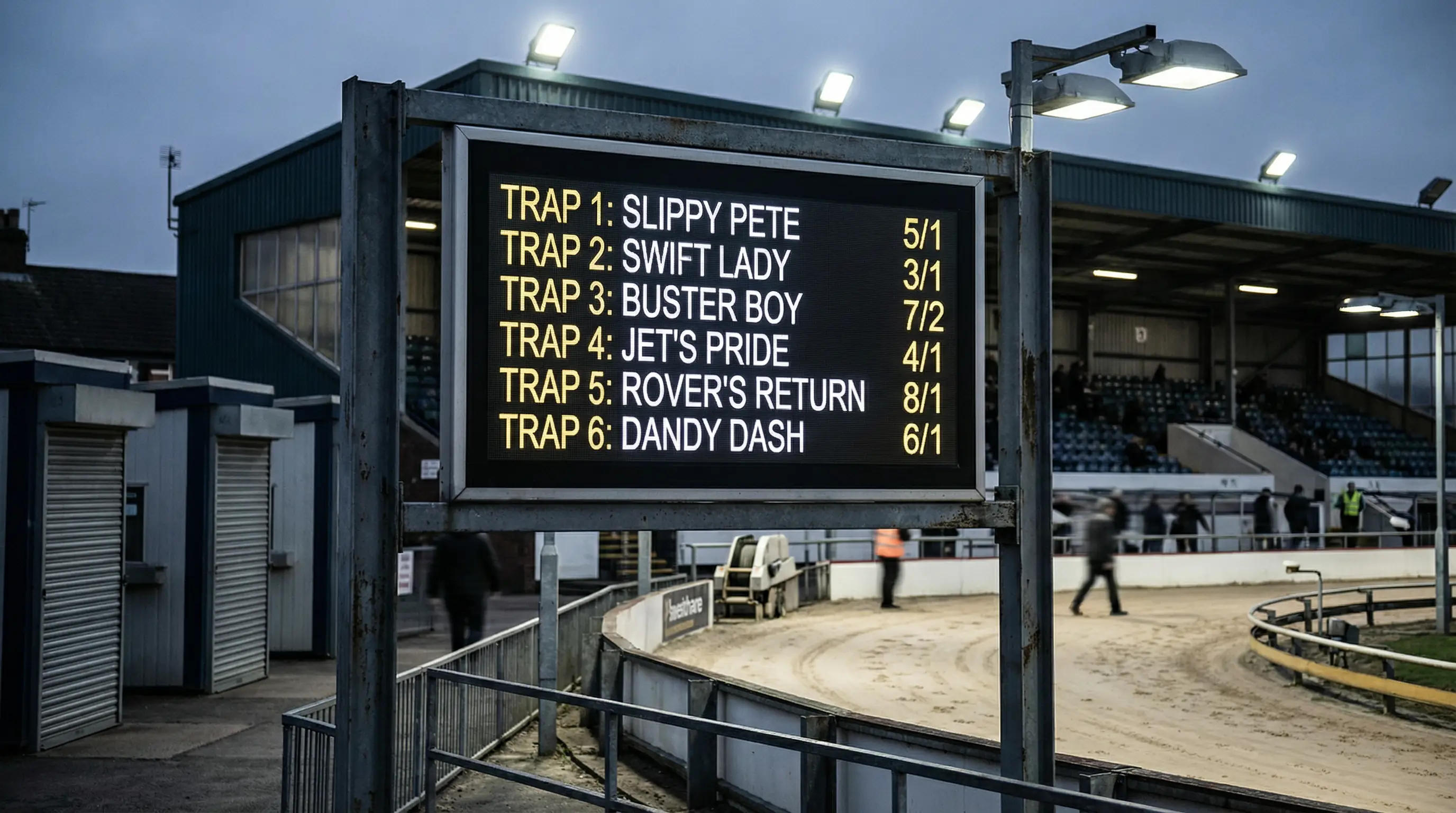
Each Way Betting on Greyhounds
Each way betting in greyhound racing works differently from horse racing because the field sizes are always six or fewer. The standard each way terms for a six-runner greyhound race are one-quarter the odds for a place, with places paying on first and second. That means your each way bet consists of two equal stakes: one on the dog to win and one on it to place (finish first or second). If your selection wins, both parts pay. If it finishes second, only the place part pays — at one-quarter the win odds.
Each way makes most sense at Kinsley when you have identified a dog with strong form that the market has priced at 4/1 or longer. At shorter prices the place return on a second-place finish rarely covers both stakes, making the bet mathematically poor unless you are confident of a win. At 5/1 or 6/1, the place return on a second-place finish starts to cover the total outlay or even produce a small profit, which means you get paid for being nearly right rather than only exactly right.
Kinsley 462m Graded Race — Race 7
Trap 3: Ballymac Storm — 5/1
A ten-pound each way bet at 5/1 costs twenty pounds total (ten pounds win, ten pounds place). If the dog wins, the return is ten pounds at 5/1 (sixty pounds) plus ten pounds at 5/4 (twenty-two pounds fifty) — total return eighty-two pounds fifty, profit sixty-two pounds fifty. If the dog finishes second, only the place part pays: ten pounds at 5/4 returns twenty-two pounds fifty, a net loss of minus seven pounds fifty on the total twenty-pound stake but still a recovery of over half the outlay.
Forecast and Tricast Bets
Forecast and tricast bets are where Kinsley's volatility becomes an asset rather than a hazard. A straight forecast requires you to predict the first and second dog in the correct order. A reverse forecast covers both possible orders (your two selections finishing first-second or second-first) and costs twice the unit stake. A combination forecast covers three or more dogs in any first-second combination.
A tricast requires predicting the first three finishers in exact order. A combination tricast covers multiple permutations. Tricast dividends at Kinsley can be substantial — three-figure returns from small stakes are not unusual when an outsider places — precisely because the favourite fails so often that unexpected combinations occur regularly.
The mathematics of forecasts favour punters who can identify two or three dogs with genuine claims while the rest of the field is overpriced or underqualified. A common approach at Kinsley is to identify the likely first-bend leader from the trap draw and sectional times, then pair it in forecasts with the dog most likely to benefit from following the leader through a clear run. This is not foolproof, but it is a structured way to approach a market that many punters treat as a lucky dip.
Tricast betting is inherently higher variance. The returns can be spectacular, but the strike rate is low even with strong form analysis. It makes sense as a small-stake supplement to your main betting, not as the core strategy. Treat tricasts as high-value, low-frequency bets — the dessert menu, not the main course.
The Pre-Race Checklist: Before You Bet at Kinsley
Before you stake a penny on any Kinsley race, run through this. The most common mistake among regular greyhound punters is not poor selection — it is incomplete preparation. A dog can look like the standout on form, but if you have missed a late non-runner that changes the trap dynamics, overlooked a weight shift that suggests the dog is off peak condition, or failed to check the going after an afternoon of Yorkshire rain, your form analysis is built on incomplete information. This checklist is designed to catch the things that form figures alone do not tell you.
Five checks before every Kinsley bet
- Check for non-runners and reserve replacements. A withdrawn dog changes the trap draw dynamics for every other runner. If the non-runner was the likely first-bend leader, the entire race complexion shifts. Check the final declarations as close to race time as possible — non-runners can be confirmed late.
- Match the trap draw to the dog's running style. A rails runner drawn in trap 1 has a structural advantage. The same dog drawn in trap 5 faces a longer route to the rail and a higher probability of interference. If the trap draw does not suit the dog's natural style, downgrade the selection regardless of form.
- Compare split times, not just finishing times. Pull up the dog's last three or four sectional figures at Kinsley (or calculated equivalents if it has raced at other tracks). Are the splits consistent? Have they improved or declined? A dog showing progressively slower early-pace numbers is losing trap speed — and at a track where the opening turn decides most races, that trend matters.
- Confirm the grade matches your expectations. Check whether any runners in the race have recently been regraded. A dog dropping from A4 to A5 might represent value if its sectionals suggest it was unlucky rather than genuinely slower. A dog rising from A6 to A5 might be overmatched. Grade changes within the last two meetings are the most relevant.
- Set your stake before looking at the odds. Decide what percentage of your session bankroll you are prepared to risk on this race before you see the prices. If you set the stake first, you bet with your analysis. If you set it after seeing the odds, you bet with your emotions — and the odds at Kinsley, where long-priced winners are common, have a way of tempting punters into larger stakes than their analysis warrants.
None of these steps takes more than a couple of minutes per race, and all of them can be completed from the racecard and publicly available data. The punters who consistently apply this checklist do not always win — nobody does at a venue where roughly seven out of ten favourites lose — but they eliminate the category of loss that comes from avoidable oversights. That alone shifts the long-term mathematics in your direction.
Major Events and Racing Calendar at Kinsley
Every track has its flagship nights — Kinsley's carry real weight in the northern circuit. While the bread-and-butter programme consists of regular graded meetings four times a week, the calendar also features named open races and special events that draw stronger fields and attract attention beyond the track's usual audience. For punters, these events matter because they produce form data against higher-quality opposition, which recalibrates what you know about the dogs that compete in them.
The Television Trophy is Kinsley's premier event, an open race run over the standard 462m trip that attracts entries from kennels across the north. The competition has been staged at Kinsley since 2010, with past winners including dogs that went on to compete at Category One level. The Television Trophy typically takes place during the late summer racing programme and is run as a series of heats leading to a final, which means there are multiple rounds of form data to assess before the decisive race. For punters, the heats are often more valuable than the final itself — they reveal how dogs handle the pressure of open competition and how their sectional times hold up against faster opponents than they typically face in graded company.
The Gymcrack is one of the most prestigious puppy competitions in British greyhound racing, historically run over the standard 462m trip at Kinsley. The event was inaugurated at Hall Green before switching to Kinsley in 2011, and was staged at the West Yorkshire track until 2023. In 2024, the Gymcrack moved to Owlerton Stadium in Sheffield and is now run over 500m. Notable past winners at Kinsley include Brinkleys Poet, who set a new track record in the 2018 final, clocking 26.95 seconds over 462m.
Kinsley operates under the ARC (Arena Racing Company) umbrella, which governs a network of greyhound tracks across Britain. The ARC schedule at Kinsley for 2026 runs meetings four times a week, with first races typically going off in the early evening. ARC meetings are significant for punters because they are broadcast through SIS (Sports Information Services) to licensed betting shops and online platforms, meaning the racing is available for live viewing and betting to a national audience. The 2026 fixture list maintains this four-meeting-per-week structure, giving punters consistent access to fresh form data and regular betting opportunities.
ARC meeting structure and what it means for form. Not all meeting days are equal. Daytime midweek cards at Kinsley tend to feature slightly weaker graded fields, while evening and weekend cards — with higher public attendance and greater betting turnover — often attract stronger entries and more competitive races. The practical implication: form produced at the busier sessions is generally tested against better opposition than form from quieter midweek meetings. Factor this into your cross-meeting form comparisons.
Beyond the named events, Kinsley regularly stages trial races and graded stakes that provide useful data points for tracking dog development. Trials — where dogs compete without prize money, often as preparation for a return to the graded programme — are easy to overlook but can reveal condition and fitness levels before a dog faces competitive scrutiny. Watching trial results for dogs returning from injury or a break can give you an early signal about whether a dog is ready to compete at its previous level.
If the above sparked questions, you are not alone — these three come up more than any others.
Frequently Asked Questions About Kinsley Dog Results
What distances are raced at Kinsley and how do they affect betting?
Kinsley stages races over four distances: 268 metres (sprint, two bends), 462 metres (standard, four bends), 650 metres (middle distance, six bends) and 844 metres (marathon, eight bends). Each distance produces fundamentally different race dynamics that directly influence betting outcomes. The 268m sprint is dominated by early pace and trap position — inside traps carry a significant advantage because the first bend arrives almost immediately after the boxes open, leaving little room for wide-drawn dogs to recover. The 462m standard trip is where the majority of graded racing takes place and where the most form data is available. Four bends mean the first-turn position is still critical, but there is enough race distance for a dog that encounters early trouble to recover if it has the pace. The 650m and 844m distances introduce stamina as a key variable, which means that pure sprint speed becomes less decisive and a dog's ability to sustain effort through multiple bends matters more. For betting purposes, the distance determines which form metrics to prioritise: sectional times are paramount at 268m and 462m, while at the longer trips you should weigh late-race running positions and the dog's ability to maintain speed over the final two bends.
How often does the favourite win at Kinsley compared to other UK tracks?
The favourite at Kinsley wins approximately 31.6 per cent of graded races, which places it among the lowest favourite strike rates of any GBGB-licensed track in Britain. The national average for GBGB tracks sits closer to 33 per cent, and some tracks with wider, more galloping circuits return favourite win rates above 35 per cent. Several factors contribute to Kinsley's lower figure. The 385-metre circumference produces relatively tight bends that increase the probability of crowding and interference at the first turn, particularly in larger-field races where all six traps are occupied. This crowding introduces an element of randomness that disproportionately affects favourites, since the market-leader is often the dog with the fastest recent form but not necessarily the dog best positioned in the draw to get a clear first bend. The grading system also plays a role: at Kinsley, grade changes can produce races where a recently dropped dog has significantly better underlying ability than its grade suggests, and these dogs can upset the favourite at long odds. The practical implication for punters is clear — a blanket strategy of backing the favourite at Kinsley is a losing proposition. Selective betting based on form analysis, trap draw assessment and grade context will outperform favourite-following at this venue every time.
What do the numbers and abbreviations on a Kinsley racecard actually mean?
A Kinsley racecard contains several layers of information for each runner. The trap number (1 to 6) indicates the starting box position, with trap 1 on the inside rail and trap 6 widest. The form figures are a sequence of recent finishing positions read left to right, with the most recent run on the right — so 3-1-4-2-1 means the dog finished third five runs ago, won, finished fourth, then second, then won most recently. Alongside form figures you will find abbreviations describing what happened during each race: SAw means slow away from the traps, EPace means the dog showed early pace and was prominent early, Crd means the dog was crowded during the race, Bmp means it was bumped by another runner, Led indicates it led the race at some point, and RnUp means it ran up to the leader without passing. Running style letters appear next to the dog's name: W indicates a wide runner, M a middle runner, and no letter typically implies a rails runner. The weight is shown in kilograms and reflects the dog's most recent weigh-in. The grade (such as A4 or A7) tells you the class of the race. The starting price (SP) shows the final odds at the off. Finally, the calculated time adjusts the raw finishing time for the going conditions on that particular night, making it more reliable for cross-meeting form comparisons than the unadjusted finishing time.
The Last Bend
Every race finishes, but the form book never closes. Kinsley keeps running — four meetings a week, twelve months a year, a steady stream of data that rewards the patient and punishes the impulsive. If there is a single thread connecting everything in this guide, it is that Kinsley results are not random numbers to be glanced at and forgotten. They are encoded narratives. Each finishing position, each sectional time, each running comment tells a fragment of a story that becomes actionable intelligence when you learn to read the whole thing.
This is a working-class track in a working-class part of Yorkshire, and it has survived for more than eighty years because it produces honest racing. The dogs are real athletes with measurable abilities and identifiable patterns. The trainers who kennel them have tendencies you can track. The grades that frame each race have a logic that, once understood, reveals where the genuine quality sits and where the market has mislabelled it. None of that is mystical. It is pattern recognition applied to a specific data set — and the data set at Kinsley is deep enough to sustain a genuinely analytical approach.
The punters who come out ahead over a season here are not the ones with insider knowledge or magical systems. They are the ones who treat every result as a piece of evidence rather than a verdict. A dog that finished fifth last time is not a bad dog — it might be a good dog that got crowded at the first bend from a poor draw. A dog that won by six lengths might be less impressive than it looks if the grade was weak and the sectional was slow. The discipline is in resisting the obvious interpretation and doing the work to find the accurate one.
Kinsley's low favourite strike rate is not a flaw in the track. It is a feature. It means the market is wrong more often than at most venues, and that wrongness is where value lives. But value only materialises for the punter who has done the preparation — the checklist, the form analysis, the trap draw assessment, the grade context check. Consistency in method beats intuition every time at a track where the favourite loses more often than anywhere else in Britain.
The next meeting at Kinsley is already on the schedule. The racecards will be published, the form will be there to read, and the traps will open at the appointed time. What you do with the information between now and then is the only variable you control. Make it count.
