
Non-Runners and Reserve Dogs: Rules You Need to Know
 Available in US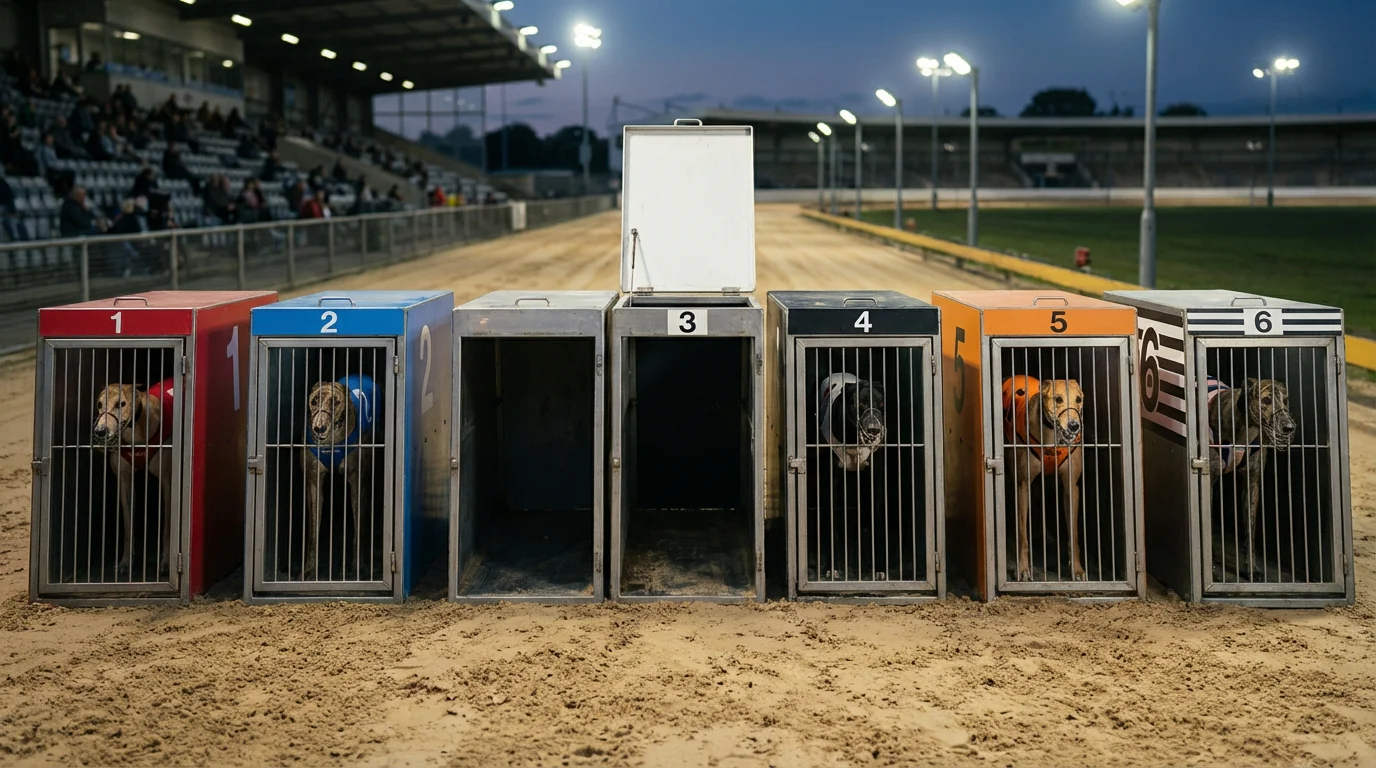
When the Card Changes
You study the racecard, assess the form, and place your bet. Then, an hour before the first race, one of the dogs in your selection is withdrawn. The trap you backed is now either empty or occupied by a reserve runner you have not analysed. Your carefully constructed assessment is compromised. This is not a rare scenario — non-runners occur at virtually every greyhound meeting, and how you respond to them has a direct impact on your betting results.
Non-runner rules in greyhound racing are straightforward in principle but often misunderstood in practice. The consequences for your bet depend on the bookmaker, the timing of the withdrawal, and whether a reserve dog replaces the original runner. Understanding the mechanics removes the uncertainty and lets you make informed decisions when the card changes — which it will, regularly.
Understand non-runners and reserves at Kinsley on the kinsleydogresults homepage.
Non-Runner Rules in GBGB Racing
A non-runner in greyhound racing is a dog that was declared to run but is withdrawn before the race takes place. The withdrawal can happen for several reasons: injury discovered during the pre-race veterinary inspection, illness reported by the trainer before the meeting, a bitch found to be in season, or a decision by the racing manager that the dog is unfit to compete. Occasionally, logistical issues — a dog failing to arrive at the track in time — also cause withdrawals.
Under GBGB rules, the racing manager at the track has the authority to withdraw a dog at any point before the race. The decision is final. When a withdrawal occurs, the racing manager will first attempt to fill the vacancy with a reserve dog. Every graded meeting has a reserve list — dogs that are available to step into vacant traps if needed. The reserve dog, if one is available and suitable, takes the trap number of the withdrawn dog and runs from that starting position.
The timing of the withdrawal matters for both the race and the betting market. Early withdrawals — those announced before the racecard goes to print or well before the meeting starts — give punters time to reassess. Late withdrawals, sometimes announced only minutes before a race, leave less time for adjustment. The market may or may not have time to reprice the remaining runners, which creates both risk and opportunity.
From a regulatory perspective, the withdrawn dog is scratched from the race and its result is recorded as a non-runner. It does not count as a loss in the dog’s form record, though the reason for withdrawal may be noted. If the dog was withdrawn due to injury or illness, the trainer must follow GBGB protocols for returning the dog to racing, which may include a veterinary clearance or a satisfactory trial.
For the punter, the first question when a non-runner is announced is simple: does this change my view of the race? If the withdrawn dog was the one you backed, the question answers itself. If it was a rival, the withdrawal may improve your selection’s chances. If it was a dog you had dismissed, the race dynamics may be unchanged. The key is to reassess rather than assume the original analysis still holds.
Reserve Substitution: What Happens Next
When a reserve dog enters the race, it inherits the trap number of the withdrawn dog. This is a critical detail. The reserve does not get to choose its starting position — it runs from whatever trap was vacated. A reserve dog that is a confirmed wide runner may find itself drawn in trap one. An inside runner may end up in trap six. The trap assignment is mechanical, not tactical, and the mismatch between the reserve’s natural running style and the allocated trap can significantly affect both the reserve’s performance and the race dynamics.
Reserve dogs are selected from a pool of available greyhounds that are ready to race on the night. They are typically dogs that were not included in the original racecard — perhaps because they were not entered for that meeting, or because the card was full. Their form may be current or slightly stale, and they may or may not be suited to the grade of the race they are entering. The racing manager will try to match the reserve to the grade, but the selection is constrained by availability.
The practical implication is that a reserve runner is, almost by definition, a less predictable participant than the dog it replaces. You have not assessed it in the context of this specific race. You may not have studied its form at all. It is running from a trap that was not assigned based on its running style. And it may be stepping into a grade that is slightly above or below its recent level. All of these factors increase the uncertainty of the race.
Some punters treat reserve dogs as automatic avoids — dogs to be dismissed because they were not the original intended runner. This is too crude. A reserve with strong recent form, drawn in a suitable trap, entering a grade it has competed in before, is a genuine contender. The fact that it was not on the original card does not diminish its ability. The question is whether you can assess it quickly enough and accurately enough to make a sound judgement. If you cannot, the honest response is to pass the race rather than bet on incomplete information.
Betting Implications of Non-Runners
The betting rules around non-runners vary between bookmakers and between bet types. Understanding these rules before you bet is essential, because the financial consequences of a withdrawal can be significant.
For win and each way bets, the standard bookmaker rule is that if a dog is withdrawn before the race and your bet was on the withdrawn dog, your stake is refunded. This applies whether the withdrawal is early or late, and whether or not a reserve replaces the dog. The refund is to the original stake, not to any potential winnings. If you backed the withdrawn dog in a multiple bet, the leg is voided and the rest of the bet stands at reduced odds.
If a reserve dog replaces the withdrawn dog and you had backed the original dog, your bet is void — it does not transfer to the reserve. You receive your stake back but have no interest in the race unless you place a new bet on the reserve or another runner. Some bookmakers offer the option to redirect the voided stake to another selection, but this is not automatic and varies by operator.
For forecast and tricast bets, the implications are more complicated. If one of your named dogs in a forecast is withdrawn, most bookmakers will void the bet and refund the stake. If a reserve replaces your named dog, the bet is still void because the dog you selected is no longer running. Combination forecasts and tricasts involving a withdrawn dog follow the same rule — any permutation that included the withdrawn runner is voided, and the remaining permutations stand.
The critical scenario is a late withdrawal that occurs after the market has moved. If you took an early price on a dog and a key rival is subsequently withdrawn, your selection’s chances have improved but your price remains the same. In this situation, the non-runner benefits you — you are holding a bet at a price that no longer reflects the reduced competition. Conversely, if the non-runner was a weak dog and the reserve is stronger, the field has toughened and your original price may now overstate your selection’s chances. The early-price punter must accept both sides of this equation.
Empty Trap Scenarios
When no reserve is available to replace a withdrawn dog, the race runs with an empty trap. At Kinsley, where the standard field is six runners, this means the race goes off with five dogs and one vacant starting box. The empty trap changes the race dynamics in ways that are easy to overlook.
The most obvious effect is on the first bend. With five dogs instead of six, there is more space entering the first turn. The crowding that causes checks and bumps in a full field is reduced. Dogs drawn adjacent to the empty trap benefit most — they have an open lane on one side and can take a slightly wider or slightly tighter line through the first bend without encountering another dog. This positional advantage is real and quantifiable. Dogs drawn next to the vacancy win at a higher rate than their form alone would suggest.
The trap draw effect of an empty trap depends on which trap is vacant. An empty inside trap (one or two) creates space on the rail, which benefits the dog drawn in the next-lowest trap number. An empty outside trap (five or six) gives the widest remaining runner more room to manoeuvre without being squeezed against the outside. An empty middle trap (three or four) opens a channel that dogs on either side can exploit, depending on their running style.
See how non-runners affect your bets in betting odds explained.
From a betting perspective, an empty trap is free information that the market sometimes fails to fully incorporate. The racecard may show the vacancy, but the odds on the remaining runners do not always adjust proportionally. The dogs adjacent to the empty trap receive a structural advantage that goes beyond the simple removal of one competitor. If you identify this advantage and the market has not priced it in, you have an edge. It is a small edge, and it will not win every race, but it is the kind of marginal gain that, accumulated over hundreds of bets, contributes to a positive long-term record.
