
Greyhound Weight and Its Impact on Performance
 Available in US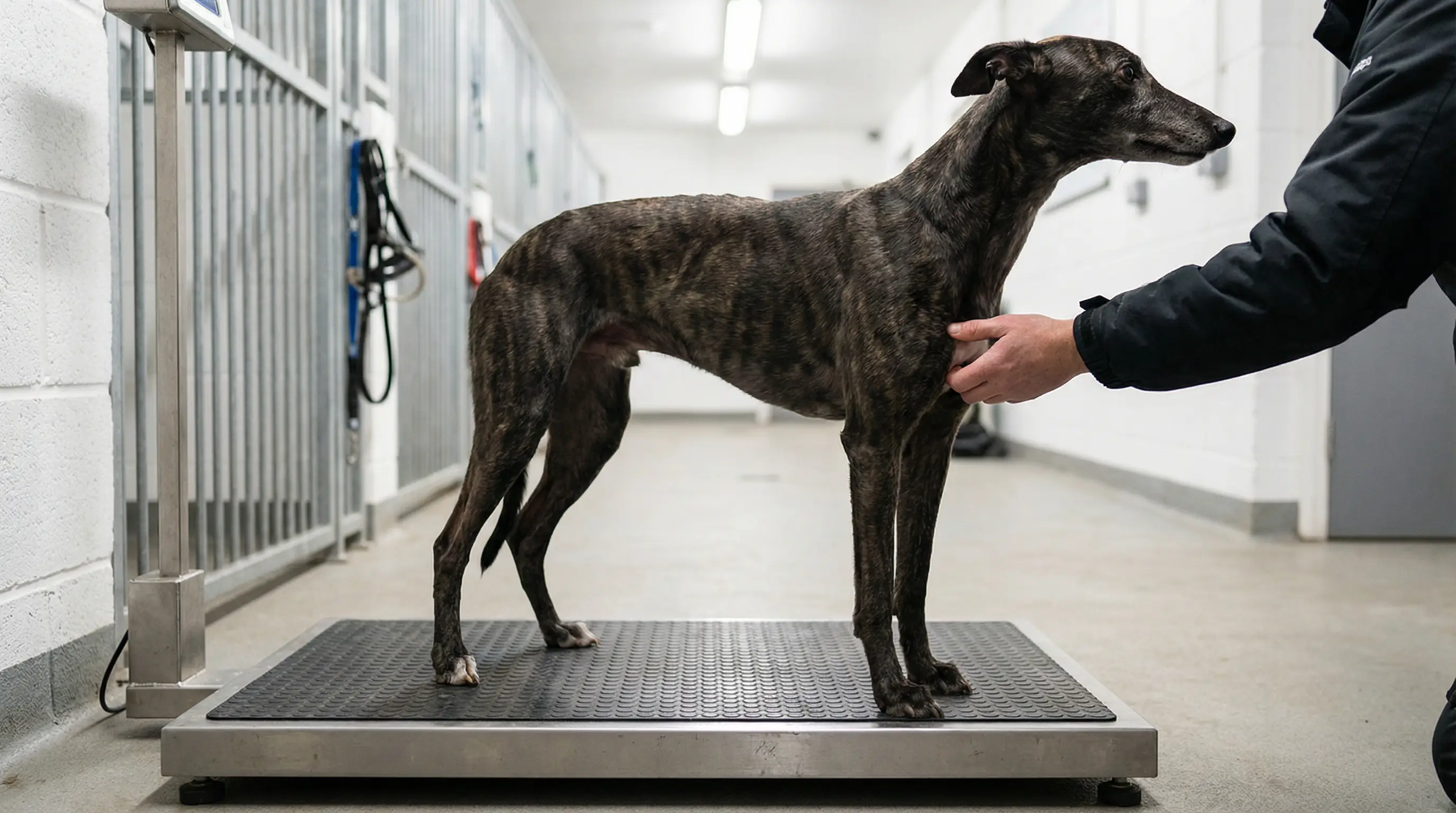
Every Pound Tells a Story
A greyhound’s weight is printed on every racecard, recorded at every meeting, and largely ignored by most punters. It sits there in kilograms alongside the dog’s name, trap number, and form figures — a small number that attracts far less attention than the finishing times or the grade. This is a missed opportunity. Weight does not win or lose races on its own, but shifts in a dog’s weight across successive runs can tell you something about its condition that no other single figure reveals.
The weight recorded on the racecard is taken at the track on race night, under standardised conditions. It is the dog’s live racing weight, not an estimate or a historical figure. It changes, sometimes by a fraction of a kilogram, sometimes by more. Those changes are signals. Reading them correctly requires understanding what the set-weight system is, what normal fluctuation looks like, and what constitutes a meaningful deviation. The dog’s weight will not replace form analysis. It will sharpen it.
Learn how weight affects Kinsley racing on the kinsleydogresults homepage.
The Set Weight System
Under GBGB regulations, every greyhound has a set weight — the weight at which it is deemed to race most effectively. This figure is established during the dog’s early career, usually across its first few races, and is recorded on its official racing record. The set weight is not a fixed ceiling or floor; it is a reference point. The racing manager at the track uses it to assess whether a dog’s current weight is within acceptable parameters for competition.
The set weight system exists primarily as a welfare measure. Under GBGB Rule 52, a greyhound whose weight at kennelling varies by more than one kilogram from its weight at its previous race or trial must be withdrawn and complete at least one satisfactory trial before racing again. In practice, most dogs that present within the permitted range are allowed to run, regardless of whether they are at the top, bottom, or middle of that range. The weight monitoring system acts as a safety net, not as a performance optimiser.
For the punter, the set weight provides context for the race-night figure. A dog with a set weight of 30.0 kilograms that races at 30.8 is at the top of its permitted range. A dog that races at 29.2 is at the bottom. Both are within the rules, but the implications for performance may differ. A dog at the upper end of its range may be carrying extra condition — possibly well-fed and strong, possibly slightly heavy and lacking sharpness. A dog at the lower end may be lean and fit, or it may be light because it has not been eating well, which can indicate underlying health issues or stress.
The set weight itself is periodically reviewed. If a dog’s racing weight consistently sits above or below the original set figure, the trainer can apply to have the set weight adjusted. This is a routine administrative process and does not necessarily indicate anything unusual. Young dogs, in particular, often see their set weight revised upward as they mature and fill out physically. Older dogs may see it revised downward as they naturally lose muscle mass. The revision is an acknowledgement that the dog’s body has changed, and the reference point needs to follow.
The key takeaway for bettors is that the set weight tells you what the dog “should” weigh. The race-night weight tells you what it actually weighs. The gap between the two, and how that gap has moved over recent runs, is where the information lies.
Normal Fluctuation vs Meaningful Change
Greyhound weight fluctuates. A dog will not weigh exactly the same at every meeting, just as a human athlete’s weight varies from day to day depending on hydration, food intake, and activity levels. Small variations of two or three tenths of a kilogram between successive races are normal and carry no particular significance. The dog ate slightly more or less, drank more or less water, or was weighed at a slightly different point in its daily cycle.
Meaningful weight changes are larger — half a kilogram or more between successive runs — or are part of a sustained trend across several races. A dog that has gained 0.3 kilograms each run for three consecutive meetings has put on nearly a full kilogram in total. That is not random fluctuation. Something has changed in the dog’s routine: the feeding, the exercise, the trial work, or possibly its health. The same applies in the other direction. Consistent weight loss across multiple runs suggests the dog is not holding its condition, and the reasons may be concerning.
The direction of the change matters, but so does the context. A dog coming back from an injury layoff may be heavier than its set weight because it has been resting and eating without racing. The first run or two after a break often show the dog slightly above its optimal weight, with the expectation that racing fitness will bring it back down. If the weight drops back toward the set figure over the next two or three runs, the pattern is normal. If it stays high, the dog may not be fully fit.
Similarly, a dog that races frequently — twice a week at a busy track like Kinsley — may gradually lose weight through the workload if the calorie intake does not keep pace with the energy expenditure. A slight downward trend in a heavily raced dog is not alarming in itself, but it warrants attention. If the weight loss is accompanied by declining finishing positions or slower times, the dog may be running itself thin, and a rest may be overdue.
Reading Weight Trends for Betting
The practical application of weight data is as a supplementary indicator rather than a primary selection tool. You would not back a dog solely because it has gained or lost weight. But when the weight trend aligns with other form signals, it strengthens the overall assessment.
A dog that has been running well, posting improving times, and is steady at or near its set weight is ticking every box. The form says it is in good shape, and the weight confirms it. This is a dog you can back with added confidence. Conversely, a dog whose form has been declining and whose weight has been creeping upward is showing two independent symptoms of the same problem — it is not in peak condition. The weight trend corroborates what the form already suggests, and the combination should make you cautious.
The more interesting scenario is when weight and form diverge. A dog whose recent form looks poor — finishing fourth, fifth, beaten several lengths — but whose weight is stable and at an optimal level may have been unlucky rather than out of form. Check the race comments. If the poor finishes were caused by crowding, checking, or unfavourable draws rather than by the dog running slowly, the stable weight suggests the dog’s underlying condition is fine. It may be a value bet next time out if the draw improves.
The opposite divergence — improving form but a weight trend moving in the wrong direction — is a warning sign. A dog that has won its last two races but has dropped half a kilogram across those runs may be performing on adrenaline and natural talent while its physical condition is declining. This is the dog that looks good in the form book but may be about to hit a wall. The weight is the early-warning system that the finishing times have not yet caught up with.
At Kinsley, weight figures are available on the standard racecard and in the results service. Building a simple spreadsheet that tracks each dog’s weight across its recent runs takes minutes and reveals patterns that are invisible on a single racecard. The effort is minimal. The information is genuine. And the market, for the most part, does not bother.
The Scales Do Not Lie
Weight is one of the few entirely objective data points on a greyhound racecard. The finishing time is influenced by going, the grade is influenced by the racing manager’s decisions, and the race comments are a human observer’s interpretation. The weight is a number on a calibrated scale. It is not subject to opinion or adjustment. It simply is.
This objectivity is what makes weight valuable as a cross-reference. When you are trying to decide between two dogs on form, and one has been racing at a stable optimal weight while the other has been drifting upward or downward, the weight gives you a tiebreaker that is grounded in physical fact. It does not guarantee the outcome, but it tilts the probability in a direction that the rest of the data supports.
Combine weight data with trainer analysis in trainers affect.
The punters who track weight do not gain a transformative advantage from any single reading. They gain a small, consistent informational edge that compounds over time. That is the nature of greyhound betting: no single factor decides enough races to be a silver bullet, but the accumulation of small edges — form, trap draw, trainer, sectional times, and yes, weight — builds a profile of each race that is more accurate than the profile the casual punter works from. The scales do not lie, and they do not need to shout. They just need to be read.
