
Accumulator Bets on Greyhound Racing
 Available in US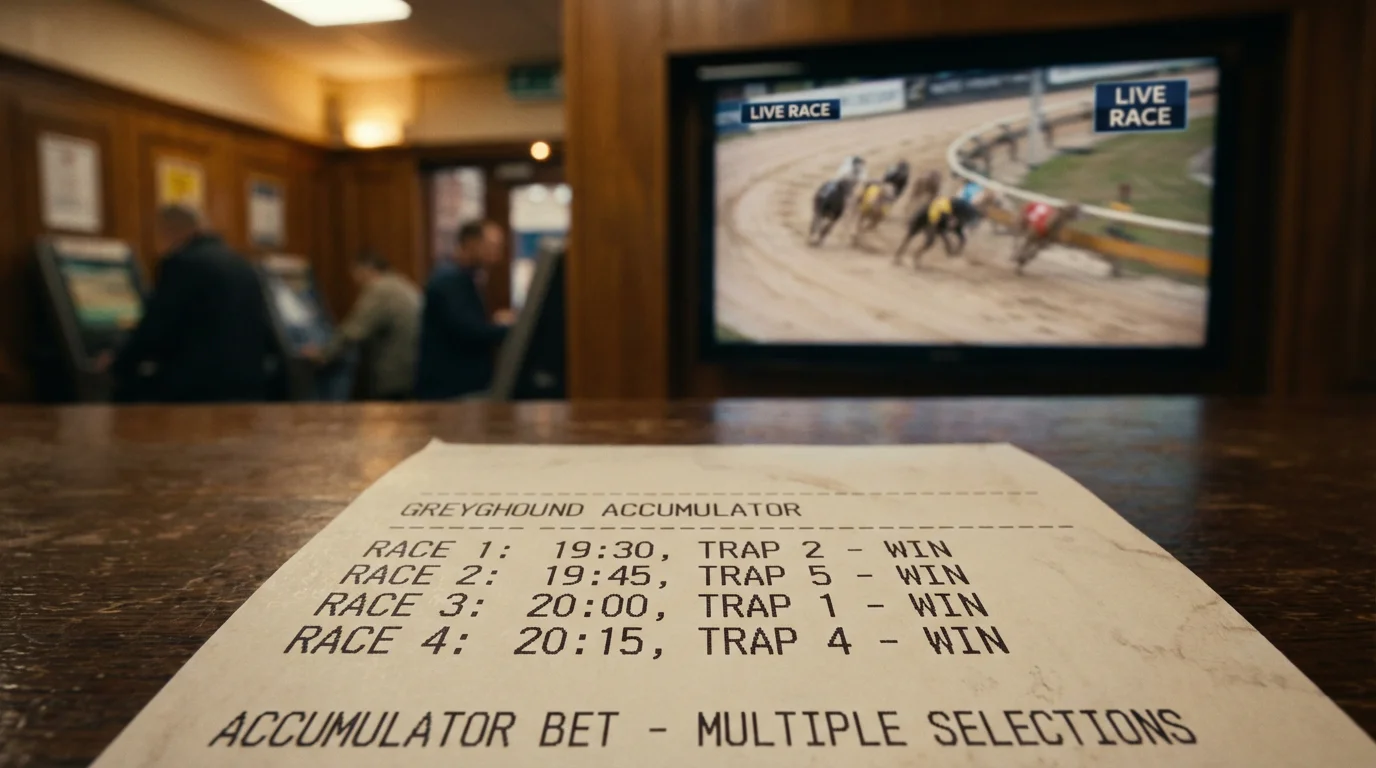
The Allure of the Big Return
An accumulator bet — the acca — combines multiple selections into a single wager. All selections must win for the bet to pay out. The appeal is straightforward: by linking two, three, four, or more winners together, the odds multiply and the potential return balloons far beyond anything a single bet could produce. A four-fold accumulator on dogs at 3/1, 2/1, 5/1, and 4/1 returns a combined payout of 179/1. One pound becomes one hundred and eighty.
That multiplication is the hook. It is also, for most punters, the trap. The mathematics of accumulators are brutally clear: the more legs you add, the lower the probability of success, and the more the bookmaker’s margin compounds against you. Accumulators are the most popular bet type in UK betting shops and one of the least profitable for the punter. Understanding why — and understanding the narrow circumstances where they might make sense — requires stripping the acca back to its mechanics.
Find all accumulator bet guides on the kinsleydogresults homepage.
How Accumulators Work
An accumulator works by rolling the returns from one winning selection into the stake on the next. If you place a three-fold accumulator on three greyhound selections, the first dog must win. The returns from that winner — stake plus profit — become the stake on the second selection. If the second dog wins, the combined returns roll into the third. If all three win, you collect the final payout. If any single leg loses, the entire bet loses.
The payout calculation is straightforward. Take each selection’s decimal odds, multiply them together, and multiply the result by your stake. Three dogs at decimal odds of 3.00, 4.00, and 2.50 produce a combined multiplier of 30.00. A one-pound stake returns thirty pounds. In fractional terms, the same three dogs at 2/1, 3/1, and 6/4 produce a combined return that can be calculated by converting each price to its decimal equivalent and performing the same multiplication.
The critical feature of an accumulator is the compounding of both probability and margin. Each additional leg reduces the overall probability of the bet landing. A single bet on a dog at 3.00 (decimal) has an implied probability of roughly 33 per cent. Two such bets in an accumulator have a combined probability of roughly 11 per cent. Three have a combined probability of about 3.7 per cent. By the time you reach a six-fold accumulator, the probability of all legs winning is below one per cent, even if every individual selection has a realistic chance.
The bookmaker’s margin also compounds. Each leg of an accumulator carries the bookmaker’s overround — the built-in percentage that ensures the odds are slightly less generous than the true probabilities. On a single bet, the margin is typically five to fifteen per cent depending on the market. On a four-fold, that margin applies to each leg, and the cumulative effect is substantial. By the time the margins have compounded across four or five legs, the effective overround on the accumulator is significantly larger than on any individual bet. You are paying a hidden surcharge that grows with every selection you add.
This compounding is the fundamental problem with accumulators. Each leg you add makes the bet less likely to win and increases the proportion of the potential payout that the bookmaker retains as margin. The enormous headline returns are real, but they are enormous precisely because the probability of achieving them is tiny. The bookmaker is not being generous. The bookmaker is pricing the improbability correctly and keeping a growing slice of the value as the legs multiply.
Doubles, Trebles, and Full-Cover Bets
Not all multiple bets are straightforward accumulators. The betting industry offers a range of combination bets that break a multi-selection wager into smaller components, providing partial coverage against one or more legs losing.
A double is the simplest multiple: two selections, both must win. The payout is the product of both prices. Doubles are the least risky form of multiple bet because only two legs need to land, and the compounding of probability and margin is relatively modest. For greyhound punters with strong views on two races at the same meeting, a double can be a reasonable way to increase the return without drastically inflating the risk.
A treble links three selections with all three required to win. The risk profile is steeper than a double — three independent events must all go your way — but the potential return is correspondingly larger. Trebles sit at the boundary of what many disciplined punters consider acceptable. Beyond three legs, the probability of success drops into territory where the bet becomes more of a lottery than an informed wager.
Full-cover bets — the Trixie, Yankee, Lucky 15, Lucky 31, and their derivatives — address the fragility of accumulators by combining multiple doubles, trebles, and accumulators within a single bet. A Yankee, for example, covers four selections in six doubles, four trebles, and one four-fold — eleven bets in total. If two of the four selections win, you collect on one double. If three win, you collect on three doubles and a treble. Only if all four win do you collect on every component.
The advantage of full-cover bets is that they provide returns even when not all selections win. The disadvantage is cost. A one-pound Yankee costs eleven pounds. A one-pound Lucky 15 (which adds four singles to the Yankee structure) costs fifteen pounds. A one-pound Lucky 31 (five selections) costs thirty-one pounds. The outlay escalates quickly, and the returns on partial success are often modest — barely recovering the total stake if only two or three of your selections win. Full-cover bets offer psychological comfort by increasing the chance of some return, but the mathematical reality is that they rarely produce a long-term profit for the punter.
The Greyhound Accumulator Reality
Greyhound racing presents specific challenges for accumulator betting that make it even less favourable than accumulators on horse racing or football. The six-dog field means that even a well-analysed selection has a ceiling on its probability of winning. The compressed grading at tracks like Kinsley means that most races are genuinely competitive, with no single runner dominating the market. The non-runner issue — a dog withdrawn and replaced by a reserve at short notice — introduces unpredictable disruptions that can destroy a carefully constructed multiple bet in a single moment.
The low favourite strike rate at Kinsley is particularly relevant. If the favourite wins roughly thirty per cent of the time — below the national average — then backing four favourites in an accumulator gives you a combined win probability of under one per cent. Even backing selections that you rate higher than the market’s favourite still faces the fundamental competitiveness of six-dog fields. A strike rate of thirty per cent on individual bets translates to an expected four-fold accumulator strike rate below one per cent.
The non-runner issue compounds the problem. Every leg of an accumulator is an additional opportunity for a withdrawal to disrupt your bet. If one of your selections is a non-runner, that leg is voided and the accumulator drops to a lower-level multiple at reduced odds. You might place a four-fold and end up collecting a treble because one dog was withdrawn — a frustrating outcome if that dog was your strongest selection and its absence from the payout reduces the return significantly.
None of this means that accumulators never win. They do, occasionally, and when they do the returns can be dramatic. But the occasional big win must be weighed against the steady attrition of losing stakes across all the accumulators that did not land. Over a season of regular accumulator betting, the net position for most punters is negative, and often substantially so.
The Mathematical Truth
The honest assessment of accumulator betting is this: if you have an edge on individual selections — if your form analysis produces a positive return on single bets over time — then accumulators are an inefficient way to deploy that edge. Every leg you add dilutes the advantage by compounding the bookmaker’s margin against you. A punter who makes a two per cent profit on single bets over a large sample will make less than two per cent on doubles using the same selections, and progressively less on trebles, four-folds, and beyond.
The logic of accumulators only works in one narrow scenario: when the combined odds offered by the bookmaker are greater than the true combined probability justifies. This is theoretically possible but extremely difficult to achieve in practice, because the compounding margin works against you at every step. To overcome that margin on a four-fold, you would need a significant edge on every individual leg — an edge that most punters, including good ones, do not consistently possess.
Compare with each-way betting in each-way betting.
For the greyhound punter at Kinsley, the practical advice is clear. If you enjoy accumulators as entertainment — a small-stake flutter with the potential for a large return — there is no harm in the occasional double or treble, provided the stake comes from your entertainment budget rather than your serious betting bankroll. If you are betting for profit, singles are the most efficient vehicle for your edge. Every pound you divert into accumulators is a pound that would produce a higher long-term return if staked on the same selections individually. The maths is unambiguous. The acca appeals to hope. The single bet appeals to logic. Over a season, logic wins.
