
Virtual Greyhound Racing vs Real Dog Racing
 Available in US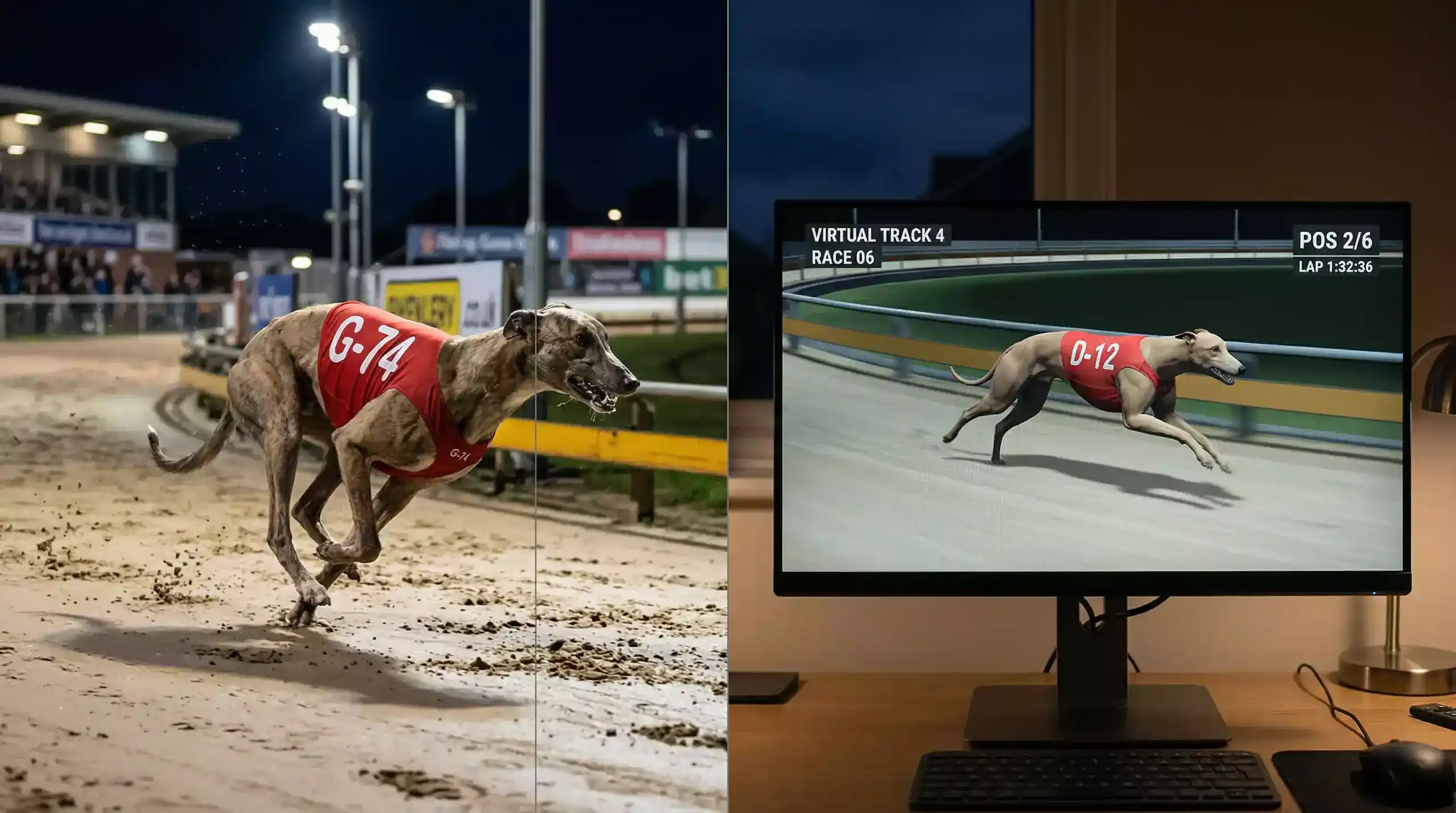
Same Screen, Different Sport
Open a bookmaker’s app and scroll through the greyhound racing section. Between the listings for Kinsley, Monmore, and Romford, you will find virtual greyhound races — computer-generated events that look like real races, run every few minutes, and accept bets just like the genuine article. The visual similarity is deliberate. The underlying reality is entirely different. Virtual greyhound racing and live greyhound racing share a name, a visual format, and a place on the bookmaker’s menu. They share almost nothing else.
The distinction matters because punters who blur the line between the two will apply techniques to virtual racing that cannot work, and may approach real racing with assumptions borrowed from virtual markets that do not apply. Understanding what virtual racing is, how it differs from the real thing, and why the analytical tools covered in this series are irrelevant to virtual events is necessary housekeeping for any punter who encounters both products on the same platform.
Compare virtual and real greyhound racing on the kinsleydogresults homepage.
How Virtual Greyhound Racing Works
A virtual greyhound race is a computer-generated simulation. There are no real dogs. The animated greyhounds on screen are graphical representations driven by a random number generator (RNG) that determines the outcome of each race before the animation begins. The “race” you watch is a visualisation of a result that has already been decided by the software, not a live event whose outcome depends on the performance of living animals.
The RNG is the core of the product. It operates under a certified algorithm that produces outcomes within a defined probability framework. Each virtual dog in a virtual race is assigned a probability of winning, and the RNG selects the finishing order based on those probabilities. The probabilities are set by the virtual racing provider — companies such as Inspired Entertainment or Kiron Interactive — and are calibrated to produce results that align with the odds offered by the bookmaker.
The virtual dogs are given names, trap numbers, and sometimes fictional form data to create the appearance of a real racing event. Some products display simulated odds movements in the minutes before the virtual race, mimicking the pre-race market activity of a genuine event. This presentation is designed to make the virtual experience feel familiar to punters who are accustomed to real racing. But the familiarity is cosmetic. The names, the form, and the odds movements are decorative elements layered on top of a random outcome. They carry no predictive information because there is nothing to predict — the result is generated by the RNG, not by the performance of animals with real form, real abilities, and real running styles.
Virtual races run on a rapid cycle — typically every three to five minutes — producing a continuous stream of betting opportunities throughout the day and night. This frequency is a key feature of the product’s design. There is no preparation time, no form study, and no waiting for the next meeting. The races are always available, always instant, and always accepting bets. This constant availability is part of the appeal and, for some punters, part of the risk.
RNG vs Form: Why Analysis Cannot Apply
Every analytical tool discussed in this series — sectional times, calculated times, trap draw bias, weight trends, trainer form, race comments, going allowance, season cycles — is designed to extract information from real events involving living animals whose performance is influenced by measurable physical factors. None of these tools has any application to virtual greyhound racing, because virtual races are not influenced by physical factors. They are influenced by a random number generator operating within a fixed probability framework.
In a real race, trap one has a statistical advantage because the geometry of the track gives the inside dog a shorter route to the first bend. In a virtual race, any advantage assigned to trap one is a design decision embedded in the software’s probability model. It may or may not exist, and even if it does, it is already reflected in the odds. You cannot gain an edge by analysing trap bias in virtual racing because the bias, if present, is known to the provider and priced into the market from the start.
In a real race, a dog’s recent form — its finishing times, its race comments, its weight — tells you something about its current condition and its probability of performing well. In a virtual race, any “form” displayed on the screen is a fictional construct with no predictive value. The virtual dog that “won” its last three virtual races has no greater probability of winning the next one than the virtual dog that “lost” its last three, unless the provider’s algorithm specifically programmes a form-based weighting — and even then, the weighting is already incorporated into the odds you are offered.
The fundamental difference is information asymmetry. In real racing, the punter can obtain information — through form study, race watching, and track knowledge — that the market has not fully priced. This information gap is the source of value. In virtual racing, there is no information to obtain. The RNG outcome is determined by probabilities that the provider controls and the bookmaker prices. There is no hidden form to uncover, no kennel run to exploit, and no race comment to decode. The odds are the odds, and over time, the bookmaker’s margin ensures that the punter loses.
Betting Differences
The bet types available on virtual greyhound racing are broadly similar to those on real racing: win, each way, forecast, tricast. The mechanics of placing a bet are identical. The difference lies in the expected return.
In real racing, a skilled punter with a genuine analytical edge can produce a positive return over time. The edge is small — a few percentage points of profit on turnover — but it is real and sustainable. In virtual racing, no such edge exists. The outcomes are random within a fixed probability framework, and the bookmaker’s margin is embedded in every market. Over a large sample of virtual bets, the punter will lose an amount approximately equal to the bookmaker’s overround, regardless of their selection method. No strategy, no system, and no pattern of bets can overcome this structural disadvantage, because there is no information in the product that is not already reflected in the price.
The payout structures are also different in practice, even if they appear similar on screen. Virtual racing odds are set by the provider’s probability model and adjusted by the bookmaker to ensure a target margin. Real racing odds are influenced by market activity — the money bet by thousands of punters, each with their own opinion, collectively moves the price toward an efficient equilibrium. Real markets are dynamic and sometimes inefficient. Virtual markets are static and always efficient, because the probabilities are predetermined.
The practical implication is that time spent analysing virtual greyhound races is time wasted. There is nothing to analyse. If you enjoy virtual racing as a form of entertainment — a quick flutter between real meetings, with the expectation that you will lose over time — that is a personal choice, and the entertainment value is real even if the analytical value is not. But if you treat virtual racing as an extension of your real racing betting, applying the same focus and the same stakes, you are directing resources toward a product where your skills cannot produce a return. Every minute and every pound spent on virtual racing is a minute and a pound diverted from the real meetings where your form analysis can make a difference.
Different Sport, Different Rules
The clearest way to think about virtual greyhound racing is to stop thinking of it as greyhound racing at all. It is a number-generation game dressed in a greyhound racing costume. The dogs are not real. The form is not real. The track is not real. The only real elements are the money you stake and the odds you accept, and those odds are calibrated to ensure the house wins over time.
Real greyhound racing — the kind contested at Kinsley every week by living dogs with measurable form, trained by identifiable handlers, running on a physical surface affected by weather and wear — is a sport. It has variables, uncertainties, and information asymmetries that create opportunities for the informed punter. The entire analytical framework of this series is built on that foundation: the premise that knowledge, diligently applied, can produce an edge over the betting market.
Read our full racing guide in kinsley greyhound racing.
Virtual racing offers no such premise. It is a fixed-margin product. The punter cannot outperform the RNG because the RNG has no form to read, no condition to assess, and no trainer to track. Recognising this distinction — clearly, without ambiguity — is the first step toward ensuring that your analytical effort is directed where it can actually produce results. The real dogs at Kinsley are running. The form is there to be read. The edge is there to be found. That is where your attention belongs.
