
Kinsley Greyhound Betting Guide: Odds, Markets and Strategy
 Available in US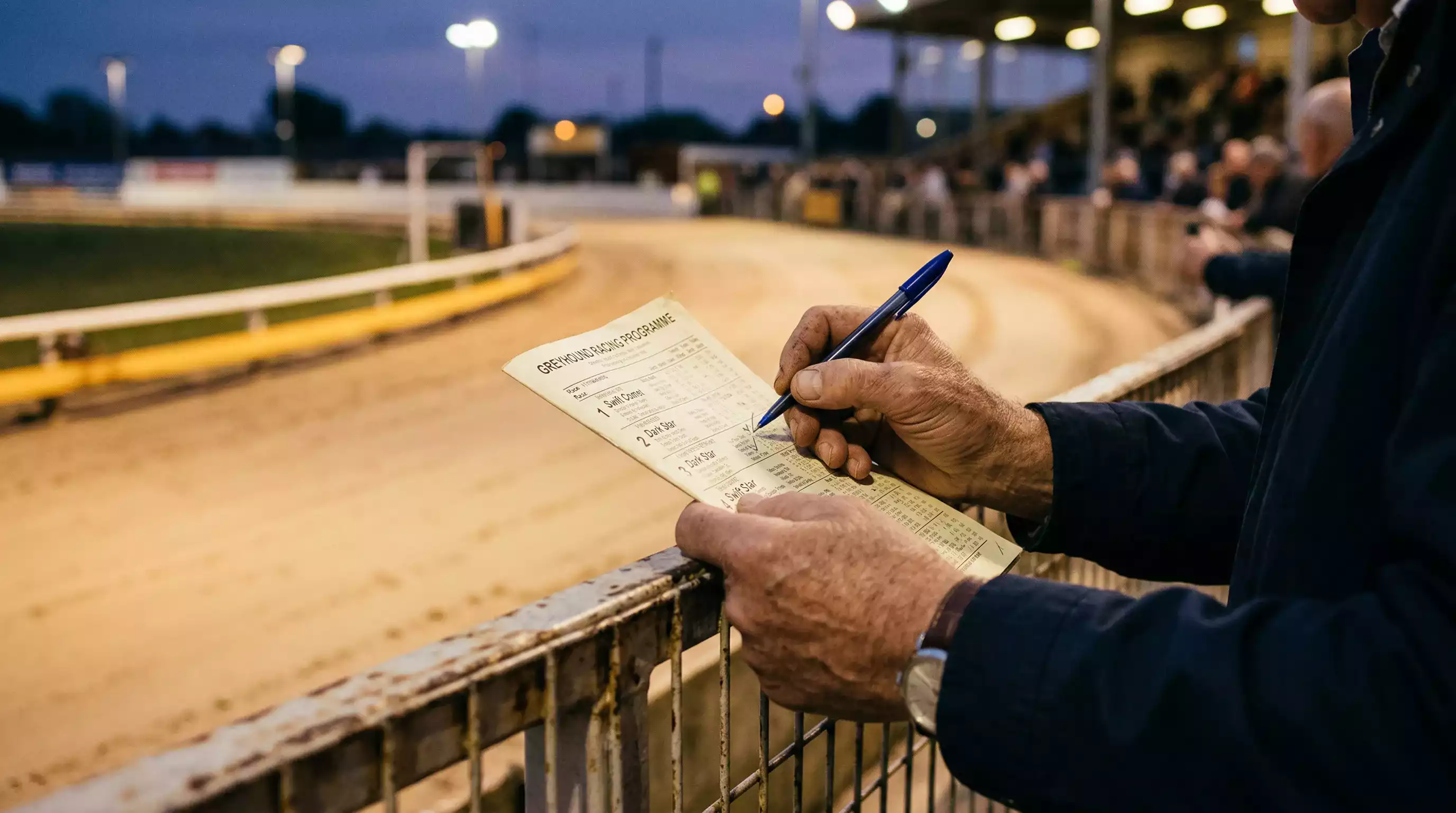
More Than Picking a Name
Betting on dogs at Kinsley isn’t complicated — but profitable betting requires more than picking a name. That distinction is what separates the punter who enjoys the odd flutter from the one who treats greyhound racing as a discipline with its own logic, its own markets, and its own traps for the unwary. Kinsley is a GBGB-regulated track in West Yorkshire running four meetings a week under the Arena Racing Company banner, and it offers every standard betting market available in UK greyhound racing. The question is not what you can bet on. The question is how to bet intelligently on it.
This guide covers the mechanics of greyhound betting as they apply to Kinsley — from the basics of how odds work through to each way rules, forecasts, tricasts, accumulators, and staking discipline. It is written for the punter who already understands roughly what a bet is but wants a clearer picture of how the various options function, where value tends to hide, and how to avoid the structural mistakes that quietly drain a bankroll over a season.
Kinsley has characteristics that make its betting landscape somewhat different from other UK tracks. The favourite strike rate in graded races hovers around 31 per cent — one of the lowest in the country. That statistic alone reshapes everything: which bet types make sense, how aggressively you should stake, and whether backing short-priced runners represents genuine value or a slow path to losses. A betting guide that ignores the specific track it applies to is a theory textbook. This one is built for the punter standing at Kinsley or sitting in front of the live stream, card in hand, money in the balance.
Whether you are placing your first bet at the track or your thousandth, the principles here apply. Markets do not care how experienced you are. Odds do not adjust for confidence. And the bookmaker’s margin never sleeps. Understanding all three is where the edge begins.
Find all Kinsley betting guides on the kinsleydogresults homepage.
How Greyhound Odds Work
Odds are a language — fractional, decimal, and SP each tell the same story differently. Before you can evaluate whether a bet is worth placing, you need to understand what the odds are actually communicating. They are not just a payout multiplier. They represent the bookmaker’s assessment — filtered through their margin — of how likely a given outcome is. Learning to read that assessment and compare it against your own is the foundation of every profitable approach to greyhound betting.
Fractional and Decimal Odds
In the UK, greyhound odds are most commonly displayed as fractions. A dog at 3/1 will return three pounds of profit for every one pound staked, plus your stake back. A dog at 5/2 returns two pounds fifty for every pound. A dog at 4/6 returns sixty-seven pence profit on a one-pound stake — it is odds-on, meaning the bookmaker considers it more likely to win than to lose.
Decimal odds, more common on betting exchanges and some online bookmakers, express the same information differently. The decimal figure represents the total return per unit staked, including the stake. A dog at 3/1 in fractional becomes 4.00 in decimal. A dog at 5/2 becomes 3.50. A dog at 4/6 becomes 1.67. The maths is straightforward: to convert fractional to decimal, divide the first number by the second and add one. To convert decimal to fractional, subtract one and express as a fraction.
The practical importance of understanding both formats is that they allow you to calculate implied probability — what the odds suggest about a dog’s chance of winning. A dog at 4.00 decimal has an implied probability of 25 per cent (one divided by 4.00). A dog at 2.00 implies 50 per cent. If you believe a dog’s actual probability of winning is 35 per cent but its implied probability from the odds is only 25 per cent, the bet has positive expected value. That gap — between what you think will happen and what the market is pricing — is the entire basis of value betting.
Starting Price Rules
At Kinsley, as at all GBGB tracks, the Starting Price is the official odds at which a dog is returned when the race begins. If you bet at SP rather than taking a fixed price, your payout is determined by whatever the market settles at when the traps open. The SP is calculated by independent assessors based on the on-course bookmakers’ boards at the time of the off.
Betting at SP makes sense in specific circumstances. If you expect the price to drift — to lengthen — because you believe public money will come for a different dog, waiting for SP gives you better odds than taking an early price. Conversely, if you think the dog you fancy will be backed heavily and its price will shorten before the race, taking an early fixed price locks in value that the SP will not match. At Kinsley, where field sizes are always six and the betting market is relatively thin compared to major metropolitan tracks, prices can move sharply on modest volumes. A few hundred pounds wagered on a single dog can shift the entire market. This means early prices at Kinsley are not always reliable indicators of what the SP will be, and experienced punters learn to read market movements as a signal in their own right.
Some online bookmakers also offer Best Odds Guaranteed on greyhound racing, meaning if you take a fixed price and the SP is higher, you receive the SP instead. Where this offer is available, it eliminates the risk of taking an early price that subsequently drifts, making it the optimal strategy whenever the bookmaker provides it. Check the terms — not all bookmakers extend BOG to greyhound markets, and those that do may restrict it to certain meetings or bet types.
Bet Types for Greyhound Racing
Six dogs in a race, but the betting menu runs much deeper than ‘pick the winner’. Greyhound racing at Kinsley supports a full range of bet types, from the straightforward win single through to exotic combination wagers that can produce substantial payouts from modest stakes. Understanding each type — not just how it works mechanically but when it makes sense to use it — is essential for any punter who wants to match their bet selection to the race conditions in front of them.
Singles, Each Way and Place Bets
The win single is the cleanest bet in the sport. You select one dog to win one race. If it finishes first, you collect. If it doesn’t, you lose your stake. The simplicity is its strength — there is no complexity to miscalculate and no hidden terms to misunderstand. For most punters at Kinsley, the win single should form the backbone of their betting activity.
The each way bet splits your stake into two halves: one on the dog to win, one on it to place. In greyhound racing with six runners, the standard place terms are first or second at one quarter of the win odds. So if you back a dog each way at 6/1 with a total stake of two pounds (one pound win, one pound place), a win returns seven pounds from the win part plus two pounds fifty from the place part (6/1 divided by four is 6/4, which pays one pound fifty profit plus your pound back). If the dog finishes second, you lose the win pound but collect two pounds fifty from the place part, giving you a net return of fifty pence profit on your total two-pound stake.
Each way bets in six-runner greyhound races require careful thought. Because the place terms pay only two positions in a six-dog field, the each way market is structurally tighter than in horse racing where eight or more runners may trigger three-place terms. At Kinsley, each way betting makes most sense on dogs at longer odds — typically 5/1 or bigger — where the place part alone can return a meaningful profit even if the dog doesn’t win. Backing a 2/1 shot each way in a six-runner race is mathematically questionable because the place return on the losing half barely offsets the cost of splitting your stake.
Place-only betting, where available, allows you to back a dog to finish first or second without the win component. This can be useful when you are confident a dog will be competitive but uncertain about whether it can beat a specific rival. Not all bookmakers offer standalone place markets for greyhound races, but those that do provide a useful option for races where the likely winner is obvious but the second-place battle is wide open.
Forecasts and Tricasts
A straight forecast requires you to predict the first and second dog in the correct order. It is a tote pool bet, meaning the payout is determined by the pool rather than fixed odds, and the dividends can be substantial when unfancied dogs fill the first two positions. At Kinsley, where the favourite wins less often than at most tracks, straight forecasts regularly pay double-digit multiples of the stake.
The reverse forecast is two straight forecasts in one: your two selected dogs to finish first and second in either order. The stake is doubled — a one-pound reverse forecast costs two pounds — but it removes the need to predict which of your two fancied dogs will beat the other. For races where you have identified two strong contenders but cannot separate them, the reverse forecast is a cleaner bet than trying to force one ahead of the other.
A tricast extends the principle to the first three finishers in correct order. The payouts can be dramatic — three-figure returns from a one-pound stake are not unusual in lower-grade races at Kinsley where the field is open. But the probability of nailing the top three in sequence is, as you might expect, substantially lower than predicting the first two. A combination tricast covers all possible orderings of your three selected dogs, costing six times the unit stake (three dogs can finish in six different arrangements). It is the practical choice when you are confident about which three dogs will fill the frame but not about the order.
Forecast and tricast bets are where deep racecard analysis pays dividends most directly. The tote pool does not care whether you spent five minutes or five hours studying the form — it pays the same dividend. But the punter who has identified a likely first and second through rigorous form analysis is placing a forecast with a better probability of success than the casual punter picking on colours and names. Over a season, that difference in analysis quality translates into a measurable difference in return.
Multiples and Accumulators
A double combines two selections from different races: both must win for the bet to pay. A treble requires three winners. An accumulator, or acca, chains four or more selections together. In each case, the returns from the first winning selection become the stake for the next, producing compounded odds that can look extremely attractive on a betting slip and almost never materialise in practice.
The harsh reality of accumulators in greyhound racing is mathematical. Even if each selection has a 50 per cent chance of winning — which is generous for any greyhound at any track — a four-fold accumulator has a success probability of 6.25 per cent. At Kinsley, where the average favourite has roughly a 31 per cent win rate, an acca built on four favourites has roughly a 0.9 per cent chance of landing. The big payout is the lure. The accumulated bookmaker margin across multiple selections is the trap.
This does not mean multiples are always irrational. A carefully selected double on two races where you have identified strong value — where your assessed probability exceeds the implied probability by a meaningful margin — can be a legitimate bet with positive expected value. But adding selections for the sake of boosting the odds, without genuine confidence in each one, is the fastest way to burn through a greyhound betting bankroll. At Kinsley, where results are less predictable than at most UK tracks, restraint in accumulator betting is not just advisable — it is essential.
Staking and Bankroll Management
No staking plan can rescue bad selections — but bad staking can destroy good ones. This is the section most casual punters skip and most profitable ones consider the most important. The size and structure of your bets matter at least as much as the quality of your selections, and at a track like Kinsley where variance runs higher than the UK average, getting the staking wrong can wipe out weeks of good analysis in a single evening.
The starting point is defining a bankroll — a fixed sum of money set aside exclusively for greyhound betting, separate from your personal finances. This is not a casual suggestion; it is the structural prerequisite for disciplined staking. Your bankroll might be fifty pounds, five hundred pounds, or five thousand — the amount is less important than the principle that it is defined, ring-fenced, and finite. When it is gone, you stop. No exceptions, no top-ups mid-session, no chasing losses with money earmarked for something else.
With a bankroll established, the next decision is how much to stake per bet. The two most common approaches are level staking and percentage staking. Level staking means wagering the same fixed amount on every bet — say, two per cent of your starting bankroll. If you begin with a five-hundred-pound bank, every bet is ten pounds regardless of the odds or your confidence level. The advantage is simplicity and emotional insulation. You cannot talk yourself into a reckless forty-pound bet on a dog you “feel good about” because the rule does not allow it.
Percentage staking adjusts the bet size to the current bankroll. You still wager two per cent, but two per cent of a bankroll that has grown to six hundred pounds is twelve pounds, while two per cent of one that has shrunk to four hundred is eight pounds. This method automatically reduces your exposure during losing runs and increases it during winning streaks, which is mathematically sound but psychologically harder to maintain. Most punters find that staking less after a losing run feels counterintuitive, even though the maths supports it.
At Kinsley specifically, staking discipline needs to account for the track’s low favourite strike rate. That figure — already one of the lowest in the country — means that even well-selected bets will lose more often than they win. If you are backing dogs at average odds of 3/1, you need to win roughly one in three to break even before the margin. That means losing runs of five, six, even eight bets in succession are not just possible but statistically expected over any meaningful sample. Your staking plan must be able to absorb those runs without depleting the bankroll to a point where recovery becomes impractical.
A useful rule of thumb: never stake more than five per cent of your bankroll on a single bet, regardless of confidence. At two per cent per bet, a losing streak of ten — brutal but not unprecedented at Kinsley — costs you roughly eighteen per cent of your starting bank. At five per cent per bet, the same streak costs forty per cent. At ten per cent per bet, you are looking at a bank that has nearly halved, and the psychological pressure to chase at that point becomes almost impossible to resist. The smaller the individual stake, the longer you survive — and survival, in greyhound betting, is the first condition of profitability.
Keep records. Every bet, every result, every return. A simple spreadsheet tracking date, race, selection, odds, stake, and result gives you data that no amount of memory or intuition can match. After a month of disciplined record-keeping, you will see patterns — which bet types are working, which distances produce your best returns, which grades you analyse well and which you consistently misjudge. That information feeds back into your staking decisions and selection process in ways that make the entire operation more rigorous. Without records, you are guessing at your own performance. With them, you know.
Betting Angles Specific to Kinsley
Kinsley has specific characteristics that shape where value typically sits. A generic greyhound betting strategy applied uniformly across every UK track will miss the edges that are particular to this venue. What follows are not tips or systems — they are structural features of Kinsley’s racing programme that, once understood, inform better betting decisions over time.
The low favourite strike rate is the headline feature. At roughly 31 per cent in graded races, Kinsley’s favourites underperform the national average by a meaningful margin. This has several practical implications. First, backing short-priced favourites as a routine strategy is a losing proposition here. A dog at 6/4 that wins 31 per cent of the time returns less over a season than the same approach at a track where favourites win 38 per cent. The maths is unforgiving. Second, the corollary is that longer-priced runners win more often than the market implies. This creates potential value in the each way market and in straight forecasts involving non-favourites.
Trap statistics at Kinsley show distance-dependent biases that the odds do not always fully reflect. Over 268 metres, inside traps — particularly traps one and two — have historically higher win rates because the short run to the first bend rewards dogs that break quickly from favourable positions. Over 462 metres, the picture is more balanced but trap one still performs slightly above expectation in large samples. Over longer trips, the trap draw matters less because the race develops over multiple bends and the initial positioning advantage diminishes. Punters who factor trap-distance interactions into their selection process at Kinsley are working with information that the casual bettor ignores.
Grade drops at Kinsley frequently produce value runners. When a dog drops from, say, A4 to A5 after a couple of moderate performances at the higher level, the market often prices it as though those poor results define its current ability. But if the racecard shows that the dog was crowded or badly drawn in those A4 races, the drop in grade represents an easier assignment for a dog whose underlying pace remains A4-standard. These grade-drop runners at Kinsley do not win every time, but they win often enough at odds that overstate the probability of them losing to make them worth identifying systematically.
Bitches returning from seasonal absence are another Kinsley-specific angle. The GBGB rules require bitches to be off the track during their season, and the performance curve after return is well-documented in greyhound racing. Many bitches show a marked improvement in the weeks following their return, sometimes running personal-best times. At Kinsley, where the form book is thinner than at major metropolitan tracks, these post-season improvements are not always captured quickly by the market. A bitch returning from a break of eight to twelve weeks, previously running competitive times at A5, may be entered at A6 or A7 on the basis of her pre-season form — and the market prices her accordingly, missing the likely improvement.
Finally, weather and going conditions at Kinsley affect betting value in ways that are track-specific. Kinsley’s sand surface responds to rainfall differently from the surfaces at Romford or Nottingham. Heavy rain can slow times significantly, which disproportionately affects front-runners who expend energy early on a slower surface. Dogs with strong late pace — the ones coded as RnOn in their race comments — tend to benefit in wet conditions because the leaders tire sooner. If you are betting at Kinsley on a wet evening and the market has not adjusted the favourite’s price downward, you may be looking at a value opportunity on a closer in the field.
When Not to Bet
The best bet is sometimes no bet at all — especially at a track where favourites fail this often. This is the hardest principle in greyhound betting to put into practice, and the one that most consistently separates punters who survive a season from those who don’t. The urge to have something running in every race is powerful. It is also the single most reliable way to ensure your bankroll trends downward.
At Kinsley, with its four-meeting weekly schedule and typically ten to twelve races per card, a dedicated follower of the track is exposed to forty or more races a week. The vast majority of those races offer no identifiable edge. The form is ambiguous, the grades are evenly matched, the trap draw creates no obvious advantage, and the odds accurately reflect the probability of each outcome. In these races — which make up perhaps sixty to seventy per cent of any card — the correct action is to watch, take notes, and wait.
Waiting is not passive. It is an active decision based on a clear set of criteria. Before any Kinsley race, you should be able to articulate a specific reason for backing a specific dog. That reason might be a grade drop that the market hasn’t accounted for, a trap draw that perfectly suits a dog’s running style, a calculated time that is significantly faster than any other runner in the field, or a returning bitch with a demonstrated post-season improvement pattern. If you cannot identify a concrete reason, the bet should not happen. “I like the look of it” is not a reason. “The name is good” is not a reason. “I haven’t had a bet in three races” is emphatically not a reason.
There are also structural situations at Kinsley where passing is advisable regardless of your form analysis. Races with two or more first-time-out dogs — those with no form to assess — inject an unpredictable element that no amount of racecard reading can resolve. Races where a non-runner has been replaced by a reserve at a late stage distort the intended dynamics of the field. Races with heavy going on a night when the track has been poorly maintained can produce bizarre results that bear no relation to underlying form. In all these cases, the risk-reward calculation shifts against the bettor, and the disciplined response is to step back.
Understand betting odds in betting odds explained.
Consider the maths one more time. If you bet on all twelve races at a Kinsley meeting with a five-pound stake, you have committed sixty pounds. Even with a solid strike rate of 25 per cent at average odds of 3/1, you might win three races for sixty pounds in returns — precisely break-even before the bookmaker’s margin, which means a net loss. But if you selected only four of those twelve races — the four where your analysis identified genuine value — and staked ten pounds on each, a 50 per cent hit rate at the same odds returns eighty pounds from a forty-pound outlay. Selectivity did not just protect your bankroll; it improved your return per race by a factor that no staking adjustment alone could achieve.
Kinsley rewards patience. Its competitive grading, its open fields, and the track’s well-documented tendency to unseat market leaders all conspire to punish the punter who bets for the sake of betting. The ones who prosper here are the ones comfortable with long stretches of not betting — treating every race they pass as data collected rather than money missed. The racecard is always there. The next meeting is always coming. The only resource that is genuinely finite is your bankroll, and protecting it during the races that don’t offer value is how you ensure it is still there when the races that do come along.
