
Kinsley 462m Races: The Standard Trip
 Available in US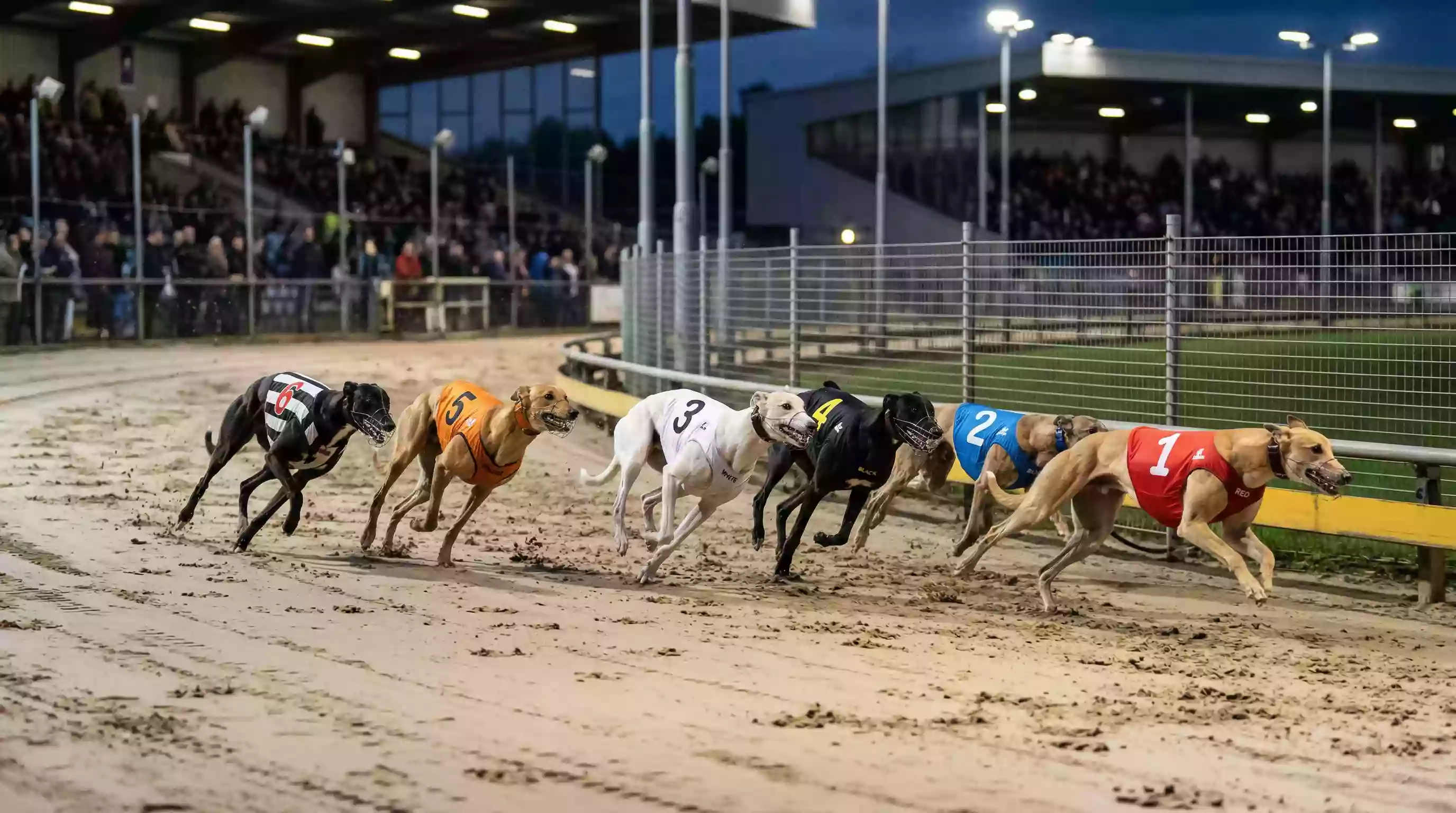
The Distance That Defines Kinsley
The 462-metre trip is Kinsley’s bread-and-butter distance. It is the standard trip over which dogs are graded, the distance where most races on any given card take place, and the one that generates the deepest form data for punters to work with. If you bet on greyhounds at Kinsley with any regularity, the 462m is where you will spend the majority of your time.
Understanding this distance in detail — how it rides, what it demands from a greyhound, and where the tactical flashpoints occur — is essential. It is a four-bend race, which means that unlike the shorter sprints, there are multiple opportunities for the running order to change. Early pace matters, but it is not everything. A dog’s ability to negotiate bends cleanly, maintain speed through the back straight, and produce a finish all play into the result.
The 462m also generates the most reliable form for comparison purposes. Because the bulk of the graded programme is run over this distance, there is a constant stream of data: times, sectional splits, positions in running, and race comments. Every dog racing at Kinsley will have the majority of its form recorded over 462 metres, making cross-referencing between opponents far more straightforward than it is over the sprint or staying trips. For anyone serious about form analysis, this is the distance that matters most.
Explore Kinsley 462m race data on the kinsleydogresults homepage.
The 462m Distance Profile
Kinsley’s 462-metre trip involves four bends. The dogs break from the traps on the back straight, run to the first bend, continue through the second, proceed down the home straight past the finish line for the first time, then navigate the third and fourth bends before sprinting down the final straight to the winning post. This is a full circuit of the track plus a portion of the home straight.
The track itself is 385 metres in circumference with an outside Swaffham McGee hare. The circumference is moderate by GBGB standards — not as tight as some of the smaller circuits, but notably smaller than venues like Nottingham or Towcester. This matters because tighter bends amplify the advantage of dogs that handle curves well and penalise those that run wide or lose momentum through the turns.
Typical winning times over 462 metres at Kinsley vary with the grade and conditions, but a useful reference range sits somewhere between 28 and 30 seconds. An A1 or A2 dog in good form on a fast track might post a time around 28.2 to 28.5 seconds. Mid-grade dogs — A4 to A6 — tend to finish in the range of 29.0 to 29.8 seconds. Dogs in the lower grades will generally run above 30 seconds. These figures fluctuate depending on going conditions, the pace of the hare, and the nature of the race itself, but they provide a baseline for comparison.
What constitutes a “fast” time at this distance depends on context. A 29.1 in an A5 race is excellent — it suggests the dog is running above its grade. The same 29.1 in an A2 race is unremarkable. Time must always be read against grade, and both must be read against conditions. A slow track will push every dog’s time upward, so a 29.8 on a heavy night might be the equivalent of a 29.3 on a fast surface. This is where calculated times and going allowance become essential tools, adjusting raw figures to account for the conditions on the night.
The 462m trip at Kinsley is long enough that early pace alone does not guarantee victory. A dog can break sharply from the traps, lead through the first two bends, and still be caught if it lacks the stamina or the bend technique to sustain that lead through bends three and four. Equally, a dog with a moderate break but genuine finishing speed can make up ground on the final straight. This dynamic is what makes the standard trip at Kinsley the most tactically interesting distance on the card. The sprint races are more predictable — fast out, fast home. The staying races introduce different stamina variables. The 462m sits in the middle, blending elements of both.
Form Factors Over the Standard Trip
Split times — also called sectional times — are the single most informative metric for evaluating form over 462 metres at Kinsley. The split is the time from the traps to the line on the first pass, measured as the dog crosses the finish line for the first time before entering the back straight again. This figure tells you how quickly a dog reaches the front of the race and, by extension, how much trouble it is likely to encounter at the first bend.
A fast split at Kinsley typically falls under 4.5 seconds. Dogs with splits in the 4.2 to 4.4 range are genuine early-pace dogs that will be at or near the lead when the field hits the first bend. This is significant because the first bend is where most trouble occurs. Six dogs converging on the first turn creates crowding, bumping, and checking — all of which cost lengths and, crucially, time. A dog that arrives at the first bend in front, or at least clear of the pack, avoids the worst of this. Its finishing time will more accurately reflect its true ability.
For dogs with slower splits — above 4.6 or 4.7 seconds — the first bend is often a hazard rather than an opportunity. These are the dogs most likely to suffer interference, and their form needs to be interpreted accordingly. A dog that finished fifth with a comment of “Crd1” (crowded at the first bend) may have run a far better race than the position suggests. Conversely, a dog that led from the start and won unchallenged may have posted a flattering time that it could not reproduce if it had to overcome any trouble.
Bend positions throughout the race tell a story that finishing positions alone cannot. A racecard will typically show each dog’s position at bends one, two, three, and four. A dog that sits third at bend two, second at bend three, and first at bend four is a confirmed closer — a greyhound that improves its position as the race develops. Such dogs are often undervalued in the market because their form lines show a series of second and third-place finishes, obscuring the upward trajectory within each race.
The opposite pattern — a dog that leads at bend one and fades to fourth by bend four — signals a frontrunner with stamina limitations. These dogs are dangerous in sprint races but less reliable over the full 462-metre trip, especially when drawn against confirmed closers who can sustain their pace through the second half of the race.
Going allowance also plays a role in comparing form across different race nights. Kinsley, like all GBGB tracks, publishes a going allowance figure that adjusts each dog’s time to account for track conditions. A dog whose raw time was 29.5 on a slow night might have a calculated time of 29.1 after the going allowance is applied. Ignoring this adjustment will give you a distorted picture of relative ability. Always use calculated times when comparing form over 462 metres, not raw finishing times.
Trap Draw at 462 Metres
Trap draw at 462 metres matters more than many casual punters realise, and less than some data obsessives claim. The truth, as usual, sits in the middle. At Kinsley, the six traps do not all produce equal win rates over the standard trip, but the bias is not dramatic enough to make trap draw a primary selection tool on its own.
The inner traps — one and two — benefit from a shorter run to the rail on the first bend. A dog breaking from trap one has the inside position and, provided it shows reasonable early pace, can hold the rail into the first turn without interference from dogs on either side. Trap two sits immediately outside and can tuck in behind or alongside the trap one dog relatively easily. The statistical edge for these traps tends to show up as a slightly higher win rate when measured across a full season of data.
The middle traps — three and four — are generally considered the most vulnerable. Dogs breaking from these positions are flanked on both sides and have to commit to a line early. If the dog inside them is fast away and cuts across, or the dog outside them drifts in, the middle traps are the ones that get squeezed. Race comments showing trouble at the first bend are disproportionately attached to dogs drawn in traps three and four. This does not mean these traps cannot win — they can and do — but the incidence of interference is higher.
The outer traps — five and six — offer clean air at the start but require the dog to cover more ground to reach the first bend. A wide runner drawn in trap six at Kinsley’s 462m trip can often race untroubled if it has the pace to hold its position, but it is running a slightly longer route than the inside dogs. Over four bends, that extra distance accumulates. For dogs that naturally run wide, though, an outside draw can be a positive: it keeps them out of trouble and lets them use their preferred running line.
The key for punters is not to memorise raw trap statistics but to match the trap draw to the running style of the individual dog. A confirmed rail runner drawn in trap one is ideally placed. The same dog drawn in trap five faces a problem — it needs to cross the field to reach the rail, and that creates the kind of crowding it would normally avoid. Racecard comments and the “W” (wide) or “M” (middle) designations next to a dog’s name are the indicators to check. When the draw suits the running style, you have a legitimate positive factor. When it works against the dog’s natural tendencies, you have grounds for caution.
Think in Bends, Not Metres
The most useful shift in thinking a punter can make when assessing 462m races at Kinsley is to stop thinking in metres and start thinking in bends. A four-bend race is not a test of raw speed over a given distance. It is a sequence of four tactical events connected by straights, and each bend presents its own set of risks and opportunities.
Bend one is where the race is shaped. The field converges for the first time, and the dog that emerges in front — or at least in a clear position — gains an advantage that carries through the rest of the race. Bend two is a continuation of that order, though some reshuffling occurs. Bend three is the pivot. By this point, frontrunners are either holding strong or beginning to tire, and closers are beginning their moves. Bend four is the final test of stamina and determination — the last turn before the run to the line.
When you look at a form line for a Kinsley 462m race, read it as a four-act structure. Where was the dog at bend one? Did it maintain or improve through bends two and three? What happened at bend four? A dog that moves from fourth at bend one to second at bend three and first at bend four is running a textbook closing race. That pattern, repeated across several recent runs, tells you more about the dog’s current ability than its finishing time or grade ever could.
Compare with sprint and stayer distances in kinsley 268m sprint races.
The 462-metre trip at Kinsley rewards dogs that combine early pace with bend technique — the ability to take bends tightly, maintain speed through the turns, and switch off the bend onto the straight without losing momentum. The dogs that do this consistently are the ones that win consistently, regardless of what the raw numbers might suggest about their grade. If you can identify that quality in a dog’s form, you have found something the racecard alone will not tell you.
