
Kinsley 268m Sprint Races
 Available in US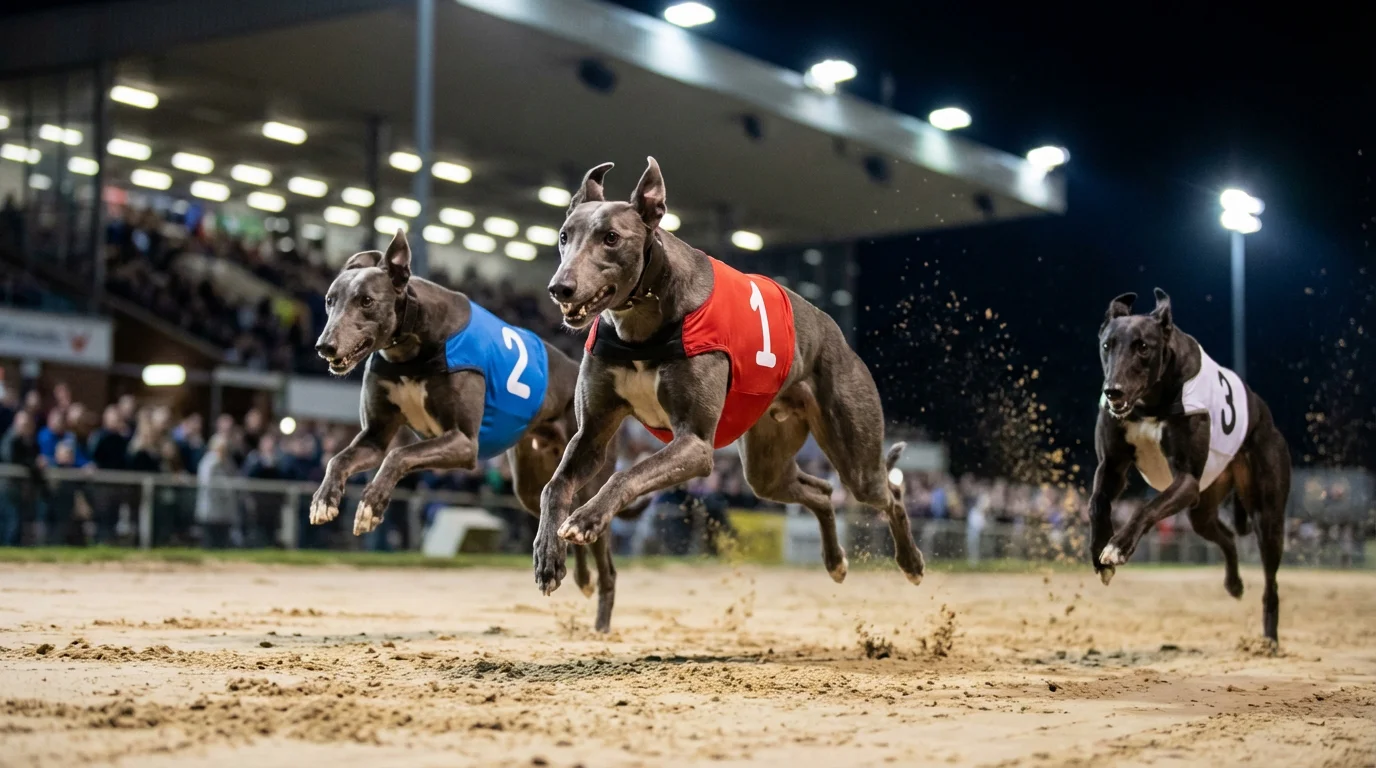
The Shortest Trip on the Card
At 268 metres, the sprint is Kinsley’s shortest racing distance and the one that leaves the least room for error. Two bends, a short run from the traps, and a race that is over in roughly sixteen seconds. In that time, there is almost no opportunity to recover from a slow start, a crowded first bend, or a wide run. The dog that breaks fastest and reaches the rail first will, more often than not, be the dog that wins.
Sprint races appear on Kinsley cards less frequently than the standard 462-metre trip, but they are a regular fixture and attract dedicated interest from punters who appreciate the sharpness of the contest. The races are graded separately using a “D” prefix rather than the standard “A” — D1 being the highest sprint grade, descending from there — because the skills required to win over 268 metres are distinct from those needed over four bends.
For bettors, the 268m trip demands a different analytical approach. Form analysis shifts from a multi-factor assessment to something more concentrated: who breaks fastest, who reaches the first bend in front, and which traps offer a structural advantage over this particular distance at this particular track. Speed trumps stamina. Tactical ability barely registers. The sprint is, in the purest sense, a test of raw acceleration and first-bend positioning.
Explore Kinsley sprint race data on the kinsleydogresults homepage.
How the 268m Sprint Works at Kinsley
The 268-metre trip at Kinsley begins with the traps positioned on the home straight and involves just two bends before the dogs return to the finishing line. The field breaks, runs to the first bend, navigates the second, and then sprints down the final straight. The entire race covers less than three-quarters of the track’s 385-metre circumference.
Because the distance is so short, the run from the traps to the first bend is compressed. Dogs have less time and less space to find their position before the field converges on the turn. In a 462m race, there is a full back straight before the first bend, giving dogs time to sort themselves out. At 268 metres, that sorting process happens in a matter of strides. The result is that the first bend in a sprint race is typically more congested and more chaotic than in longer races.
Winning times for the 268m at Kinsley depend on the grade and conditions, but competitive times fall in the range of 15.8 to 16.8 seconds. The fastest dogs — those in D1 or D2 — can break sixteen seconds on a good night. Lower-grade sprinters will finish closer to seventeen seconds. The margins in these races are tiny. A length at the finish translates to hundredths of a second, and the difference between first and fourth is often less than half a second.
The track surface and going conditions matter in sprints, but they matter differently. On a slower surface, all times increase, but the relative advantage of early pace does not diminish. If anything, it intensifies. On a heavy track, dogs with strong acceleration from the boxes maintain their edge because the surface punishes dogs trying to make up ground from behind — there is simply not enough race left to close a gap that on a fast surface might be manageable.
The Swaffham McGee hare runs on the outside at Kinsley, and its line affects sprinters in a specific way. Dogs that naturally follow the hare’s running rail tend to maintain a tighter line through the bends. Dogs that drift wide — even slightly — are covering extra ground that, over a two-bend race, they cannot afford. At 462 metres, a wide runner might make up for the extra distance over the subsequent straights. At 268 metres, there are no subsequent straights. What you lose on the bends stays lost.
Early Pace Is Everything
In standard four-bend races, the old saying “early pace wins the race” is a useful heuristic but not an absolute rule. Dogs can overcome moderate starts through superior bend work or closing speed. In sprints, the saying comes closer to being literal. The correlation between early pace and finishing position over 268 metres is stronger than over any other distance at Kinsley.
The metric to focus on is the split time — the time from the traps to the line on the first pass. In a sprint, this figure represents a larger proportion of the total race time than it does in a four-bend event. A dog with a split of 4.1 seconds at 268m is demonstrating explosive acceleration. One at 4.5 seconds is already at a significant disadvantage before the first bend is reached. Unlike the standard trip, where a dog can recover from a slow break over the remaining distance, the 268m offers almost nowhere to make up lost ground.
When evaluating sprint form, the split time is the primary filter. If a dog does not have a history of fast breaks, it is fighting the distance. There are occasional exceptions — a dog that breaks moderately but navigates the first bend brilliantly and emerges in front can still win — but these cases are rare enough that building a betting strategy around them is inadvisable.
Race comments from previous sprint outings are also revealing. A comment of “EP” (early pace) or “QAw” (quick away) tells you the dog has demonstrated fast-breaking ability before. Comments like “SAw” (slow away) or “MsdBrk” (missed break) are red flags at this distance. A dog that is slow away in a 462m race might still finish third or fourth and earn a paycheck. A dog that is slow away in a 268m race is effectively out of the contest before it reaches the first bend.
There is a temptation to back proven sprinters at short prices, reasoning that their early speed makes them near-certainties. The problem with this logic is that the market already accounts for early pace. A known speed dog drawn in a sprint race will almost always be the favourite, and the price will reflect that expectation. The value, when it exists, tends to be found in dogs stepping up to sprint distance from standard trips and showing untapped early speed — dogs whose split times over 462 metres suggest they could be effective over two bends but have not yet been tested there. The transition from four-bend racing to sprint racing does not suit every dog, but when it works, the market is slow to adjust.
Trap Bias in Sprint Races
Trap bias in sprint races at Kinsley is more pronounced than over the standard trip, and the reason is mechanical. The shorter run to the first bend means that the inside traps have less distance to cover before they reach the rail. A dog in trap one is already on the rail when it breaks. A dog in trap six has to travel further just to reach a racing line, and in a race measured in fractions of a second, that extra distance matters.
Over a full season of sprint data at Kinsley, traps one and two tend to produce a higher win rate than their statistical share would suggest. This does not mean inside draws win every sprint — far from it — but the percentage advantage is meaningful over a large sample. It reflects the geometry of the start: inside traps have a shorter path to the first bend and less risk of being carried wide by dogs breaking on their outside.
Traps five and six face the opposite challenge. Dogs breaking from these wide boxes need to be genuinely fast out of the traps to hold their position into the first bend. A wide runner with explosive early speed can absolutely win from trap six, but the margin for error is smaller. If the break is anything less than clean, the dog is already behind and running wide.
The middle traps — three and four — again sit in the danger zone, flanked on both sides with limited room to manoeuvre in the first few strides. In sprints, the congestion at the first bend is intensified by the shorter approach, and dogs from these middle boxes are statistically the most likely to encounter interference.
For punters, the practical application is this: when two dogs in a sprint have similar early-pace credentials, the one drawn in the lower trap holds a structural advantage. It is not a guarantee, but it is a factor that should influence your assessment. When a known early-pace dog is drawn in trap one or two for a sprint race, the advantage is compounded. When a moderate breaker is drawn in trap five or six, the mathematical odds of a clean run are against it.
The Two-Bend Truth
The two-bend sprint at Kinsley is the most honest distance on the card in one specific sense: it minimises the variables. Over 462 metres, a dog’s finishing position is the product of speed, stamina, trap draw, bend technique, trouble in running, the hare line, going conditions, and a dozen other factors that interact in complex ways. Over 268 metres, most of those variables are compressed or eliminated. What remains is early pace and first-bend positioning.
This honesty makes sprint form easier to read but harder to profit from, precisely because the market also reads it clearly. The favourite in a sprint race tends to be the dog with the fastest splits, drawn in a favourable trap. The market is rarely wrong about that assessment. Where it can be wrong is in the degree of certainty it assigns to the outcome. A 4/6 favourite in a sprint is not four times more likely to win than the 5/1 outsider — it is just the most likely winner in a small and competitive field.
Compare with stayer distances in kinsley 650m 844m stayers.
The smartest approach to sprint betting at Kinsley is selective. Do not bet every sprint race on the card. Wait for situations where the trap draw and early-pace data align strongly in favour of a dog whose price offers some return. And accept that sprints, by their nature, produce fewer upset results than four-bend races. The shorter the distance, the fewer the opportunities for the unexpected. That is the two-bend truth: sprint racing is fast, sharp, and often predictable — which makes it a discipline where discipline in your betting matters more than anywhere else on the card.
