
Kinsley 650m and 844m Staying Races
 Available in US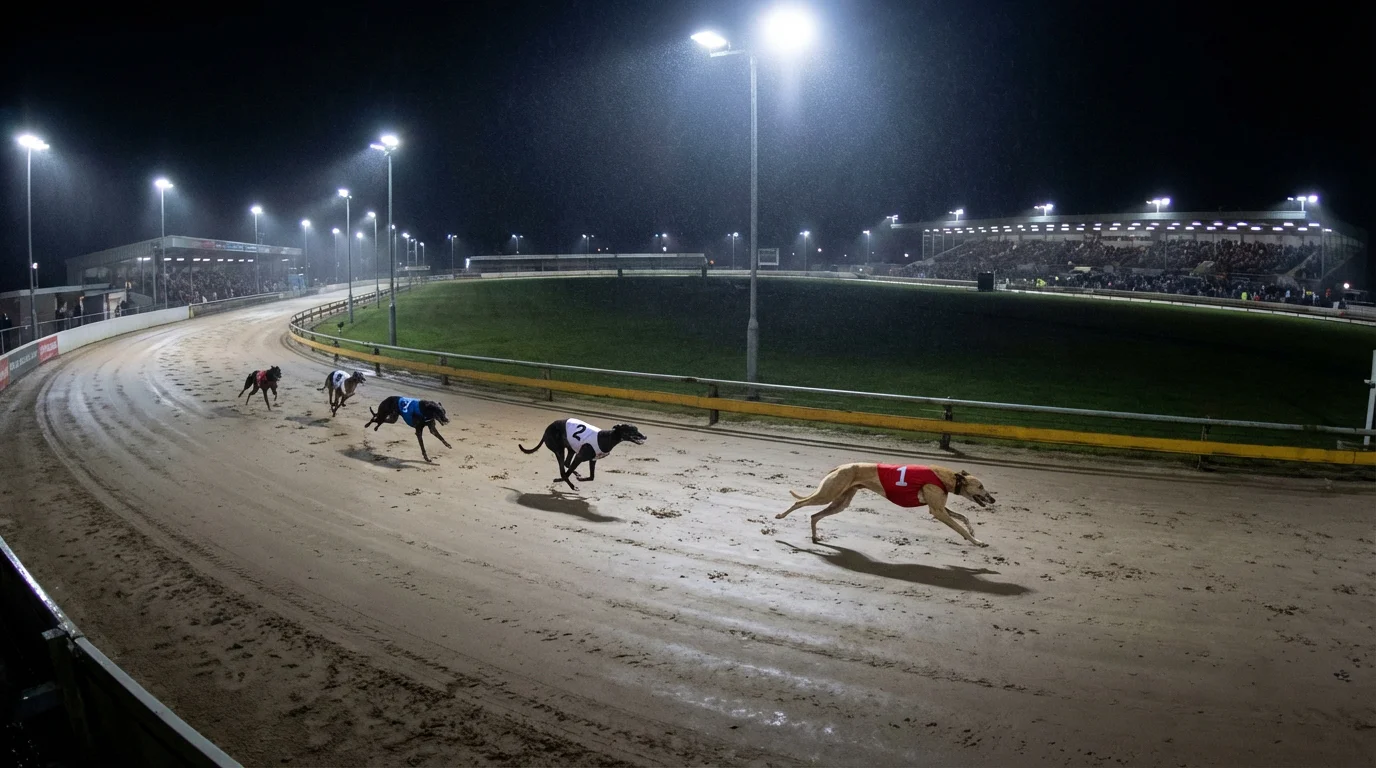
Where Stamina Separates the Field
Most of the racing at Kinsley happens over 462 metres. The sprints add variety at the short end. But at the other extreme sit the 650-metre and 844-metre staying trips — distances that test a greyhound’s stamina in ways that the standard trip never does. These races appear less frequently on the card, but when they do, they demand a fundamentally different form assessment.
The 650m trip involves six bends. The 844m involves eight. Both are full multi-circuit affairs that ask a dog to sustain effort over significantly more ground than a standard race. The field composition is different too: not every greyhound is built for staying, and the dogs that race over these distances tend to be specialists. Some have been identified as stayers early in their careers and directed toward the longer trips. Others graduate from the standard distance after showing they have the stamina to go further.
For punters, staying races at Kinsley offer smaller fields, less predictable outcomes, and form that requires careful interpretation. The factors that determine the result over 650 or 844 metres are not the same as those over 462 — and treating them as if they are is a reliable way to lose money.
Explore Kinsley stayer race distances on the kinsleydogresults homepage.
What Staying Distances Demand
The 650-metre distance at Kinsley takes the field over six bends — essentially one and a half laps of the 385-metre circuit. The 844-metre marathon pushes that to eight bends, covering more than two full circuits. Both distances start from different positions on the track compared to the 462m trip, and the racing dynamics change substantially.
At 650 metres, the dogs still need early pace to secure a good position, but the race is long enough that a moderate start is not fatal. Dogs can settle behind the leaders through the early bends, conserve energy, and begin to make their move from the fourth bend onward. The extra two bends create more opportunities for overtaking and more points at which the race order can change. Races over this distance are often more fluid than standard-trip events, with positions shifting through the middle stages before the strongest finishers pull clear in the final straight.
The 844-metre trip takes this further. Eight bends is a genuine test of endurance, and the dogs that excel over this distance are rarely the fastest in the kennel over shorter trips. Marathon greyhounds tend to be rangy, efficient movers that maintain a consistent galloping rhythm rather than relying on explosive acceleration. The pace of an 844m race is typically slower through the early stages than a 462m contest, because the dogs and the hare are covering more ground and the tactical emphasis shifts from breaking fast to running economically.
Winning times for the 650m at Kinsley generally fall between 40 and 42 seconds depending on grade and conditions. The 844m trip produces times in the region of 54 to 57 seconds. These are not figures that most punters have committed to memory, because staying races are less common and the form sample is smaller. But having a general sense of competitive times helps when assessing whether a particular performance was strong or ordinary.
The hare plays a different role in staying races. Over a longer distance, the hare’s speed and consistency affect the pace of the race more than in a sprint, where the race is over almost before the hare’s running line becomes a factor. Dogs that settle and track the hare efficiently over multiple bends tend to perform better in staying events than dogs that fight the pace or run erratically. The smooth galloper, not the frantic chaser, is the archetype of a successful stayer.
Stamina vs Speed: A Different Balance
In sprint and standard-distance races, raw speed is the dominant attribute. The fastest dog, assuming it avoids trouble, will usually win. In staying races, speed still matters — a stayer that cannot maintain a reasonable galloping pace will not be competitive — but it is no longer the deciding factor. Stamina takes over as the primary separator, and with it comes a different kind of form analysis.
A dog’s stamina is harder to measure from a racecard than its speed. Speed shows up in split times and finishing times. Stamina shows up in patterns. The key pattern to look for is how a dog’s position changes through the late stages of a race. A stayer with genuine endurance will maintain or improve its position from the sixth bend onward in a 650m race, or from the sixth to eighth bends in an 844m event. A dog that fades — sitting second at bend four and finishing fifth by the line — is showing that its stamina does not match the distance.
Breeding is a more relevant factor in staying races than in sprints. Certain sire lines are associated with stamina, and trainers who specialise in stayers will deliberately seek out dogs from these bloodlines. While breeding alone does not guarantee staying ability, it provides a useful baseline when a dog is trying the distance for the first time. A first-time stayer from a sire known to produce marathon dogs is a more credible candidate than one from a speed-oriented line.
Weight is another consideration. Lighter greyhounds tend to have an advantage over extreme distances because they carry less mass through each stride cycle. A dog that races at 30 kilograms is burning marginally less energy per bend than one at 34 kilograms, and over eight bends, that marginal difference accumulates. This is not a rule that holds in every case — heavier dogs with efficient movement can still be effective stayers — but as a statistical tendency, it is worth noting.
The other factor that distinguishes staying races is recovery. A dog that ran a hard 844m on Friday will need more recovery time before it races again than one that ran a 268m sprint. Trainers manage this by spacing their stayers’ outings, but punters should check when a dog last raced and whether the gap between runs is sufficient. A stayer returning to race after only four or five days may not have fully recovered, particularly if its previous run was a hard-fought contest.
Compare with sprint distances in kinsley 268m sprint races.
Reading Form for Stayers
Reading staying form at Kinsley requires adjusting your analytical method. The first adjustment is accepting that the form sample will be smaller. A dog racing over the standard trip might have twenty or thirty form lines accumulated over a few months. A stayer might have six or eight. Smaller samples mean less certainty, and punters need to be comfortable making assessments based on limited data.
Sectional times are still useful but need context. A fast split in a staying race does not carry the same weight as it does over 268 or 462 metres. In a sprint, a fast split usually predicts the winner. In a staying race, a dog that uses too much energy in the early stages may fade badly in the final circuit. What you want to see is a split that is competitive without being reckless — quick enough to secure a good early position but not so fast that it suggests the dog has overcooked the opening.
Bend-by-bend positions are the most important data for stayers. Track each dog’s movement through the race. The pattern you are looking for is either consistent positioning — the dog holds second or third throughout and finishes strongly — or progressive improvement from mid-pack to the front. Dogs that hold a strong early position and maintain it through six or eight bends without fading are demonstrating genuine stamina. Dogs that lead early and then slide backward through the middle bends are vulnerable, even if they occasionally hold on for a place.
Going conditions are amplified in staying races. A slow track over 462 metres adds perhaps half a second to every dog’s time. Over 844 metres, the impact is roughly doubled. Dogs that handle soft going well — typically those with a lighter build and more economical action — gain a disproportionate advantage in marathon races on wet nights. Checking previous form on similar going is more important for stayers than for any other category of racing.
Trainer specialisms become more relevant here as well. Certain trainers at Kinsley are known for producing stayers, and their dogs will tend to be better prepared for the demands of six- or eight-bend races. A stayer from a kennel with a track record of success over longer distances starts with a credibility advantage over one from a kennel primarily associated with sprinters.
The Long Game
Staying races at Kinsley occupy a niche. They are not the headline events, they do not attract the biggest betting turnover, and they appear on the card with less regularity than the standard-trip races. But that niche status is precisely what makes them interesting for punters who are willing to do the work.
Because fewer people specialise in staying form, the market for these races can be less efficient than for the heavily-traded 462m events. A dog with a clear staying profile — strong late-race positions, form on slow going, a stamina-oriented pedigree — may go off at a longer price than its chances warrant, simply because the casual punter does not recognise the relevant signals. The form student who takes the time to understand what 650m and 844m races demand, and who tracks the small pool of stayers racing at Kinsley, has a genuine information edge.
The long game in greyhound racing is not just a description of the distance. It is a description of the approach that staying races reward. Patience in analysis, patience in waiting for the right race, and patience in accepting that the data will never be as abundant as it is for the standard trip. Those who master that patience find staying races to be among the most rewarding bets on the Kinsley card.
