
Sectional Times Explained for Greyhound Betting
 Available in US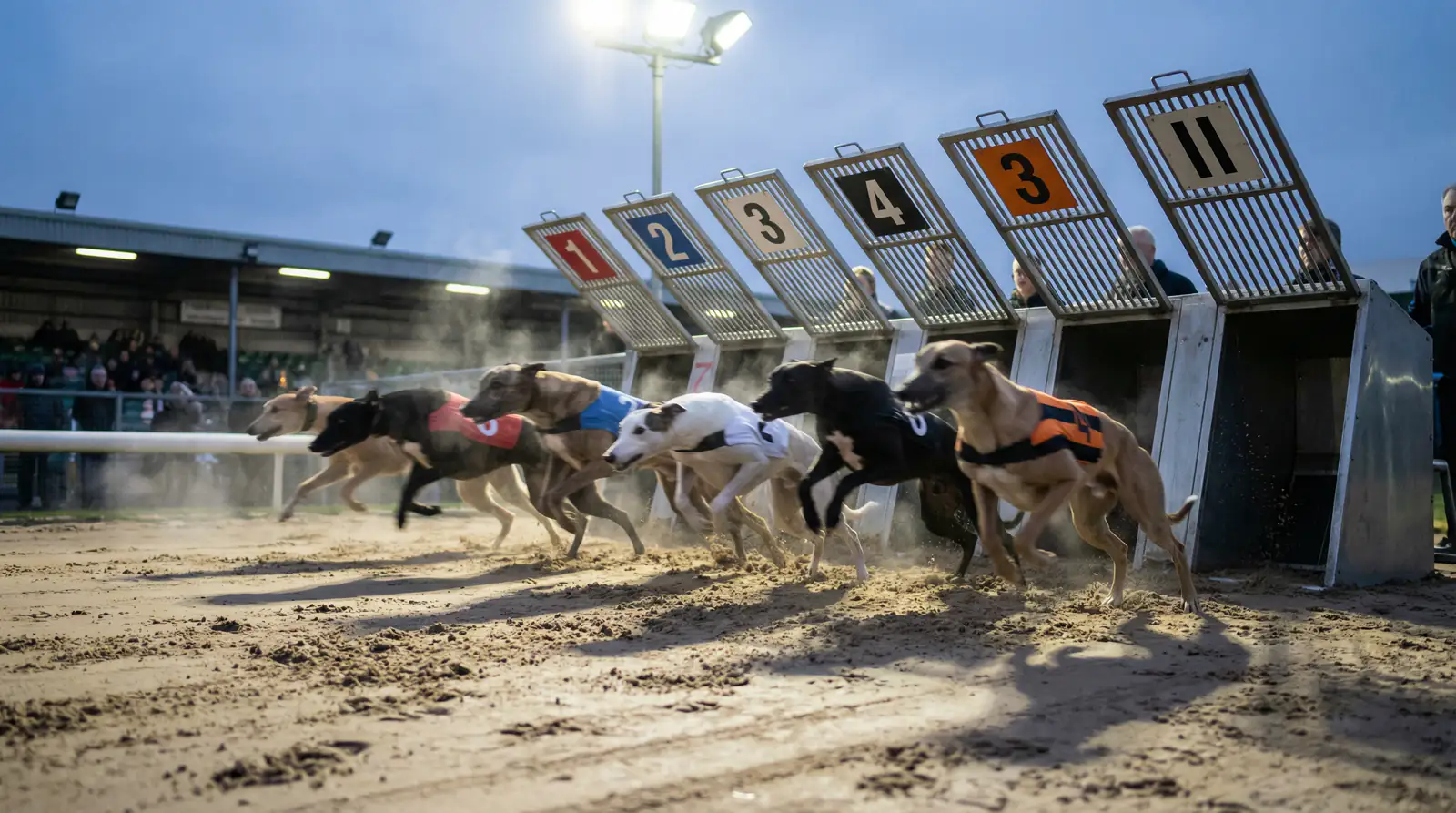
The Number Most Punters Overlook
Every greyhound racecard publishes a finishing time. It is the most visible number on the page, the one that casual punters glance at first, and very often the one that tells you the least about a dog’s actual ability. The sectional time — sometimes called the split time — sits lower on the card, attracts less attention, and is worth considerably more.
A sectional time measures how quickly a greyhound travels from the traps to the finishing line on its first pass. In a standard four-bend race at Kinsley, the dogs cross the line once during the race before completing the full circuit. The time recorded at that crossing point is the sectional. It captures the opening phase of the race: the break from the boxes, the run to the first bend, and the dog’s position as the field starts to sort itself out.
Why does this matter? Because the opening phase is where the race is shaped. A dog that posts a fast sectional has demonstrated explosive early speed, secured a good position before the first bend, and given itself the best possible platform for the rest of the race. A dog with a slow sectional has already conceded ground and is likely running into trouble at the first turn. The finishing time blends all of this together into a single number. The sectional separates cause from effect, and that separation is where informed betting begins.
Master sectional times at Kinsley on the kinsleydogresults homepage.
What Sectional Times Actually Measure
The sectional time captures three distinct qualities compressed into a single figure. The first is trap speed — how quickly the dog leaves the starting box. This is partly innate and partly a product of the dog’s alertness and readiness on the night. Some greyhounds are naturally explosive out of the traps. Others are consistently half a step slow. Trap speed is remarkably consistent for most dogs across their career, which makes the sectional a reliable indicator of what to expect.
The second quality is early running pace — the speed the dog carries from the boxes toward the first bend. A dog might leave the traps cleanly but then decelerate before reaching full stride, posting a moderate sectional despite a sharp initial break. Conversely, a dog that is marginally slow out of the box but accelerates strongly through the first few strides can still post a competitive split. The sectional captures the combined effect.
The third quality, and the one that makes sectionals so valuable for betting, is positional advantage. A dog with a fast sectional is almost always at or near the front of the field when the runners reach the first bend. This matters enormously. The first bend in any greyhound race is a bottleneck. Six dogs, all travelling at speed, converge on a single turn. The dogs at the front have clear air. The dogs behind get crowded, bumped, and checked. The positional advantage earned by a fast sectional translates directly into a cleaner run through the early bends, and a cleaner run means the dog’s finishing time more accurately reflects its genuine ability.
A dog that finishes a race in 29.3 seconds after leading from the start has posted a time that you can take at face value. A dog that finishes in 29.3 seconds after being crowded at the first bend and losing two lengths has run a race that was actually faster than the clock suggests — perhaps the equivalent of 29.0 or better if it had enjoyed a clear passage. The sectional time, combined with the race comments, lets you make that distinction. The finishing time alone does not.
At Kinsley, sectional times over the 462-metre standard trip typically range from around 4.0 seconds for the fastest dogs to 5.0 seconds or more for the slowest. A split of 4.2 to 4.4 seconds puts a dog in the front rank of early-pace runners. Anything under 4.2 is exceptional. Anything above 4.7 means the dog is likely to be in the back half of the field at the first bend and vulnerable to trouble.
How to Use Split Times in Form Analysis
The practical application of sectional times is comparative. You are not looking at a single dog’s split in isolation — you are comparing it against the splits of the other dogs in the same race, and against the dog’s own historical splits. Both comparisons reveal different things.
Comparing splits within a race tells you who is likely to lead at the first bend. If one dog in a six-runner field has a sectional average of 4.3 seconds and every other runner sits at 4.6 or above, you have a clear early-pace dog that will almost certainly be in front when the field hits the first turn. That dog has a significant structural advantage: it will avoid the first-bend trouble that is likely to affect at least two or three of its rivals. Whether it can sustain that lead through the remaining bends is a separate question, but the platform is there.
When two or three dogs in a race have similar fast splits, the dynamic changes. Multiple early-pace dogs converging on the first bend creates a different kind of trouble — not the crowding that affects dogs further back, but a battle for the lead that can result in wide running, bumping, and wasted energy. In these races, the dog drawn on the inside with a fast split has a mechanical advantage over the fast-breaking dog drawn outside, because it has less ground to cover to reach the rail. The trap draw becomes a tiebreaker between dogs of similar early speed.
Comparing a dog’s splits across its recent races reveals consistency and trends. A dog that posted splits of 4.3, 4.4, 4.3, and 4.4 over its last four outings is a predictable early-pace runner. You know what to expect. A dog whose splits read 4.3, 4.8, 4.2, 4.7 is erratic out of the boxes — sometimes sharp, sometimes sluggish — and that inconsistency makes it a riskier proposition. The form student who tracks this pattern can identify when a dog’s split is trending upward (slowing) or downward (improving), and adjust expectations accordingly.
There is another layer to split-time analysis that experienced punters use: the relationship between a dog’s sectional and its finishing time. A dog that posts a fast split but a modest finishing time is burning energy early and fading through the later bends. A dog that posts a moderate split but a strong finishing time is closing from off the pace. Neither pattern is inherently good or bad — both can win races — but they tell you about the dog’s racing style and help you predict how it will perform in different tactical scenarios. A strong closer drawn against a field of early-pace dogs may find itself well placed when the frontrunners tire. A frontrunner in a field of slow breakers may lead unchallenged from start to finish.
Sectional Times at Kinsley: Track-Specific Context
Every track produces its own range of sectional times, and the figures are not directly transferable between venues. A 4.3-second split at Kinsley does not mean the same thing as a 4.3-second split at Romford or Monmore, because the position of the traps, the length of the run to the first bend, and the track geometry all differ. Sectional comparisons are only valid within the same track and the same distance.
At Kinsley’s 462-metre trip, the traps sit on the back straight with a moderate run to the first bend. This gives every dog a reasonable chance to find its stride before the field converges, and the sectional times reflect that. The spread between the fastest and slowest splits in a typical race tends to be narrower than at tracks where the run to the first bend is shorter. A tight spread means that positional advantages earned through early pace are smaller, which partly explains why Kinsley’s favourite strike rate is lower than the national average — fewer races are decisively settled at the first bend.
For sprint races over 268 metres, sectional times carry even more weight because the race is shorter and the first bend arrives sooner. A dog with a fast split over the sprint trip is in an even stronger position than one with a fast split over 462 metres, because there are fewer subsequent bends where the advantage can be eroded. Sprint sectionals at Kinsley should be treated as the single most predictive form metric for that distance.
Staying races present the opposite situation. Over 650 or 844 metres, the sectional time is less important relative to the overall performance. A fast split in a staying race does not guarantee success because the race has so much further to run. The dogs that win staying events are often those that post moderate early splits and conserve energy for the second and third circuits. Applying sprint-style sectional analysis to staying races will lead you astray.
One practical tip for working with Kinsley sectionals: always check whether a dog’s recent splits were recorded on the same surface conditions. A split of 4.4 seconds on a fast track and 4.6 seconds on a heavy track might represent the same effort from the dog. Going allowance adjustments are typically applied to finishing times but not always to sectional times, so you may need to make a mental adjustment when comparing splits from different nights.
Faster Than It Looks
The real power of sectional times is not in identifying the obvious speed dogs — the market already knows who they are. It is in identifying dogs that are faster than their results suggest. These are the greyhounds whose finishing positions mask their true ability because of circumstances the bare result does not reveal.
A dog that posts a fast sectional, encounters trouble at the first bend, loses three lengths, and finishes fourth has run a race that looks poor on the form line. Fourth place, a moderate finishing time, perhaps a grade drop to follow. But the sectional tells a different story. The dog broke well, showed genuine speed, and was beaten by bad luck rather than lack of ability. If it draws a cleaner trap next time, or faces a field with less early pace, the fast sectional suggests it is capable of a much better result.
These are the form lines that produce value bets. The market sees a dog that finished fourth and prices it accordingly. The form student who reads the sectional and the race comments sees a dog that was better than the result, and may be underpriced in its next outing. This edge is not available to anyone who ignores sectionals and relies only on finishing positions and times.
Compare with calculated times in calculated times.
The discipline lies in doing this consistently. Not every dog with a fast split and a poor finish is a value bet next time out — sometimes the trouble was caused by the dog itself, running wide or interfering with others. The race comments are the cross-reference. A fast split paired with comments like “Crd” (crowded), “Bmp” (bumped), or “CkBnd” (checked at a bend) is a genuine excuse. A fast split paired with “RnW” (ran wide) or “SltdRls” (slipped rails) suggests the dog’s own running style contributed to the problem, which may recur. The sectional opens the door to hidden form. The race comments tell you whether to walk through it.
