
The GBGB Grading System for UK Greyhound Racing
 Available in US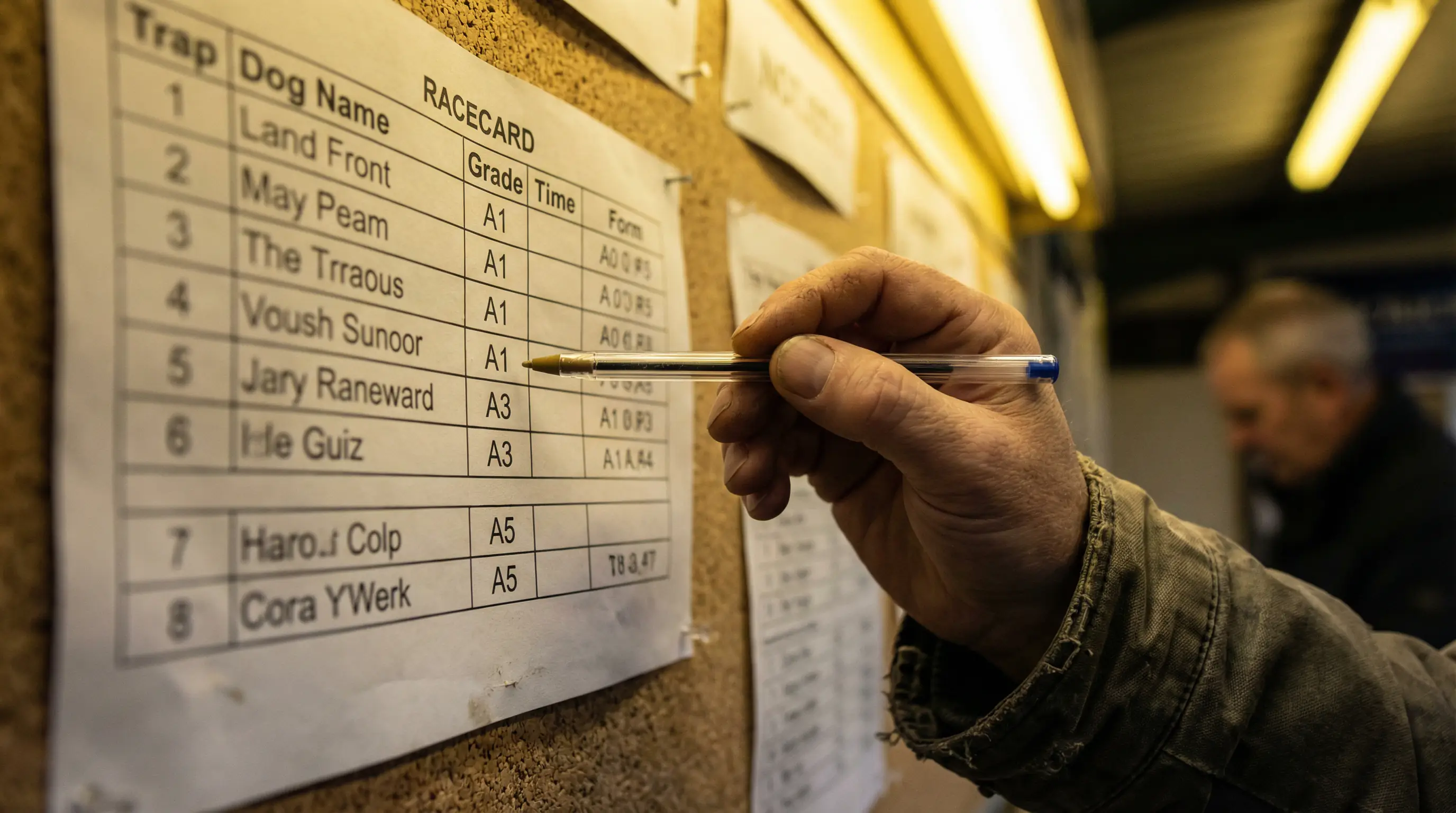
The Framework Behind Every Race
Every graded greyhound race in the United Kingdom operates within a structure set by the Greyhound Board of Great Britain. The GBGB is the sport’s governing body, responsible for regulation, welfare, and the framework that determines which dogs race against which. The grading system is central to that framework. It sorts dogs into competitive bands based on their recent performances, ensuring that races are contested between animals of broadly similar ability.
For the bettor, the grading system is not background administration — it is the architecture of every racecard. The grade assigned to a dog determines which races it enters, which rivals it faces, and how its form should be interpreted. A dog’s grade is not a fixed measure of talent. It moves. It responds to results. And the movement itself — promotion after a win, relegation after a sequence of defeats — carries information that the racecard does not always make obvious. Understanding the GBGB’s system, and how individual tracks like Kinsley apply it, turns the grade column from a label into an analytical tool.
Understand GBGB grading on the kinsleydogresults homepage.
The GBGB’s Role in Greyhound Racing
The Greyhound Board of Great Britain regulates licensed greyhound racing across England, Scotland, and Wales. Its remit covers welfare, integrity, doping controls, licensing of trainers and tracks, and the rules of racing. The grading system sits within this broader regulatory function as the mechanism that organises competitive racing.
The GBGB sets the national rules that govern grading: the grade structure, the criteria for promotion and relegation, and the principles that racing managers at individual tracks must follow when assigning dogs to races. These rules provide a consistent framework, but they also allow significant local discretion. Each track’s racing manager interprets the rules in the context of their specific dog pool, race programme, and competitive balance. This is why the same grade — A3, for example — does not represent the same standard at every track. An A3 at a major stadium with a deep pool of racing dogs is a different competitive level from an A3 at a smaller independent venue.
The GBGB also maintains the official racing database, which records every dog’s race history, grade movements, and performance data. This database is the backbone of form analysis. When you look up a dog’s record on a form service, the underlying data comes from the GBGB’s registry. The accuracy and completeness of this record is one of the strengths of regulated greyhound racing in Britain — every run, every time, every grade change is documented and available.
Welfare is an increasingly prominent part of the GBGB’s function, and it intersects with grading in specific ways. The board sets limits on how frequently a dog can race, monitors injury rates, and requires veterinary clearance for dogs returning from layoffs. These welfare rules affect the availability of dogs for racing and can influence grade dynamics at individual tracks — a cluster of injuries in a particular grade band can thin the field and lead to reshuffling of the race programme.
How Grades Are Allocated and Adjusted
The grading system for standard races uses a letter-and-number combination. The letter indicates the race type and distance: “A” for standard four-bend races (typically 450–480 metres), “D” for sprint races (typically 260–280 metres), and “S” for staying races (typically 630 metres and above). The number indicates the competitive level within that distance category, with lower numbers representing higher grades. An A1 dog is near the top of the standard-distance hierarchy. An A10 dog is near the bottom.
Grade allocation for a new dog arriving at a track is based on its recent form and times at other venues. The racing manager assesses the dog’s performances and assigns an initial grade that places it at a level where it should be competitive. This initial assessment is not always accurate — a dog that has raced at a bigger track with faster times may be placed too high for a smaller venue, or vice versa — and the first few runs often trigger grade adjustments as the racing manager refines the placement.
Promotion and relegation follow a set of principles, though the exact implementation varies by track. The general rule is that a winner is promoted — moved up one grade — unless the racing manager determines that the margin of victory was narrow enough to suggest the dog is already at the right level. Conversely, a dog that finishes in the lower half of the field across several consecutive races may be relegated — dropped one or more grades to find a level where it is more competitive.
The racing manager has discretion in applying these rules. A dog that wins by eight lengths in an A5 race will almost certainly be promoted to A4 or possibly A3. A dog that wins by a neck in a tightly contested A5 might be kept at A5 for another run to see if the form is confirmed. This discretionary element means that grade changes are not purely mechanical — they involve a human judgement about the dog’s ability relative to the available competition. For the punter, this discretion creates both uncertainty and opportunity. A dog that deserves promotion but has been held at its current grade for one more run is a potential value bet — it is racing below its proven ability.
Relegation often produces the opposite dynamic. A dog that has been dropped from A3 to A4 after a sequence of poor runs may be viewed by the market as a declining performer. But the drop in grade means it now faces weaker opposition, and its best form at the higher level may be more than enough to win at the lower grade. Grade droppers are among the most commonly profitable angles in greyhound betting, provided the reason for the grade drop is competition level rather than genuine decline in the dog’s ability.
Open Races vs Graded Races
The majority of races at a track like Kinsley are graded — they are restricted to dogs within a specific grade band, ensuring a competitive field. Open races operate differently. They are not restricted by grade, meaning dogs of varying ability can compete against each other. Open races are less common on a standard card but appear regularly as feature events, invitation races, or competition rounds.
Open races present a different analytical challenge for the punter. In a graded race, you know that all six runners are at roughly the same competitive level, and the form comparison is made within a narrow band. In an open race, the field may include a dog that has been racing at A2 alongside one from A5. The grade gap is significant, and the higher-graded dog is likely faster on raw ability. The question is whether the open format introduces variables — different distances, unfamiliar trap draws, or tactical dynamics that the higher-graded dog is not accustomed to — that might level the field.
Handicap races are a specific type of open event where dogs start from staggered trap positions based on their ability, with the weakest dog given a head start and the strongest starting from behind. Handicaps are rare at Kinsley but more common at some other tracks. They require a fundamentally different approach to form analysis, because the result depends not just on speed but on whether the handicapper’s assessment of each dog’s ability is accurate. If you believe the handicapper has underestimated a dog’s speed, that dog may represent value because it has been given a more generous start than it needs.
For most punters at Kinsley, graded racing will constitute the vast majority of the betting programme. Open events, when they appear, should be treated with additional caution. The form comparisons are less direct, the variables are greater, and the market’s ability to price the field accurately is reduced. This can work in the punter’s favour — reduced market efficiency means more opportunities for value — but it also increases the risk of a result that no form analysis would have predicted.
The National Framework, the Local Reality
The GBGB’s grading system provides national consistency: a set of rules and principles that every licensed track must follow. But the practical application of those rules is local, and the local reality is what determines the races you bet on. At Kinsley, the dog pool, the race programme, and the racing manager’s interpretation of the grading rules all shape the competitive landscape in ways that are specific to the venue.
Kinsley’s compressed grading — the result of a smaller dog pool than major stadiums — means that the difference between adjacent grades is narrower than at bigger tracks. A dog promoted from A5 to A4 at Kinsley faces a smaller step up in competition than the same dog would at a track with a deeper talent pool. This has practical implications for betting: grade changes at Kinsley are less disruptive to form than they would be elsewhere, and dogs moving between grades tend to remain competitive against their new opponents.
The GBGB framework also means that a dog’s form from other tracks is, in principle, transferable. A dog that has been racing at A3 level at Nottingham and transfers to Kinsley will be assessed for placement into Kinsley’s A-grade structure. But the times, the track configuration, and the standard of competition may all differ, which means the initial grade placement at Kinsley is an estimate that may need adjusting. Dogs in their first few runs at a new track are worth watching carefully — they may be over-graded or under-graded, and the market may not know which until the results come in.
See how grading links to race grades in understanding race grades.
The grading system is a tool, not a verdict. It tells you what level the racing manager believes a dog should compete at, based on recent evidence. It does not tell you whether the dog is improving, declining, or about to produce a career-best performance. That assessment is yours to make, using the grade as one input among many. The punter who reads the grade as a fact is reading only the surface. The punter who reads it as a hypothesis — one that may be confirmed or refuted by the next race — is closer to how the system actually works.
